## Flowchart: Simple Program Flow
### Overview
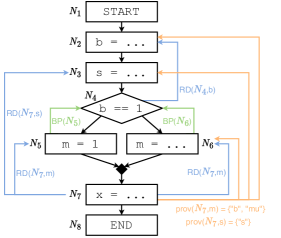
The image shows a flowchart representing a simple program flow. It starts with a "START" node, proceeds through several processing steps, includes a conditional branch based on the value of 'b', and ends with an "END" node. The flowchart also includes annotations indicating data dependencies and control flow.
### Components/Axes
* **Nodes:** The flowchart consists of rectangular and diamond-shaped nodes, labeled N1 through N8.
* N1: START
* N2: b = ...
* N3: s = ...
* N4: b == 1 (Diamond shape, indicating a conditional)
* N5: m = 1
* N6: m = ...
* N7: x = ...
* N8: END
* **Arrows:** Arrows indicate the flow of control between nodes.
* **Annotations:**
* RD(N4, b): Data dependency annotation near the arrow from N3 to N4.
* RD(N7, s): Data dependency annotation near the arrow from N3 to N7.
* RD(N7, m): Data dependency annotation near the arrows from N5 and N6 to N7.
* BP(N5): Branch prediction annotation near the arrow from N4 to N5.
* BP(N6): Branch prediction annotation near the arrow from N4 to N6.
* prov(N7, m) = {"b", "mu"}: Provenance annotation near N7.
* prov(N7, s) = {"s"}: Provenance annotation near N7.
### Detailed Analysis or ### Content Details
1. **Start (N1):** The program begins at the "START" node.
2. **Initialization (N2, N3):**
* N2: The variable 'b' is assigned some value.
* N3: The variable 's' is assigned some value.
3. **Conditional Branch (N4):**
* N4: The program checks if 'b' is equal to 1.
* If 'b' is equal to 1, the program proceeds to N5.
* If 'b' is not equal to 1, the program proceeds to N6.
4. **Assignment (N5, N6):**
* N5: If 'b' is equal to 1, the variable 'm' is assigned the value 1.
* N6: If 'b' is not equal to 1, the variable 'm' is assigned some other value.
5. **Calculation (N7):**
* N7: The variable 'x' is assigned some value based on 's' and 'm'.
6. **End (N8):** The program ends at the "END" node.
### Key Observations
* The flowchart represents a simple program with a conditional branch.
* The annotations indicate data dependencies and control flow.
* The provenance annotations indicate the sources of the values used in the calculation of 'x'.
### Interpretation
The flowchart illustrates a basic program structure involving initialization, a conditional check, and a final calculation. The data dependency annotations highlight how the values of variables 'b', 's', and 'm' influence the subsequent steps. The provenance annotations provide information about the origin of the values used in the calculation of 'x', which can be useful for debugging or understanding the program's behavior. The conditional branch based on 'b' allows the program to take different paths depending on the value of 'b', leading to different values being assigned to 'm'.