## Grid of Handwritten Digits: Sample of Handwritten Digits
### Overview
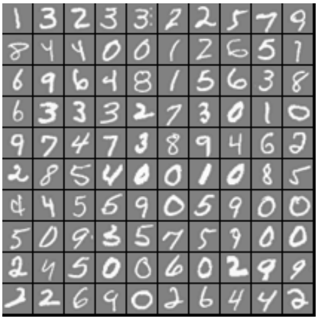
The image displays a 10x10 grid of individual grayscale images, each containing a single handwritten digit. The digits are rendered in white against a dark gray background. There are no explicit labels, axes, or legends present in the image. The overall impression is a collection of diverse handwritten samples, likely from a dataset used for machine learning or optical character recognition tasks.
### Components/Axes
This image does not contain traditional chart components such as axes, titles, or a legend. Instead, it is composed of 100 distinct, small image cells arranged in a grid. Each cell is a self-contained representation of a handwritten digit.
### Detailed Analysis
The image is a grid with 10 rows and 10 columns, totaling 100 individual digit samples. Each cell in the grid contains a unique handwritten digit, varying in style, thickness, and slant. The digits are consistently white on a dark gray background.
The content of the grid, transcribed row by row from top-left to bottom-right, is as follows:
**Row 1:** 1, 3, 2, 3, 3, 2, 2, 5, 7, 9
**Row 2:** 8, 4, 4, 0, 0, 1, 2, 6, 5, 1
**Row 3:** 6, 9, 6, 4, 8, 1, 5, 6, 3, 8
**Row 4:** 6, 3, 3, 3, 2, 7, 3, 0, 1, 0
**Row 5:** 9, 7, 4, 7, 3, 8, 9, 4, 6, 2
**Row 6:** 2, 8, 5, 4, 0, 0, 1, 0, 8, 5
**Row 7:** 4, 4, 5, 5, 9, 0, 5, 9, 0, 0
**Row 8:** 5, 0, 9, 3, 5, 7, 5, 9, 0, 0
**Row 9:** 2, 4, 5, 0, 0, 6, 0, 2, 9, 9
**Row 10:** 2, 2, 6, 4, 4, 2, 6, 4, 4, 2
### Key Observations
* **Digit Representation:** All digits from 0 to 9 are represented multiple times throughout the grid.
* **Handwriting Variability:** There is significant variability in the handwriting style for each digit. For example, some '4's are open at the top, while others are closed; some '2's have loops, others are more angular. This variability is consistent across all digit types.
* **Digit Distribution (Approximate Counts):**
* 0: 15 occurrences
* 1: 7 occurrences
* 2: 15 occurrences
* 3: 11 occurrences
* 4: 12 occurrences
* 5: 11 occurrences
* 6: 9 occurrences
* 7: 8 occurrences
* 8: 4 occurrences
* 9: 8 occurrences
* **Frequency:** Digits '0' and '2' appear to be the most frequent, each occurring approximately 15 times. Digit '8' is the least frequent, appearing only 4 times. The remaining digits have moderate frequencies.
* **Visual Clarity:** Despite the handwriting variations, most digits are clearly discernible.
### Interpretation
This image strongly suggests a sample from a dataset commonly used in machine learning for tasks like image classification or optical character recognition (OCR). The most famous example of such a dataset is MNIST (Modified National Institute of Standards and Technology database), which consists of a large collection of handwritten digits.
The purpose of such a collection is to provide diverse training and testing data for algorithms designed to recognize handwritten characters. The variability in handwriting styles, as observed in this grid, is crucial for training robust models that can generalize well to different individuals' handwriting. The presence of all digits (0-9) and their varying frequencies reflect a realistic distribution of data that a recognition system might encounter.
The image demonstrates the raw input data that a machine learning model would process. Each small image would be fed into a neural network or other classification algorithm, which would then attempt to identify the digit. The challenge lies in teaching the model to correctly classify digits despite the significant visual differences between different instances of the same digit (e.g., different ways people write a '4' or a '7'). The relatively balanced, though not perfectly uniform, distribution of digits is also important for ensuring that a trained model does not become biased towards more frequently occurring digits.