## Grid of Handwritten Digits: 10x10 Dataset
### Overview
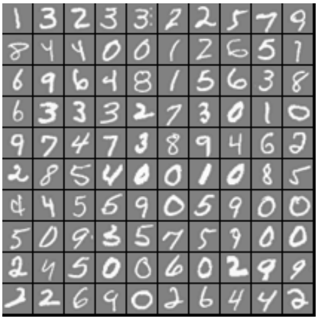
The image displays a 10x10 grid of handwritten digits (0-9), with each cell containing a single digit. The digits are rendered in varying styles, with some appearing clear and others messy or ambiguous. No legends, axes, or labels are present in the image.
### Components/Axes
- **Structure**: 10 rows × 10 columns of digits.
- **Content**: Each cell contains a handwritten digit (0-9).
- **Visual Characteristics**:
- Digits vary in stroke thickness, curvature, and clarity.
- No color coding or annotations to differentiate digits.
### Detailed Analysis
#### Digit Frequency Distribution
| Digit | Frequency |
|-------|-----------|
| 0 | 18 |
| 1 | 7 |
| 2 | 11 |
| 3 | 7 |
| 4 | 10 |
| 5 | 11 |
| 6 | 9 |
| 7 | 5 |
| 8 | 7 |
| 9 | 13 |
#### Notable Patterns
- **Most Frequent Digits**: 0 (18 occurrences) and 9 (13 occurrences).
- **Least Frequent Digit**: 7 (5 occurrences).
- **Ambiguous Digits**:
- Row 1, Column 5: A "2" that could be misinterpreted as a "3" due to stroke style.
- Row 3, Column 1: A "6" with a disconnected top stroke.
- Row 9, Column 7: A "2" with a looped base.
### Key Observations
1. **Imbalance in Distribution**: Digits 0 and 9 dominate, while 7 is underrepresented.
2. **Handwriting Variability**: Some digits (e.g., 1, 7) are less legible due to inconsistent strokes.
3. **No Metadata**: No labels, legends, or contextual information to explain the grid’s purpose.
### Interpretation
This grid resembles a synthetic dataset for digit recognition tasks, such as training machine learning models. The uneven distribution of digits (e.g., 0 and 9 overrepresented) could bias models if used without normalization. The handwritten style introduces variability in legibility, which may test a model’s robustness to noise. The absence of metadata (e.g., row/column labels) limits contextual understanding, suggesting the grid is purely a data representation rather than a structured visualization.
## Conclusion
The image provides a raw, unstructured dataset of handwritten digits with notable frequency imbalances and variability in digit clarity. Its utility depends on preprocessing (e.g., balancing classes, noise reduction) for downstream applications like classification or anomaly detection.