## Flowchart Diagram: System Architecture or Process Flow
### Overview
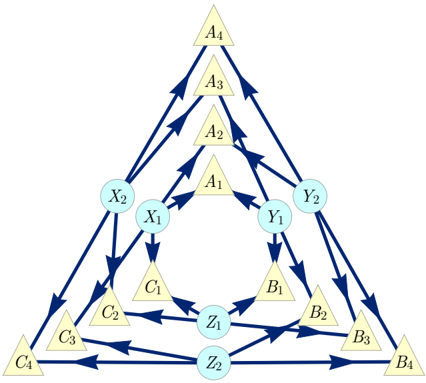
The diagram depicts a hierarchical, layered structure with directional flow between nodes. It consists of six tiers of labeled nodes (A1-A4, B1-B4, C1-C4, X1-X2, Y1-Y2, Z1-Z2) connected by dark blue arrows. Nodes are color-coded: yellow (A), light blue (X/Y), dark blue (B/C), and cyan (Z). The flow progresses from top (A nodes) to bottom (Z nodes), suggesting a top-down process or data flow.
### Components/Axes
- **Nodes**:
- **Top Layer (A)**: A1-A4 (yellow triangles)
- **Middle Layer (X/Y)**: X1-X2 (light blue circles), Y1-Y2 (light blue circles)
- **Lower Middle Layer (B/C)**: B1-B4 (dark blue circles), C1-C4 (dark blue circles)
- **Base Layer (Z)**: Z1-Z2 (cyan circles)
- **Arrows**: Dark blue, unidirectional, connecting nodes between layers.
- **Color Coding**:
- Yellow (A nodes) → Light Blue (X/Y) → Dark Blue (B/C) → Cyan (Z)
- No explicit legend, but color consistency implies categorical grouping.
### Detailed Analysis
- **Top Layer (A)**:
- A1-A4 form a pyramid structure.
- Arrows from A1-A4 point to X1, X2, Y1, Y2 (middle layer).
- **Middle Layer (X/Y)**:
- X1-X2 and Y1-Y2 receive input from A nodes.
- Arrows from X1-X2 and Y1-Y2 direct to B1-B4 and C1-C4 (lower middle layer).
- **Lower Middle Layer (B/C)**:
- B1-B4 and C1-C4 receive input from X/Y nodes.
- Arrows from B1-B4 and C1-C4 point to Z1-Z2 (base layer).
- **Base Layer (Z)**:
- Z1-Z2 are terminal nodes with no outgoing arrows.
- Z1 connects to B1-B4 and C1-C3; Z2 connects to B4 and C4.
### Key Observations
1. **Hierarchical Flow**:
- Data/process flows from A (top) → X/Y → B/C → Z (bottom).
2. **Symmetry**:
- Left and right sides mirror each other (e.g., A1→X1→B1→Z1; A4→Y2→B4→Z2).
3. **Terminal Nodes**:
- Z1 and Z2 act as endpoints with no further connections.
4. **Missing Connections**:
- No direct links between X/Y nodes or between B/C nodes.
### Interpretation
This diagram likely represents a **system architecture** or **data flow process** with the following implications:
- **Layered Dependency**: Higher-tier nodes (A) influence middle-tier nodes (X/Y), which in turn govern lower-tier nodes (B/C), culminating in foundational nodes (Z).
- **Symmetry**: The mirrored structure suggests redundancy or parallel processing paths (e.g., X1 and X2 may handle similar roles on opposite sides).
- **Terminal Nodes (Z)**: Z1 and Z2 could represent final outputs, storage, or decision points where the process concludes.
- **Potential Gaps**: The absence of feedback loops or bidirectional arrows implies a strictly linear, non-iterative process.
### Uncertainties
- **Purpose of Nodes**: Without context, the exact function of A/B/C/X/Y/Z nodes (e.g., data types, processes) remains speculative.
- **Color Significance**: While colors group nodes, their semantic meaning (e.g., priority, category) is not explicitly defined.