## Line Chart: Gemini-2.0-Flash Proportion of Flips
### Overview
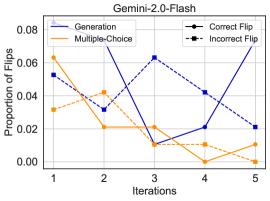
This image displays a 2D line chart titled "Gemini-2.0-Flash", illustrating the "Proportion of Flips" on the Y-axis against "Iterations" on the X-axis. Four distinct data series are plotted, representing "Generation", "Multiple-Choice", "Correct Flip", and "Incorrect Flip", each with unique line styles, colors, and markers. The chart shows how these proportions change over five iterations.
### Components/Axes
* **Chart Title**: "Gemini-2.0-Flash" (positioned at the top-center).
* **X-axis**: Labeled "Iterations" (positioned at the bottom-center).
* Markers are present at integer values: 1, 2, 3, 4, 5.
* **Y-axis**: Labeled "Proportion of Flips" (positioned vertically along the left side).
* Markers are present at intervals of 0.02, ranging from 0.00 to 0.08.
* **Grid Lines**: Light gray grid lines are present for both X and Y axes, aiding in data point estimation.
* **Legend**: Located in the top-left quadrant of the plot area.
* **Generation**: Represented by a blue solid line with square markers.
* **Multiple-Choice**: Represented by an orange solid line with circular markers.
* **Correct Flip**: Represented by a black solid line with filled circular markers. (Visually appears dark blue/black in the image).
* **Incorrect Flip**: Represented by a black dashed line with unfilled circular markers. (Visually appears dark blue/black in the image).
### Detailed Analysis
The chart presents four data series, each tracking the "Proportion of Flips" across five "Iterations":
1. **Generation (Blue solid line, square markers)**
* **Trend**: This series shows significant fluctuation. It starts at a moderate level, dips, then rises to a peak, dips again, and finally reaches its highest point at the last iteration.
* **Data Points**:
* Iteration 1: ~0.054
* Iteration 2: ~0.032
* Iteration 3: ~0.062
* Iteration 4: ~0.022
* Iteration 5: ~0.072
2. **Multiple-Choice (Orange solid line, circular markers)**
* **Trend**: This series generally decreases over the iterations, starting as the highest proportion and dropping sharply to very low values.
* **Data Points**:
* Iteration 1: ~0.062
* Iteration 2: ~0.022
* Iteration 3: ~0.010
* Iteration 4: ~0.000 (or very close to 0.002)
* Iteration 5: ~0.010
3. **Correct Flip (Dark solid line, filled circular markers)**
* **Trend**: This series starts at a moderate level, shows a slight increase, and then steadily decreases, reaching near zero by the final iteration.
* **Data Points**:
* Iteration 1: ~0.032
* Iteration 2: ~0.042
* Iteration 3: ~0.022
* Iteration 4: ~0.010
* Iteration 5: ~0.000 (or very close to 0.002)
4. **Incorrect Flip (Dark dashed line, unfilled circular markers)**
* **Trend**: This series also fluctuates, starting at a moderate level, dipping slightly, rising to a peak, then decreasing over the subsequent iterations.
* **Data Points**:
* Iteration 1: ~0.032 (Notably, this is the same proportion as "Correct Flip" at Iteration 1)
* Iteration 2: ~0.040
* Iteration 3: ~0.062
* Iteration 4: ~0.042
* Iteration 5: ~0.022
### Key Observations
* **Initial State**: At Iteration 1, "Multiple-Choice" has the highest proportion of flips (~0.062), while "Correct Flip" and "Incorrect Flip" start at the exact same proportion (~0.032). "Generation" starts at a moderate ~0.054.
* **Declining Trends**: Both "Multiple-Choice" and "Correct Flip" show a general downward trend in the proportion of flips, with both reaching near zero by Iteration 4 or 5.
* **Fluctuating Trends**: "Generation" and "Incorrect Flip" exhibit more volatile, fluctuating patterns. "Generation" ends at its highest point (~0.072), while "Incorrect Flip" peaks at Iteration 3 (~0.062) before declining.
* **Crossover/Overlap**: "Correct Flip" and "Incorrect Flip" start at the same point at Iteration 1. "Generation" and "Incorrect Flip" both peak at Iteration 3 at the same proportion (~0.062).
* **Lowest Proportions**: "Multiple-Choice" and "Correct Flip" reach the lowest proportions (near 0.00) by Iteration 4-5.
* **Highest Proportions**: "Generation" reaches the highest proportion at Iteration 5 (~0.072).
### Interpretation
This chart, titled "Gemini-2.0-Flash", likely illustrates performance metrics or behavioral tendencies of a language model (Gemini-2.0-Flash) across different "Iterations" (perhaps training steps, evaluation rounds, or task stages). The "Proportion of Flips" could refer to instances where the model changes its output, makes an error, or exhibits a specific type of behavior.
1. **Task/Mode Comparison**: "Generation" and "Multiple-Choice" likely represent two distinct modes of operation or task types for the model. The "Multiple-Choice" mode quickly reduces its "Proportion of Flips" to near zero, suggesting that this mode either stabilizes rapidly, or the task inherently leads to fewer "flips" over time. In contrast, the "Generation" mode consistently shows a higher and more volatile proportion of flips, indicating it might be a more complex or less stable task, or one where "flips" are more inherent to the process.
2. **Flip Analysis**: "Correct Flip" and "Incorrect Flip" provide a breakdown of these "flips". The fact that they start at the same proportion at Iteration 1 suggests an initial equilibrium or a baseline where the model's "flips" are equally likely to be correct or incorrect. However, as iterations progress, "Correct Flip" rapidly diminishes to near zero, while "Incorrect Flip" remains significantly higher, especially peaking at Iteration 3. This implies that while the model might be reducing its "correct flips" (perhaps by becoming more confident or less prone to changing a correct answer), it struggles to eliminate "incorrect flips" entirely, or even sees an increase in their proportion at certain stages.
3. **Interactions and Implications**: The similar fluctuating patterns between "Generation" and "Incorrect Flip" (both peaking at Iteration 3, and "Generation" peaking again at Iteration 5 while "Incorrect Flip" is still relatively high) suggest a potential correlation. It's plausible that the "Generation" mode, being more open-ended or complex, is more susceptible to producing "incorrect flips". The model seems to improve in reducing "correct flips" and "multiple-choice" related flips, but the "incorrect flips" persist, particularly in the context of "generation" tasks. This could indicate an area for further model refinement, focusing on reducing "incorrect flips" in generative tasks.