\n
## Line Chart: Gemini-2.0-Flash Performance Over Iterations
### Overview
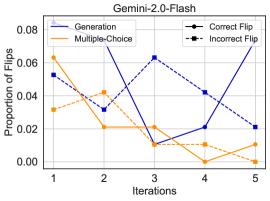
This line chart depicts the proportion of flips (likely referring to changes or errors) across different methods (Generation, Multiple-Choice, Correct Flip, Incorrect Flip) over five iterations. The chart aims to show how these methods perform and evolve with each iteration.
### Components/Axes
* **Title:** Gemini-2.0-Flash (positioned at the top-center)
* **X-axis:** Iterations (labeled 1 to 5, evenly spaced along the horizontal axis)
* **Y-axis:** Proportion of Flips (labeled, ranging from 0.00 to 0.08, evenly spaced along the vertical axis)
* **Legend:** Located at the top-right corner, containing the following labels and corresponding line styles/colors:
* Generation (Solid Blue Line)
* Multiple-Choice (Solid Orange Line)
* Correct Flip (Black Dashed-Dot Line)
* Incorrect Flip (Black Dashed Line)
### Detailed Analysis
The chart displays five data series, each representing a different method.
* **Generation (Blue Line):** This line starts at approximately 0.04 at Iteration 1, rises sharply to around 0.07 at Iteration 2, decreases to approximately 0.06 at Iteration 3, drops to around 0.04 at Iteration 4, and then increases significantly to approximately 0.07 at Iteration 5. The trend is generally fluctuating, with a noticeable increase in the final iteration.
* **Multiple-Choice (Orange Line):** This line begins at approximately 0.065 at Iteration 1, decreases to around 0.035 at Iteration 2, reaches a minimum of approximately 0.02 at Iteration 3, rises slightly to around 0.03 at Iteration 4, and then increases to approximately 0.04 at Iteration 5. The trend is generally decreasing, with a slight increase at the end.
* **Correct Flip (Black Dashed-Dot Line):** This line starts at approximately 0.055 at Iteration 1, decreases to around 0.04 at Iteration 2, remains relatively stable at approximately 0.04 at Iteration 3, decreases to around 0.035 at Iteration 4, and then increases slightly to approximately 0.04 at Iteration 5. The trend is relatively flat, with minor fluctuations.
* **Incorrect Flip (Black Dashed Line):** This line begins at approximately 0.06 at Iteration 1, decreases to around 0.02 at Iteration 3, rises to approximately 0.03 at Iteration 4, and then decreases to approximately 0.01 at Iteration 5. The trend is generally decreasing, with a significant drop after Iteration 1.
### Key Observations
* The "Generation" method shows the most significant fluctuation, with a clear upward trend in the final iteration.
* The "Multiple-Choice" method consistently exhibits a lower proportion of flips compared to the other methods, and shows a decreasing trend overall.
* The "Incorrect Flip" method starts with a high proportion of flips but experiences a substantial decrease over the iterations.
* The "Correct Flip" method remains relatively stable throughout the iterations.
### Interpretation
The data suggests that the "Generation" method, while fluctuating, is becoming more prone to flips (errors or changes) as the iterations progress, potentially indicating instability or a need for further refinement. The "Multiple-Choice" method appears to be the most stable and reliable, consistently showing a low proportion of flips. The decreasing trend in "Incorrect Flip" suggests that the system is learning to avoid these types of errors. The relatively stable "Correct Flip" line indicates that the system is consistently able to identify and apply correct changes.
The relationship between these methods suggests a trade-off between exploration (Generation) and exploitation (Multiple-Choice). The "Generation" method might be exploring a wider range of possibilities, leading to more flips, while the "Multiple-Choice" method is focusing on more reliable options. The decreasing "Incorrect Flip" line suggests that the system is learning from its mistakes and improving its accuracy over time. The Gemini-2.0-Flash model appears to be evolving, with some methods showing more promise than others.