## Photograph: Human-Robot Interaction Study
### Overview
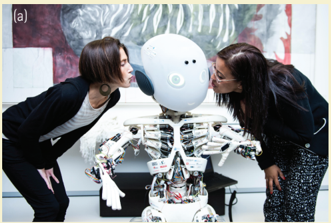
The image is a photograph labeled "(a)" in the top-left corner, depicting a close, interactive scene between two human women and a humanoid robot. The composition is a medium shot, focusing on the upper bodies of the subjects. The setting appears to be an indoor environment, possibly a lab, studio, or exhibition space, with a large abstract painting in the background.
### Components/Axes
* **Primary Subjects:**
* **Humanoid Robot:** Centrally positioned. It has a smooth, white, dome-shaped head with a single, prominent green circular light (or sensor) in the center of its "face." Its torso and arms are exposed, revealing a complex mechanical structure of white and metallic components, wires, and actuators. It is seated on a black stool or base.
* **Woman 1 (Left):** Positioned to the left of the robot, leaning in closely towards its head. She has short, dark brown hair and is wearing a black long-sleeved top with a white panel on the front. Her posture is one of focused examination or interaction.
* **Woman 2 (Right):** Positioned to the right of the robot, also leaning in closely towards its head from the opposite side. She has long, dark hair and is wearing a black top and patterned (possibly floral or abstract) trousers. Her expression and posture mirror the first woman's intent focus.
* **Background:**
* A large, framed artwork dominates the background. It features abstract, expressive brushstrokes in shades of white, grey, black, and hints of red or maroon. The style is reminiscent of abstract expressionism.
* The wall behind the artwork is a light, neutral color (off-white or light grey).
* **Text/Labels:**
* The only visible text is the label **"(a)"** in the top-left corner of the image, rendered in a simple, black, sans-serif font. This suggests the image is part of a series (e.g., Figure 1a) in a technical or academic document.
### Detailed Analysis
* **Spatial Composition:** The three subjects form a tight, triangular cluster in the center of the frame. The robot's head is the focal point, with the two women's faces converging towards it from either side, creating a strong sense of symmetrical interaction and shared attention.
* **Robot Details:** The robot's design is a blend of sleek, friendly aesthetics (the smooth white head) and raw, exposed engineering (the mechanical torso). The green light is the only active visual element on its head, suggesting it may be powered on or in a specific operational state.
* **Human Interaction:** Both women are within the robot's immediate personal space, a distance typically associated with intimate or highly engaged interaction. Their body language—leaning forward, hands on knees or thighs—indicates curiosity, study, or perhaps a collaborative task.
* **Lighting and Color:** The lighting is even and diffuse, likely from an indoor source, casting soft shadows. The color palette is dominated by the black and white of the clothing and robot, punctuated by the green light on the robot's head and the muted colors of the background painting.
### Key Observations
1. **Focused Triad:** The composition creates an intense, closed loop of attention between the two humans and the machine, emphasizing a moment of direct human-robot engagement.
2. **Contrast in Form:** There is a stark visual contrast between the organic, soft forms of the humans and the geometric, mechanical structure of the robot, highlighted by the exposed torso.
3. **Ambiguous Context:** The setting is not a sterile laboratory; the presence of large artwork suggests a space designed for presentation, creativity, or public engagement, such as a gallery, a design studio, or a tech showcase.
4. **Label Implication:** The "(a)" label is a critical piece of metadata, confirming this image is not standalone but part of a larger documented sequence or comparison.
### Interpretation
This photograph captures a moment of **close-quarters human-robot interaction**, likely within a research, design, or demonstration context. The image does not provide factual data or quantitative trends but instead offers a **qualitative snapshot** of engagement.
* **What it Suggests:** The scene demonstrates a high level of comfort and curiosity from the humans towards the robot. The robot's design, with its non-threatening head and exposed mechanics, seems intended to invite examination rather than evoke fear. The interaction appears collaborative or investigative, not passive.
* **Relationship Between Elements:** The humans are the active observers/interactors, while the robot is the passive subject of their attention. The background artwork frames the scene, potentially symbolizing the intersection of technology (the robot) and human creativity (the art).
* **Notable Anomalies:** The primary "anomaly" is the intimacy of the interaction. In many technical contexts, robots are observed from a distance. Here, the subjects are well within typical social distances, suggesting either a specific experimental protocol, a demonstration of the robot's safe and approachable design, or a moment of candid, unstructured exploration.
* **Underlying Message:** The image powerfully communicates themes of **human curiosity, the approachability of advanced technology, and the blurring lines between engineering and art.** It serves as a visual testament to the human drive to understand and connect with artificial entities.