## Photograph: Human-Robot Interaction Scene
### Overview
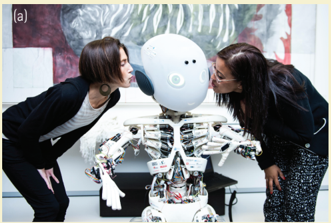
The image depicts two individuals (a woman with short hair and a woman with long hair) leaning forward to kiss a humanoid robot. The robot has a white, spherical head with two black circular "eyes" and a simple mouth-like feature. Its torso is exposed, revealing mechanical components, wiring, and structural elements. The background includes an abstract painting with red, white, and gray tones.
### Components/Axes
- **Robot**:
- **Head**: White, spherical, with two black circular "eyes" and a central mouth-like slit.
- **Torso**: Exposed mechanical framework, including metallic plates, wires, and joints.
- **Limbs**: Partially visible arms with articulated joints and white gloves.
- **Individuals**:
- **Left Person**: Short hair, black blazer over a white top, black pants.
- **Right Person**: Long dark hair, black blazer, patterned black-and-white pants.
- **Background**: Abstract mural with red, white, and gray geometric patterns.
### Detailed Analysis
- **Robot Design**:
- The robot’s head is minimalist, with no visible sensors or complex features beyond the "eyes" and mouth.
- The torso exposes internal mechanics, suggesting a focus on transparency or educational demonstration.
- **Human Interaction**:
- Both individuals are bent forward, lips nearly touching the robot’s head.
- Their body language implies curiosity or testing the robot’s responsiveness to physical contact.
- **Environment**:
- The setting appears to be an exhibition or lab, indicated by the clean, neutral flooring and the abstract mural.
### Key Observations
- No textual labels, legends, or axis markers are visible in the image.
- The robot’s design prioritizes simplicity and mechanical transparency over advanced features.
- The individuals’ attire (blazers) suggests a formal or professional context, contrasting with the playful interaction.
### Interpretation
This image likely illustrates a study or demonstration of human-robot interaction, emphasizing emotional or social engagement. The robot’s exposed mechanics may symbolize openness or vulnerability in human-machine relationships. The absence of text or branding focuses attention on the interaction itself, possibly highlighting themes of trust, curiosity, or the boundaries between human and artificial intelligence. The abstract mural in the background adds an artistic layer, suggesting the scene is staged for conceptual or artistic purposes rather than functional testing.
**Note**: No factual data, numerical values, or structured information (e.g., charts, tables) is present in the image. The description is based solely on visible elements and contextual inference.