## Flowchart: System Architecture for Tool Specification and Task Execution
### Overview
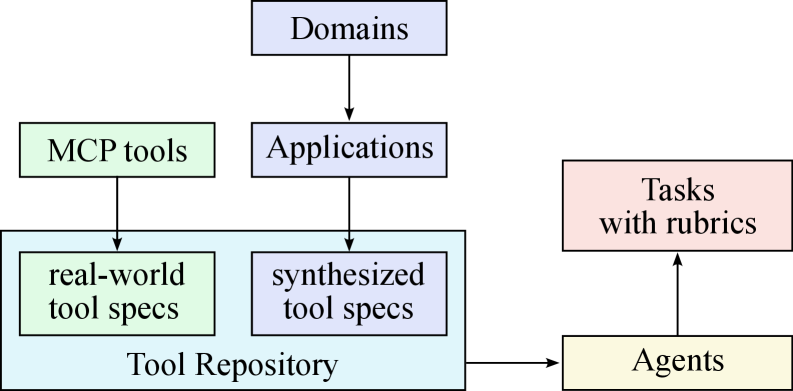
The diagram illustrates a hierarchical workflow connecting domains, applications, tool specifications, agents, and tasks with rubrics. It emphasizes the flow of data or processes from high-level domains to specific task execution, with a central "Tool Repository" acting as an intermediary.
---
### Components/Axes
- **Nodes**:
- **Domains** (topmost, purple)
- **Applications** (purple, connected to Domains)
- **MCP tools** (green, connected to Applications)
- **Real-world tool specs** (green, connected to MCP tools)
- **Synthesized tool specs** (purple, connected to Applications)
- **Tool Repository** (blue, receiving inputs from both tool specs)
- **Agents** (yellow, connected to Tool Repository)
- **Tasks with rubrics** (pink, connected to Agents)
- **Arrows**: Indicate directional flow between components.
- **Colors**:
- Purple: High-level conceptual components (Domains, Applications, Synthesized tool specs)
- Green: Real-world/tool-specific components (MCP tools, Real-world tool specs)
- Blue: Central repository (Tool Repository)
- Yellow: Processing unit (Agents)
- Pink: Output/goal (Tasks with rubrics)
---
### Detailed Analysis
1. **Flow Path**:
- **Domains** → **Applications**: High-level domains are broken down into specific applications.
- **Applications** → **MCP tools** and **Synthesized tool specs**: Applications generate both real-world tool specifications (via MCP tools) and simulated/synthesized specifications.
- **Tool specs** → **Tool Repository**: Both real and synthesized specifications are stored or processed in a central repository.
- **Tool Repository** → **Agents**: The repository supplies data to agents.
- **Agents** → **Tasks with rubrics**: Agents execute tasks defined by rubrics (performance criteria).
2. **Key Relationships**:
- The **Tool Repository** serves as a convergence point for real and synthesized tool specifications, suggesting a unified system for managing diverse data sources.
- **Agents** act as intermediaries between the repository and task execution, implying automation or decision-making capabilities.
- **Tasks with rubrics** are the final output, indicating that agent performance is evaluated against predefined standards.
---
### Key Observations
- **Dual Inputs to Tool Repository**: The system integrates both real-world and synthesized tool specifications, enabling flexibility for testing or hybrid workflows.
- **Agent-Centric Design**: Agents are positioned to process repository data and execute tasks, highlighting their role as autonomous or semi-autonomous components.
- **Rubric-Driven Tasks**: The inclusion of rubrics suggests a focus on measurable outcomes or quality control in task execution.
---
### Interpretation
This diagram represents a system architecture where **domains** are decomposed into **applications**, which define **tool specifications** (both real and simulated). These specifications are centralized in a **Tool Repository**, enabling **Agents** to execute **Tasks with rubrics**. The structure implies:
- **Modularity**: Components are decoupled (e.g., Domains → Applications → Tool specs).
- **Scalability**: The repository can handle diverse inputs, supporting both real and synthetic data.
- **Evaluation Focus**: Rubrics in tasks emphasize performance metrics, suggesting the system is designed for optimization or validation.
The absence of numerical data or explicit trends indicates the diagram is conceptual, focusing on workflow design rather than quantitative analysis.