## Diagram: Tool Repository Flow
### Overview
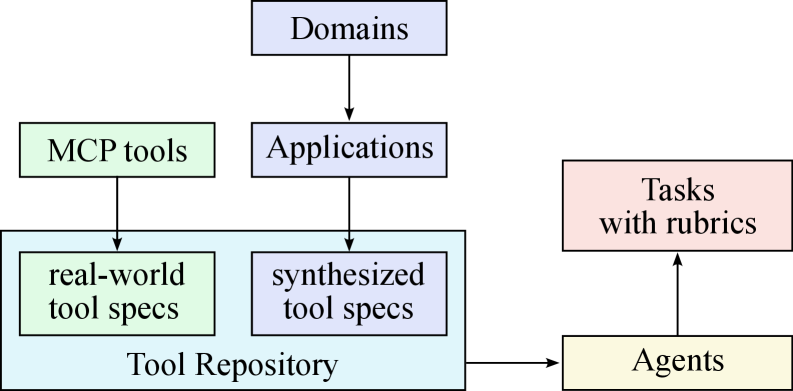
The image is a diagram illustrating the flow of information and resources related to a "Tool Repository." It shows how domains and applications feed into the repository, which contains both real-world and synthesized tool specifications. Agents interact with the repository and are associated with tasks that have rubrics.
### Components/Axes
* **Boxes:** Represent different entities or categories. Each box has a label.
* **Arrows:** Indicate the direction of flow or relationship between the entities.
* **Colors:** Each box has a different background color, indicating a different category.
The boxes and their labels are:
* **Top Center:** "Domains" (light blue box)
* **Top Left:** "MCP tools" (light green box)
* **Center Left:** "Applications" (light blue box)
* **Bottom Left:** "Tool Repository" (light blue box encompassing two sub-categories)
* "real-world tool specs" (light green box inside Tool Repository)
* "synthesized tool specs" (light blue box inside Tool Repository)
* **Right:** "Tasks with rubrics" (light red box)
* **Bottom Right:** "Agents" (light yellow box)
### Detailed Analysis
The diagram shows the following flow:
1. "Domains" flow into "Applications."
2. "Applications" flow into "Tool Repository."
3. "MCP tools" flow into "Tool Repository."
4. "Tool Repository" flows into "Agents."
5. "Agents" flow into "Tasks with rubrics."
The "Tool Repository" contains two types of tool specifications: "real-world tool specs" and "synthesized tool specs."
### Key Observations
* The diagram illustrates a hierarchical structure, with "Domains" at the top and "Tasks with rubrics" at the right.
* The "Tool Repository" acts as a central hub, receiving input from multiple sources and providing output to "Agents."
* The diagram suggests a workflow where domains and applications lead to the creation or acquisition of tool specifications, which are then used by agents to perform tasks.
### Interpretation
The diagram represents a system for managing and utilizing tools. "Domains" and "Applications" likely define the context in which the tools are used. "MCP tools" might be a specific type of tool or a source of tools. The "Tool Repository" is where these tools are stored and organized. "Agents" are the entities that use the tools, and "Tasks with rubrics" represent the work they perform, along with the criteria for evaluating their performance.
The flow suggests that the system is designed to support agents in performing tasks by providing them with the necessary tools and specifications. The inclusion of both "real-world" and "synthesized" tool specs indicates that the system can handle both existing tools and tools that are designed or adapted for specific purposes.