## Bar Chart: Generative Accuracy Across Transformation Types
### Overview
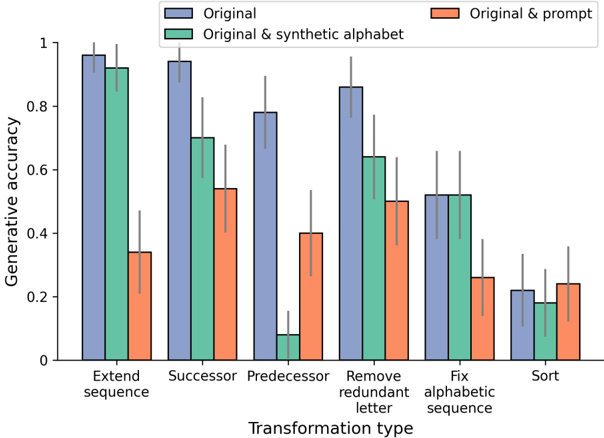
The chart compares generative accuracy (y-axis: 0–1) across six transformation types (x-axis) for three methods: "Original," "Original & synthetic alphabet," and "Original & prompt." Error bars indicate variability in measurements.
### Components/Axes
- **X-axis (Transformation type)**: Extend sequence, Successor, Predecessor, Remove redundant letter, Fix alphabetic sequence, Sort.
- **Y-axis (Generative accuracy)**: Scale from 0 to 1, labeled "Generative accuracy."
- **Legend**:
- Blue: Original
- Green: Original & synthetic alphabet
- Orange: Original & prompt
- **Error bars**: Vertical lines atop bars showing measurement uncertainty.
### Detailed Analysis
1. **Extend sequence**:
- Original (blue): ~0.95 (±0.05)
- Original & synthetic alphabet (green): ~0.92 (±0.04)
- Original & prompt (orange): ~0.35 (±0.06)
2. **Successor**:
- Original: ~0.93 (±0.06)
- Original & synthetic alphabet: ~0.70 (±0.07)
- Original & prompt: ~0.55 (±0.08)
3. **Predecessor**:
- Original: ~0.78 (±0.09)
- Original & synthetic alphabet: ~0.08 (±0.05)
- Original & prompt: ~0.40 (±0.07)
4. **Remove redundant letter**:
- Original: ~0.85 (±0.08)
- Original & synthetic alphabet: ~0.65 (±0.07)
- Original & prompt: ~0.50 (±0.06)
5. **Fix alphabetic sequence**:
- Original: ~0.52 (±0.06)
- Original & synthetic alphabet: ~0.52 (±0.06)
- Original & prompt: ~0.25 (±0.05)
6. **Sort**:
- Original: ~0.22 (±0.04)
- Original & synthetic alphabet: ~0.18 (±0.03)
- Original & prompt: ~0.24 (±0.04)
### Key Observations
- **Highest accuracy**: "Extend sequence" dominates across all methods, with "Original" achieving ~0.95.
- **Lowest accuracy**: "Sort" underperforms, with "Original" at ~0.22 and "Original & synthetic alphabet" at ~0.18.
- **Method impact**:
- "Original" consistently outperforms other methods.
- "Original & prompt" (orange) shows the largest drop in accuracy for most transformations (e.g., "Extend sequence" drops from ~0.95 to ~0.35).
- "Original & synthetic alphabet" (green) performs better than "Original & prompt" but worse than "Original" in most cases.
### Interpretation
The data suggests that the "Original" method is most effective for generative tasks, while adding synthetic alphabets or prompts reduces accuracy. Transformations like "Extend sequence" and "Successor" are inherently easier for models, whereas "Sort" poses significant challenges. The "Original & prompt" method appears to introduce noise or constraints that degrade performance, particularly for complex transformations. The near-identical performance of "Original" and "Original & synthetic alphabet" in "Fix alphabetic sequence" implies that synthetic alphabets may not always improve task-specific accuracy.