\n
## Scatter Plot: Association Types
### Overview
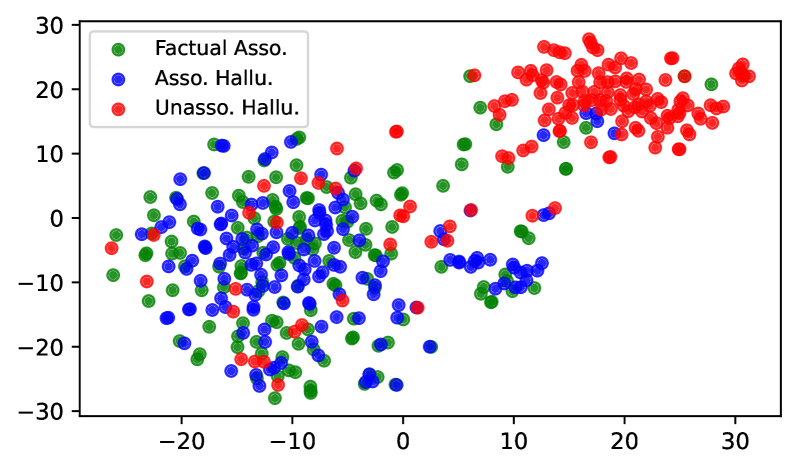
The image presents a scatter plot visualizing the distribution of three different association types: "Factual Association", "Associated Hallucination", and "Unassociated Hallucination". The plot displays these associations based on two unspecified numerical dimensions, represented by the x and y axes. The data points are color-coded according to their association type, with a legend in the top-left corner clarifying the color scheme.
### Components/Axes
* **X-axis:** Ranges approximately from -25 to 30, with tick marks at intervals of 10. The axis is unlabeled.
* **Y-axis:** Ranges approximately from -30 to 30, with tick marks at intervals of 10. The axis is unlabeled.
* **Legend:** Located in the top-left corner.
* "Factual Asso." - Green circles
* "Asso. Hallu." - Blue circles
* "Unasso. Hallu." - Red circles
### Detailed Analysis
The plot contains a large number of data points for each association type.
* **Factual Association (Green):** The points are distributed across the plot, with a concentration in the region between x = -20 and x = 5, and y = -20 and y = 10. There is a slight upward trend as x increases. Approximate data points (x, y): (-18, -15), (-10, -5), (0, 5), (5, -10).
* **Associated Hallucination (Blue):** These points are primarily clustered in the region between x = -20 and x = 10, and y = -10 and y = 10. The distribution appears relatively uniform within this region. Approximate data points (x, y): (-15, 0), (-5, 5), (5, -5), (0, 0).
* **Unassociated Hallucination (Red):** The points are concentrated in the upper-right quadrant of the plot, with x values generally greater than 10 and y values generally greater than 0. There is a clear positive correlation between x and y for this group. Approximate data points (x, y): (10, 10), (20, 15), (25, 20), (15, 5).
### Key Observations
* The "Unassociated Hallucination" data points are distinctly separated from the other two association types, residing in the upper-right quadrant.
* "Factual Association" and "Associated Hallucination" data points overlap significantly, making visual distinction difficult in certain areas.
* The "Unassociated Hallucination" data exhibits a strong positive correlation, while the other two types do not show a clear linear trend.
### Interpretation
The scatter plot suggests a relationship between the two unspecified dimensions and the type of association. The separation of "Unassociated Hallucinations" indicates that this type of hallucination is characterized by higher values on both dimensions compared to factual associations and associated hallucinations. The overlap between factual associations and associated hallucinations suggests that these two types share similar characteristics along these dimensions. The positive correlation within the "Unassociated Hallucination" group might indicate a systematic bias or underlying factor driving both dimensions upwards in these cases.
Without knowing what the axes represent, it's difficult to draw definitive conclusions. However, the plot provides a visual representation of how these association types differ and potentially relate to each other based on these two variables. The plot could be used to explore the characteristics of different types of hallucinations and their relationship to factual information.