## Diagram: Neural Network Layer with Lookup Table (LUT) Implementation
### Overview
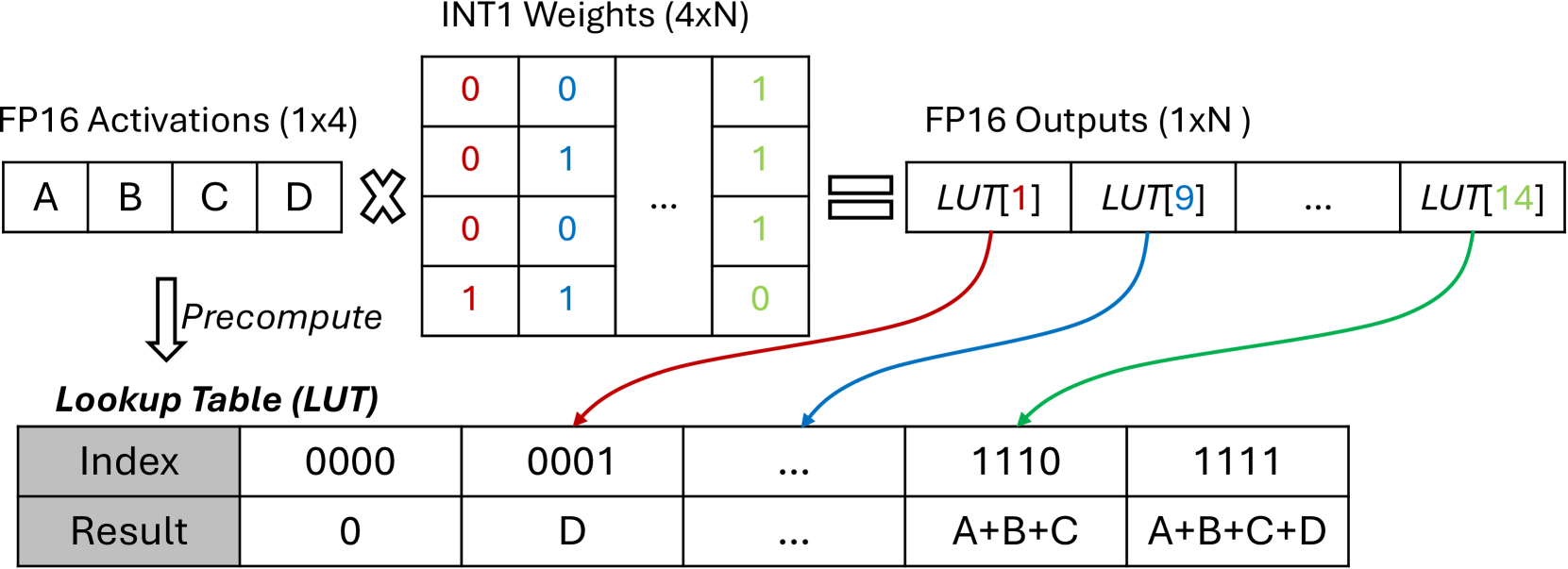
This diagram illustrates a computational process in a neural network layer, showing how input activations are transformed through matrix multiplication and a lookup table (LUT) to produce final outputs. The process involves precomputing possible activation sums and mapping them to LUT indices for efficient computation.
### Components/Axes
1. **FP16 Activations (1x4)**: Input vector with elements A, B, C, D.
2. **INT1 Weights (4xN)**: Weight matrix with binary values (0s and 1s). The first four columns are explicitly shown:
```
[0 0 ... 1]
[0 1 ... 1]
[0 0 ... 1]
[1 1 ... 0]
```
3. **FP16 Outputs (1xN)**: Result of matrix multiplication, connected to LUT via colored lines.
4. **Lookup Table (LUT)**:
- **Index**: 4-bit binary values (0000 to 1111).
- **Result**: Precomputed sums of activations (e.g., 0, D, A+B+C, A+B+C+D).
5. **Color-Coded Connections**:
- **Red**: Links matrix row 1 (0 0 ... 1) to LUT[1].
- **Blue**: Links matrix row 2 (0 1 ... 1) to LUT[9].
- **Green**: Links matrix row 4 (1 1 ... 0) to LUT[14].
### Detailed Analysis
- **Matrix Multiplication**: The 4xN weight matrix multiplies the 1x4 activation vector, producing intermediate sums. For example:
- Row 1 (0 0 ... 1) → Sum = D (activates only the last element).
- Row 2 (0 1 ... 1) → Sum = A+B+C+D (activates all elements).
- Row 4 (1 1 ... 0) → Sum = A+B+C (activates first three elements).
- **LUT Mapping**: Intermediate sums are rounded to 4-bit indices (0-15) and mapped to precomputed results. For instance:
- Index `0001` (1) → Result = D.
- Index `1010` (10) → Result = A+B+C.
- Index `1111` (15) → Result = A+B+C+D.
### Key Observations
1. **Sparse Weight Matrix**: Most weights are 0, reducing computational complexity.
2. **LUT Precomputation**: Avoids runtime summation by precomputing all possible activation combinations (16 entries for 4 inputs).
3. **Color-Coded Logic**: Each color represents a specific row in the weight matrix and its corresponding LUT index.
### Interpretation
This diagram demonstrates a **quantized neural network layer** optimized for efficiency:
- **Quantization**: Weights are binary (INT1), and activations are 16-bit floats (FP16), reducing memory and compute requirements.
- **Lookup Table Optimization**: Precomputing activation sums (via LUT) eliminates repeated arithmetic operations during inference, critical for edge devices with limited resources.
- **Sparse Connectivity**: The weight matrix’s sparsity (many 0s) suggests pruning or structured sparsity for further optimization.
The process highlights a trade-off between precision (FP16 activations) and efficiency (INT1 weights + LUT), common in deployment scenarios where speed and memory are prioritized over absolute accuracy.