\n
## Document: Instructions for GPT-4 Correctness Verification
### Overview
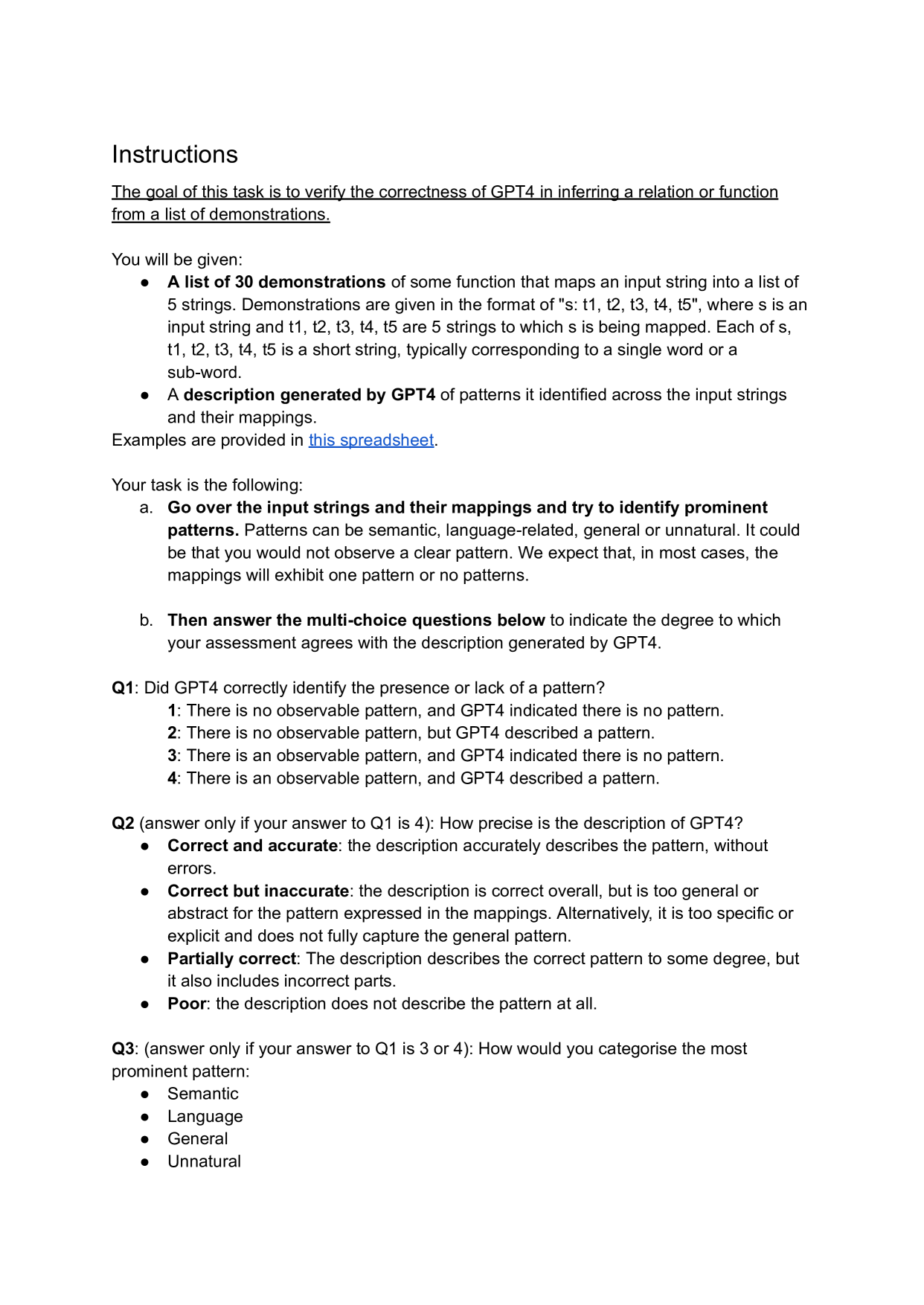
This document outlines the instructions for a task designed to verify the correctness of GPT-4 in inferring relations or functions from a list of demonstrations. The task involves analyzing a set of input-output mappings and evaluating GPT-4's ability to identify and describe any underlying patterns.
### Components/Axes
The document is structured into sections:
* **Instructions:** The main body of the document, detailing the task and evaluation criteria.
* **Demonstrations:** Mentioned as a list of 30 input-output pairs.
* **Description generated by GPT4:** A description of patterns identified by GPT-4.
* **Multi-choice Questions:** Q1, Q2, and Q3, used to assess the agreement between human assessment and GPT-4's pattern identification.
* **Link to Spreadsheet:** A hyperlink to "this spreadsheet" is provided as an example.
### Detailed Analysis or Content Details
The instructions specify the following:
* **Demonstrations:** The demonstrations are provided in the format of 's1, s2, s3, s4, s5' where 's' is an input string and 't1, t2, t3, t4, t5' are the corresponding 5 strings it is mapped to. Each of s1, s2, s3, s4, s5 is a short string, typically corresponding to a single word or a sub-word.
* **Task:** The task involves two parts:
* Identifying prominent patterns in the input strings and their mappings. Patterns can be semantic, language-related, general, or unnatural.
* Answering multiple-choice questions to indicate the degree to which the assessment agrees with the description generated by GPT-4.
* **Multi-choice Questions:**
* **Q1:** Did GPT4 correctly identify the presence or lack of a pattern?
* 1: There is no observable pattern, and GPT4 indicated there is no pattern.
* 2: There is no observable pattern, but GPT4 described a pattern.
* 3: There is an observable pattern, and GPT4 indicated there is no pattern.
* 4: There is an observable pattern, and GPT4 described a pattern.
* **Q2:** (Answer only if your answer to Q1 is 4) How precise is the description of GPT4?
* Correct and accurate: the description accurately describes the pattern, without errors.
* Correct but inaccurate: the description is correct overall, but is too general or abstract for the pattern expressed in the mappings. Alternatively, it is too specific or explicit and does not fully capture the general pattern.
* Partially correct: The description describes the correct pattern to some degree, but it also includes incorrect parts.
* Poor: the description does not describe the pattern at all.
* **Q3:** (Answer only if your answer to Q1 is 3 or 4) How would you categorise the most prominent pattern?
* Semantic
* Language
* General
* Unnatural
### Key Observations
The document focuses on a meta-cognitive evaluation of an AI model (GPT-4). It doesn't present data *per se*, but rather a framework for evaluating the *quality* of an AI's reasoning about data. The emphasis is on pattern recognition and the accuracy of descriptions. The questions are designed to assess both whether GPT-4 detects a pattern when one exists, and how well it describes that pattern.
### Interpretation
This document represents a critical step in AI validation. It moves beyond simply assessing whether an AI can *perform* a task (e.g., translation, summarization) and delves into whether it can *understand* the underlying principles governing that task. The use of human assessment to validate GPT-4's pattern identification is crucial, as it provides a benchmark for evaluating the AI's reasoning capabilities. The categorization of patterns (semantic, language, general, unnatural) suggests a desire to understand *what kind* of reasoning GPT-4 is employing. The entire process is geared towards building trust and transparency in AI systems by verifying their internal logic and ensuring they are not simply memorizing patterns without genuine understanding. The inclusion of a spreadsheet example indicates a practical, data-driven approach to this validation process.