## Heatmap: Syllogism Format Prediction Validity
### Overview
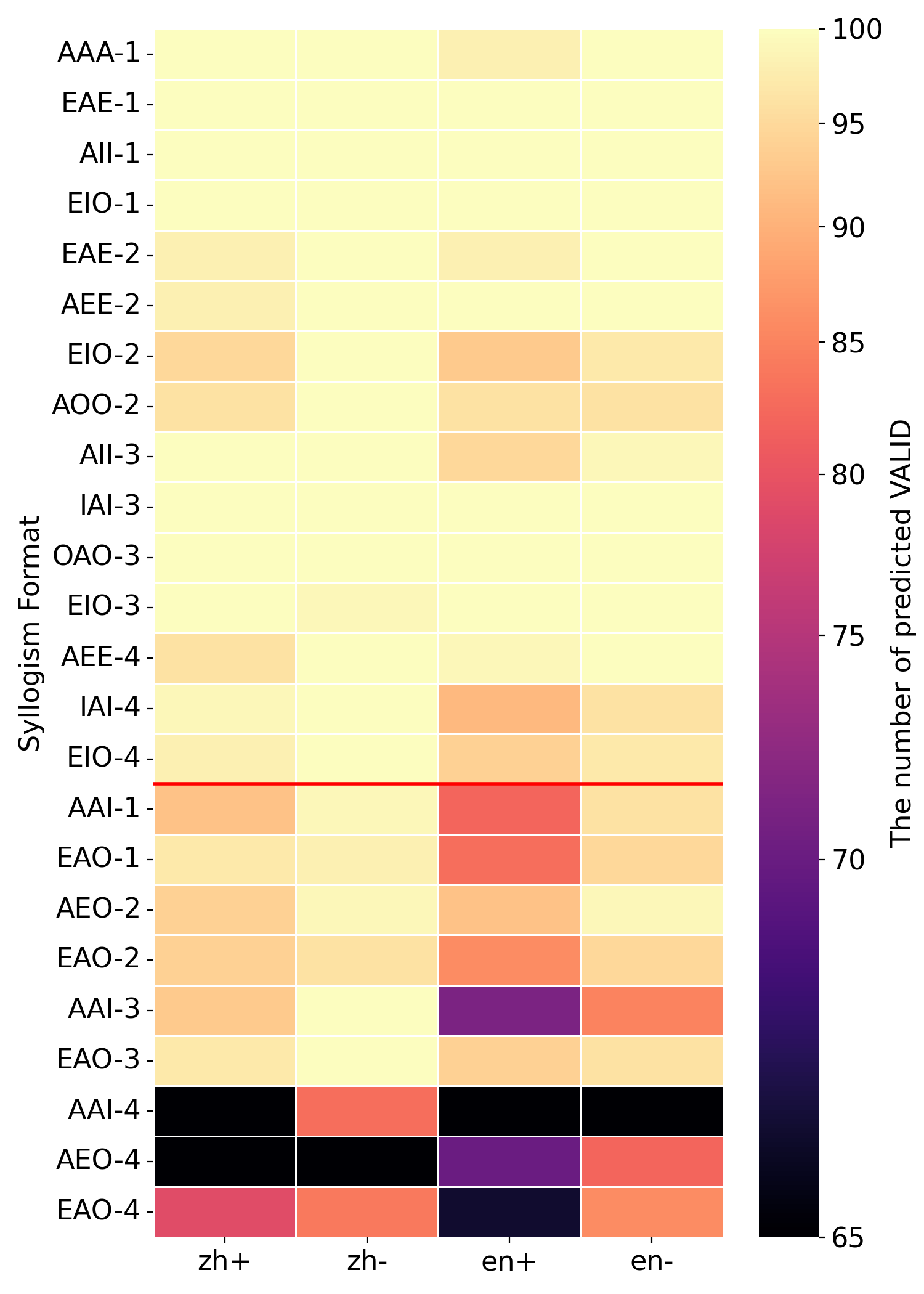
This image is a heatmap visualizing the number of predicted "VALID" outcomes for various syllogism formats across four different conditions. The data is presented as a grid where color intensity represents a numerical value, with a color scale provided on the right. A horizontal red line divides the syllogism formats into two distinct groups.
### Components/Axes
* **Y-Axis (Vertical):** Labeled "Syllogism Format". It lists 24 distinct syllogism formats, each with a numerical suffix (e.g., AAA-1, EAE-1, AII-1, etc.). The formats are grouped, with a red horizontal line separating the first 15 formats (AAA-1 through EIO-4) from the last 9 formats (AAI-1 through EAO-4).
* **X-Axis (Horizontal):** Contains four categorical labels: `zh+`, `zh-`, `en+`, `en-`. These likely represent experimental conditions, possibly related to language (Chinese/English) and another binary variable (+/-).
* **Color Bar/Legend (Right Side):** A vertical gradient bar titled "The number of predicted VALID". The scale ranges from **65** (black/dark purple) at the bottom to **100** (light yellow/cream) at the top. The gradient transitions through dark purple, purple, magenta, red, orange, and yellow.
* **Visual Separator:** A solid red horizontal line is drawn across the heatmap between the rows for "EIO-4" and "AAI-1".
### Detailed Analysis
The heatmap displays approximate values for each cell based on color matching with the legend. Values are estimates; the exact number is not written in the cells.
**Top Group (Above Red Line: AAA-1 to EIO-4)**
This group is characterized by predominantly high values (light yellow to light orange), indicating a high number of predicted VALID outcomes across most conditions.
* **General Trend:** Values are consistently high, mostly in the 90-100 range.
* **Notable Patterns:**
* The `zh-` column often shows the lightest colors (highest values, ~95-100) for many formats in this group.
* The `en+` column shows slightly more variation, with some cells (e.g., AII-3, IAI-4, EIO-4) appearing as light orange, suggesting values in the ~85-90 range.
* Formats like AAA-1, EAE-1, AII-1, EIO-1, AEE-2, IAI-3, OAO-3, and EIO-3 show very high, uniform values across all four conditions.
**Bottom Group (Below Red Line: AAI-1 to EAO-4)**
This group shows significantly more variation and generally lower values (darker colors), indicating fewer predicted VALID outcomes.
* **General Trend:** Values are more dispersed, ranging from the mid-60s to low 90s.
* **Notable Patterns:**
* The `en+` column contains the most extreme low values in the entire chart. Specifically:
* **AAI-3 / en+:** Dark purple, estimated value ~70-75.
* **AAI-4 / en+:** Black, estimated value ~65 (lowest on scale).
* **AEO-4 / en+:** Dark purple, estimated value ~70.
* **EAO-4 / en+:** Very dark blue/purple, estimated value ~65-70.
* The `zh+` and `zh-` columns for the bottom three rows (AAI-4, AEO-4, EAO-4) show a mix of black (very low, ~65) and red/orange (mid-range, ~80-85).
* The `en-` column for the bottom three rows shows orange/red values (~80-85), which are higher than the corresponding `en+` values for the same formats.
### Key Observations
1. **Bimodal Distribution:** The red line clearly separates two performance clusters. Syllogism formats above the line are predicted as VALID much more frequently than those below it.
2. **Condition-Specific Difficulty:** The `en+` condition appears to be the most challenging for the syllogism formats in the bottom group, yielding the lowest validity predictions.
3. **Format-Specific Outliers:** Within the bottom group, formats with the suffix "-4" (AAI-4, AEO-4, EAO-4) exhibit the most severe drops in predicted validity, especially under the `en+` condition.
4. **Language Condition Contrast:** For the difficult formats at the bottom, the `en-` condition consistently shows higher validity predictions than the `en+` condition, suggesting the "+" factor significantly reduces performance in English.
### Interpretation
This heatmap likely presents results from a study evaluating an AI model's or a cognitive system's ability to judge the logical validity of different syllogistic reasoning formats. The syllogism formats are classical categorical syllogisms (e.g., AAA-1 is "Barbara").
* **What the data suggests:** The system finds a clear subset of syllogism formats (those above the red line) to be reliably valid. The formats below the line, particularly those ending in "-4" (which may denote a specific figure or complexity), are much harder for the system to validate correctly.
* **How elements relate:** The x-axis conditions (`zh+`, `zh-`, `en+`, `en-`) probably manipulate the language of the premises (Chinese vs. English) and another factor (e.g., presence/absence of a distracting element, or affirmative/negative phrasing). The data shows that this second factor (`+` vs `-`) interacts strongly with language, especially for difficult syllogisms. The `en+` condition is uniquely detrimental.
* **Notable Anomalies:** The drastic performance cliff for formats like AAI-4 and AEO-4 in the `en+` condition is the most striking finding. It indicates a specific failure mode where the combination of a difficult logical format and the `en+` condition leads to near-total failure in predicting validity (values at the scale minimum of 65). The red line may represent a threshold of "formal validity" or "cognitive ease" in the experimental design.
**Language Present:** The labels `zh` and `en` are abbreviations for Chinese and English, respectively. All other text is in English.