## Line Chart: Model Performance on Various Benchmarks
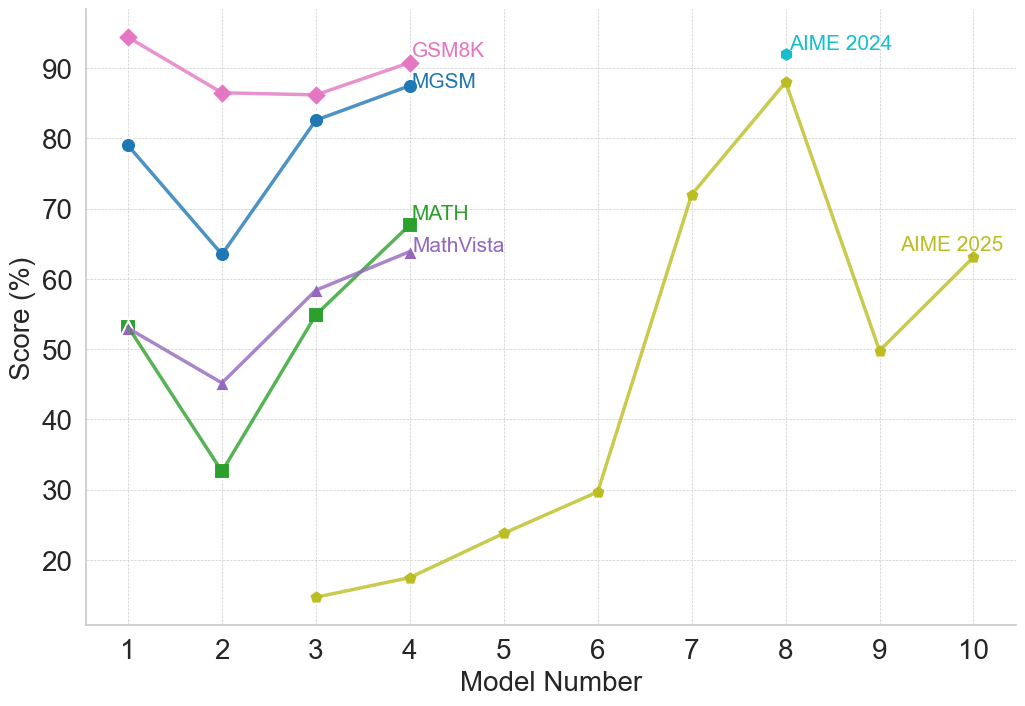
### Overview
This line chart displays the performance scores (in percentage) of different models across several benchmarks: GSM8K, MGSM, MATH, MathVista, AIME 2024, and AIME 2025. The x-axis represents the Model Number, ranging from 1 to 10. The y-axis represents the Score, measured as a percentage from 0% to 100%.
### Components/Axes
* **X-axis:** Model Number (1 to 10)
* **Y-axis:** Score (%) (0 to 100)
* **Data Series:**
* GSM8K (Pink)
* MGSM (Purple)
* MATH (Blue)
* MathVista (Green)
* AIME 2024 (Teal)
* AIME 2025 (Yellow)
* **Legend:** Located in the top-right corner of the chart, associating colors with each benchmark.
### Detailed Analysis
Here's a breakdown of each data series and their trends:
* **GSM8K (Pink):** Starts at approximately 84% at Model 1, dips to around 81% at Model 2, rises to approximately 88% at Model 3, plateaus around 86-88% from Models 3 to 10.
* **MGSM (Purple):** Starts at approximately 91% at Model 1, drops to around 82% at Model 2, rises to approximately 86% at Model 3, and remains relatively stable around 84-86% from Models 3 to 10.
* **MATH (Blue):** Starts at approximately 76% at Model 1, drops to around 63% at Model 2, rises steadily to approximately 68% at Model 3, continues to increase to around 72% at Model 4, and plateaus around 72-74% from Models 4 to 10.
* **MathVista (Green):** Starts at approximately 52% at Model 1, drops sharply to around 32% at Model 2, rises steadily to approximately 58% at Model 3, continues to increase to around 68% at Model 7, and then plateaus around 68-70% from Models 7 to 10.
* **AIME 2024 (Teal):** Starts at approximately 76% at Model 1, drops to around 65% at Model 2, rises to approximately 70% at Model 3, and then rises sharply to approximately 91% at Model 8, and then drops to approximately 85% at Model 9 and 80% at Model 10.
* **AIME 2025 (Yellow):** Starts at approximately 20% at Model 1, rises steadily to approximately 30% at Model 6, then increases sharply to approximately 65% at Model 7, rises to approximately 87% at Model 8, and then drops to approximately 65% at Model 9 and 60% at Model 10.
### Key Observations
* GSM8K and MGSM consistently achieve the highest scores, remaining above 80% across all models.
* MathVista shows the lowest initial scores but demonstrates significant improvement as the Model Number increases.
* AIME 2024 and AIME 2025 exhibit a dramatic increase in performance around Model 8, suggesting a critical threshold or improvement in the model's capabilities at that point.
* AIME 2025 starts with the lowest scores and shows the most significant improvement.
* The performance of most models appears to stabilize after Model 7 or 8.
### Interpretation
The chart suggests that the models generally improve in performance as the Model Number increases, indicating that iterative development or training leads to better results. The benchmarks GSM8K and MGSM are easier for the models to achieve high scores on, while MATH, MathVista, AIME 2024, and AIME 2025 present greater challenges. The sharp increase in AIME 2024 and AIME 2025 scores around Model 8 could indicate a specific architectural change, training data update, or optimization technique implemented at that stage. The diverging trends of AIME 2024 and AIME 2025 after Model 8 suggest that the models are responding differently to further improvements or are being optimized for different aspects of the benchmark. The data highlights the importance of continued model development and the potential for significant performance gains through targeted improvements.