## Diagram: Legal Brief Structure
### Overview
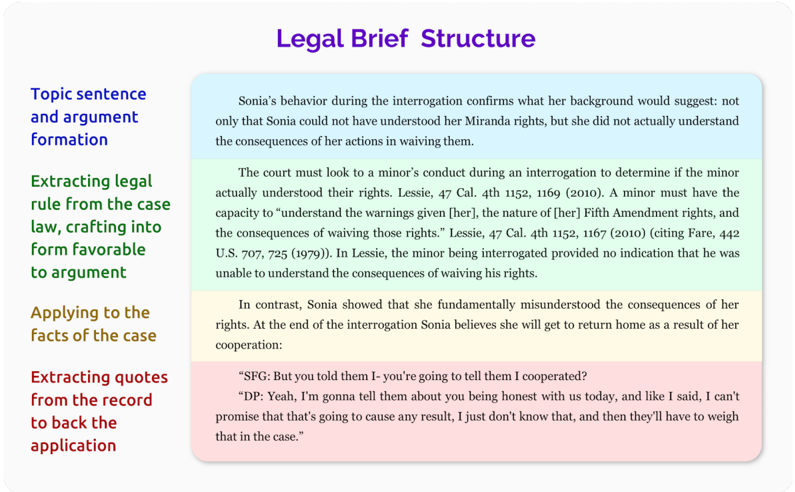
The image presents a breakdown of the structure of a legal brief, outlining the key components and their purpose. It uses color-coding to associate each component with a description and example.
### Components/Axes
* **Title:** Legal Brief Structure (located at the top-center of the image)
* **Left Column:** This column lists the structural components of a legal brief.
* Topic sentence and argument formation (top-left, green text)
* Extracting legal rule from the case law, crafting into form favorable to argument (mid-left, green text)
* Applying to the facts of the case (bottom-left, green text)
* Extracting quotes from the record to back the application (bottom-left, green text)
* **Right Column:** This column provides descriptions and examples for each component, with background colors corresponding to the left column.
* Top-right: Light blue background
* Mid-right: Light green background
* Bottom-right: Light yellow background
* Bottom-right: Light red background
### Detailed Analysis or ### Content Details
* **Topic sentence and argument formation (Light Blue Background):**
* "Sonia's behavior during the interrogation confirms what her background would suggest: not only that Sonia could not have understood her Miranda rights, but she did not actually understand the consequences of her actions in waiving them."
* **Extracting legal rule from the case law, crafting into form favorable to argument (Light Green Background):**
* "The court must look to a minor's conduct during an interrogation to determine if the minor actually understood their rights. Lessie, 47 Cal. 4th 1152, 1169 (2010). A minor must have the capacity to 'understand the warnings given [her], the nature of [her] Fifth Amendment rights, and the consequences of waiving those rights.' Lessie, 47 Cal. 4th 1152, 1167 (2010) (citing Fare, 442 U.S. 707, 725 (1979)). In Lessie, the minor being interrogated provided no indication that he was unable to understand the consequences of waiving his rights."
* **Applying to the facts of the case (Light Yellow Background):**
* "In contrast, Sonia showed that she fundamentally misunderstood the consequences of her rights. At the end of the interrogation Sonia believes she will get to return home as a result of her cooperation:"
* **Extracting quotes from the record to back the application (Light Red Background):**
* "SFG: But you told them I- you're going to tell them I cooperated?"
* "DP: Yeah, I'm gonna tell them about you being honest with us today, and like I said, I can't promise that that's going to cause any result, I just don't know that, and then they'll have to weigh that in the case."
### Key Observations
* The diagram uses a simple color-coding scheme to link the structural components of a legal brief with their corresponding descriptions and examples.
* The examples provided are specific to a case involving an individual named Sonia and her interrogation.
* The legal rules cited include case law references (e.g., Lessie, Fare).
### Interpretation
The diagram serves as a visual guide to understanding the structure of a legal brief. It highlights the importance of using topic sentences, extracting relevant legal rules, applying those rules to the facts of the case, and supporting the application with quotes from the record. The example provided illustrates how these components might be applied in a specific legal argument. The structure emphasizes a logical progression from general legal principles to specific case details, aiming to build a persuasive argument.