\n
## Document: Legal Brief Structure
### Overview
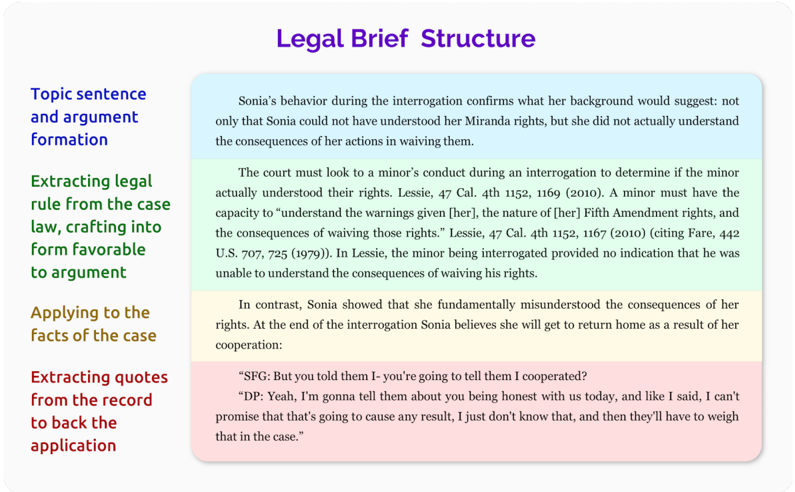
The image presents a document outlining the structure of a legal brief, specifically focusing on how to build an argument based on case law and evidence. It's a text-heavy document with four main sections highlighted in a light blue color. The document includes a short dialogue excerpt.
### Components/Axes
The document is structured into four main sections, each with a descriptive title in bold, dark blue text:
1. **Topic sentence and argument formation**
2. **Extracting legal rule from the case law, crafting into form favorable to argument**
3. **Applying to the facts of the case**
4. **Extracting quotes from the record to back the application**
The document also contains legal citations (e.g., *Lessie, 47 Cal. 4th 1152, 1169 (2010)*, *Faire, 442 U.S. 707, 725 (1979)*).
### Content Details
Here's a transcription of the text within the document:
"Sonia’s behavior during the interrogation confirms what her background would suggest: not only that Sonia could not have understood her Miranda rights, but she did not actually understand the consequences of her actions in waiving them.
The court must look to a minor’s conduct during an interrogation to determine if the minor actually understood their rights. *Lessie, 47 Cal. 4th 1152, 1169 (2010)*. A minor must have the capacity to “understand the warnings given [her], the nature of [her] Fifth Amendment rights, and the consequences of waiving those rights.” *Lessie, 47 Cal. 4th 1152, 1167 (2010)* (citing *Faire, 442 U.S. 707, 725 (1979)*)). In *Lessie*, the minor being interrogated provided no indication that he was unable to understand the consequences of waiving his rights.
In contrast, Sonia showed that she fundamentally misunderstood the consequences of her rights. At the end of the interrogation Sonia believes she will get to return home as a result of her cooperation:
“SFG: But you told them I- you’re going to tell them I cooperated?”
“DP: Yeah, I’m gonna tell them about you being honest with us today, and like I said, I can’t promise that that’s going to cause any result, I just don’t know that, and then they’ll have to weigh that in the case.”"
### Key Observations
The document emphasizes the importance of demonstrating a defendant's (Sonia's) lack of understanding of their rights, particularly Miranda rights, and the consequences of waiving those rights. It highlights the legal precedent set by the *Lessie* and *Faire* cases. The dialogue excerpt illustrates Sonia's misunderstanding – she believes cooperation will lead to going home, suggesting she did not fully grasp the legal implications of her statements.
### Interpretation
This document outlines a legal strategy for arguing that a minor's waiver of rights was not knowing and voluntary. The structure presented is a logical progression: establishing the argument, grounding it in legal precedent, applying it to the specific facts of the case, and supporting it with direct evidence from the record (the interrogation transcript). The *Lessie* and *Faire* cases are used as benchmarks for determining whether a minor possesses the capacity to understand their rights. The dialogue is crucial because it provides direct evidence of the defendant's flawed understanding. The document suggests a focus on the subjective understanding of the defendant, rather than simply whether the warnings were given. The document is a guide for constructing a persuasive legal argument, not a presentation of facts or data in the traditional sense.