## Diagram: Legal Brief Structure
### Overview
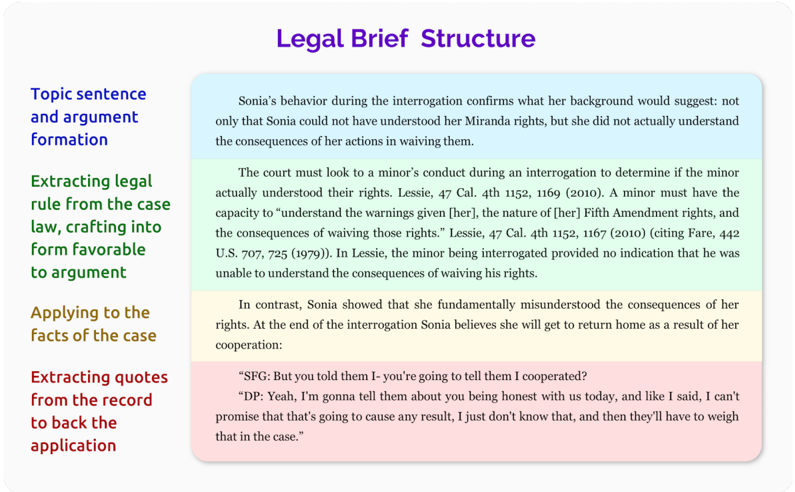
The image is a structured diagram illustrating the components of a legal brief, using a specific example about a minor named Sonia and her understanding of Miranda rights during an interrogation. The diagram is organized into four labeled sections on the left, each connected to a corresponding block of explanatory text on the right. The title "Legal Brief Structure" is prominently displayed at the top center in purple text.
### Components/Axes
The diagram is divided into two main columns:
1. **Left Column (Labels):** Contains four vertically stacked, color-coded labels that describe the steps in constructing a legal argument.
2. **Right Column (Content Blocks):** Contains four corresponding text blocks with background colors matching their labels. These blocks contain the substantive legal analysis and evidence.
**Labels (Left Column, Top to Bottom):**
1. **Label 1 (Blue Text):** "Topic sentence and argument formation"
2. **Label 2 (Green Text):** "Extracting legal rule from the case law, crafting into form favorable to argument"
3. **Label 3 (Orange Text):** "Applying to the facts of the case"
4. **Label 4 (Red Text):** "Extracting quotes from the record to back the application"
**Content Blocks (Right Column, Top to Bottom):**
* **Block 1 (Light Blue Background):** Corresponds to Label 1.
* **Block 2 (Light Green Background):** Corresponds to Label 2.
* **Block 3 (Light Orange Background):** Corresponds to Label 3.
* **Block 4 (Light Pink/Red Background):** Corresponds to Label 4.
### Detailed Analysis / Content Details
**Block 1 Content (Topic Sentence & Argument):**
"Sonia's behavior during the interrogation confirms what her background would suggest: not only that Sonia could not have understood her Miranda rights, but she did not actually understand the consequences of her actions in waiving them."
**Block 2 Content (Legal Rule Extraction):**
"The court must look to a minor's conduct during an interrogation to determine if the minor actually understood their rights. *Lesie, 47 Cal. 4th 152, 1169 (2010)*. A minor must have the capacity to "understand the warnings given [her], the nature of [her] Fifth Amendment rights, and the consequences of waiving those rights." *Lesie, 47 Cal. 4th 1152, 1167 (2010)* (citing *Fare, 442 U.S. 707, 725 (1979)*). In *Lesie*, the minor being interrogated provided no indication that he was unable to understand the consequences of waiving his rights."
**Block 3 Content (Application to Facts):**
"In contrast, Sonia showed that she fundamentally misunderstood the consequences of her rights. At the end of the interrogation Sonia believes she will get to return home as a result of her cooperation:"
**Block 4 Content (Supporting Quotes):**
"SFG: But you told them I- you're going to tell them I cooperated?
DP: Yeah, I'm gonna tell them about you being honest with us today, and like I said, I can't promise that that's going to cause any result, I just don't know that, and then they'll have to weigh that in the case."
### Key Observations
1. **Visual Structure:** The diagram uses a clear, color-coded, two-column layout to map abstract legal reasoning steps (left) to concrete textual examples (right).
2. **Legal Citations:** The text in Block 2 cites specific California and U.S. Supreme Court cases (*Lesie* and *Fare*) to establish the legal standard for a minor's waiver of rights.
3. **Contrast Argument:** The brief constructs its argument by contrasting the legal standard (from *Lesie*, where the minor understood the consequences) with the facts of Sonia's case (where she demonstrably did not understand).
4. **Evidence Type:** The final piece of evidence is a direct transcript quote from the interrogation record, showing Sonia's misplaced belief that cooperation would guarantee her return home.
### Interpretation
This diagram serves as a pedagogical or template tool demonstrating the logical flow of constructing a persuasive legal argument within a brief. It moves from a general thesis (Sonia didn't understand her rights) to the governing legal rule, then applies that rule to the specific facts, and finally anchors the application in direct evidence from the record.
The **Peircean investigative reading** reveals the underlying structure of legal reasoning:
* **The Rule (Legisign):** The cited cases (*Lesie*, *Fare*) represent the general, symbolic rule of law.
* **The Application (Sinsign):** The specific facts of Sonia's interrogation and her statement are the unique, existential instances to which the rule is applied.
* **The Argument (Argument):** The brief itself is the interpretive argument that connects the rule to the facts, asserting that Sonia's case is an instance of the rule's violation. The diagram makes this connective tissue visible.
The notable anomaly or persuasive hook is the final quote. It is not just an example of misunderstanding; it reveals a specific, consequential misunderstanding (confusing cooperation with a guaranteed outcome) that directly relates to the "consequences of waiving rights" standard from the legal rule. This tight linkage between the legal standard and the factual evidence is the core of the argument's strength.