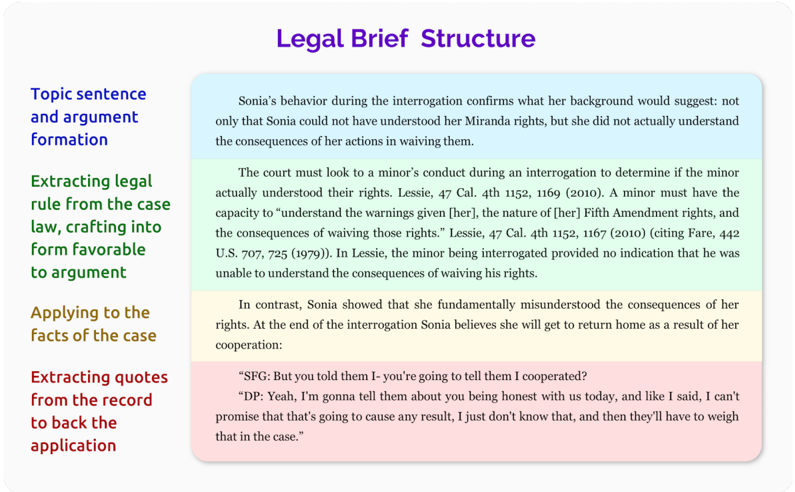
## Screenshot: Legal Brief Structure
### Overview
The image depicts a structured legal brief template divided into four color-coded sections, each with a heading and explanatory text. The layout emphasizes clarity through color differentiation and hierarchical formatting (bold headings, italicized case citations).
### Components/Axes
- **Headings**: Bold, black text with specific legal terminology.
- **Content**: Paragraphs in plain text, referencing case law (e.g., *Leslie v. Florida*, *Sonia v. State*).
- **Color Coding**:
- **Blue**: "Topic sentence and argument formation"
- **Green**: "Extracting legal rule from the case law..."
- **Yellow**: "Applying to the facts of the case"
- **Pink**: "Extracting quotes from the record..."
### Detailed Analysis
1. **Topic Sentence and Argument Formation (Blue)**
- Text: "Sonia’s behavior during the interrogation confirms what her background would suggest: not only that Sonia could not have understood her Miranda rights, but she did not actually understand the consequences of her actions in waiving them."
- Key Elements: Focuses on establishing a foundational argument about Sonia’s lack of understanding.
2. **Extracting Legal Rule (Green)**
- Text: "The court must look to a minor’s conduct during an interrogation to determine if the minor actually understood their rights... A minor must have the capacity to ‘understand the warnings given...’"
- Case Law: Cites *Leslie v. Florida* (47 Cal. 4th 1152, 2010) and *Fare v. Michigan* (442 U.S. 707, 1979).
3. **Applying to the Facts (Yellow)**
- Text: "In contrast, Sonia showed that she fundamentally misunderstood the consequences of her rights... At the end of the interrogation Sonia believes she will get to return home as a result of her cooperation."
- Key Elements: Contrasts Sonia’s case with general legal standards, emphasizing her flawed understanding.
4. **Extracting Quotes (Pink)**
- Text: Direct quotes from the record:
- "SFG: But you told them I- you’re going to tell them I cooperated?"
- "DP: Yeah, I’m gonna tell them about you being honest with us today... I can’t promise that that’s going to cause any result..."
- Key Elements: Uses verbatim dialogue to substantiate Sonia’s lack of comprehension.
### Key Observations
- **Color Consistency**: Each section’s color matches its heading, aiding visual navigation.
- **Legal Precision**: Citations include full case names, reporters, and years (e.g., *Leslie*, 47 Cal. 4th 1152, 2010).
- **Contrastive Structure**: The yellow section explicitly contrasts Sonia’s case with broader legal principles.
### Interpretation
The document outlines a methodical approach to constructing a legal argument, emphasizing:
1. **Foundational Argument**: Establishing Sonia’s lack of understanding (blue section).
2. **Legal Framework**: Citing precedents to define "understanding" of rights (green section).
3. **Fact Application**: Demonstrating how Sonia’s actions deviate from legal standards (yellow section).
4. **Evidence**: Using direct quotes to anchor the argument in the record (pink section).
The structure suggests a deliberate strategy to build a persuasive case by aligning factual details with legal doctrine, leveraging color and formatting to enhance readability and logical flow.