\n
## Diagram: Pattern Recognition/Transformation
### Overview
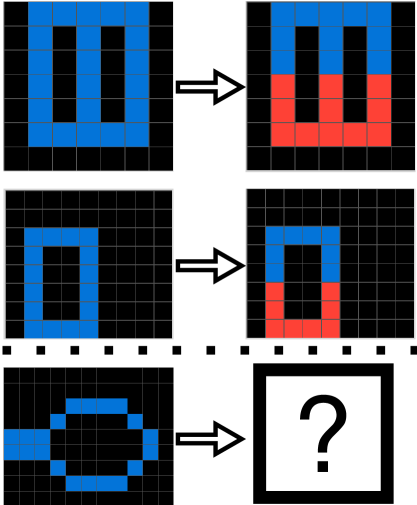
The image presents a visual pattern recognition problem. It shows three pairs of 8x8 pixel grids. In the first two pairs, a blue shape is transformed into a red shape. The third pair shows a blue shape and a question mark, implying the task is to predict the corresponding red shape. The grids are arranged in three rows, with the initial blue shape on the left and the transformed red shape on the right, separated by a right-pointing arrow.
### Components/Axes
There are no explicit axes or scales. The components are:
* **Blue Shapes:** Represent the initial state.
* **Red Shapes:** Represent the transformed state.
* **Arrows:** Indicate the transformation process.
* **Question Mark:** Represents the unknown transformed state.
* **Grid:** Each shape is displayed on an 8x8 grid of squares.
### Detailed Analysis or Content Details
Let's analyze the transformations:
* **Row 1:** The initial blue shape resembles the letter "U". The transformed red shape also resembles a "U", but with the interior filled in. The transformation appears to be filling the enclosed space with red.
* **Row 2:** The initial blue shape is a hollow square. The transformed red shape is a solid square. The transformation appears to be filling the enclosed space with red.
* **Row 3:** The initial blue shape is a "C". The question mark indicates the expected transformation. Based on the previous two examples, we can infer that the transformed shape should be a solid "C", filled with red.
### Key Observations
The transformation consistently involves filling the enclosed space of the initial blue shape with red. The shapes are relatively simple geometric forms. The pattern is consistent across the first two examples.
### Interpretation
The diagram demonstrates a simple pattern recognition task. The underlying principle is to identify the enclosed space within a shape and fill it with a different color. The question mark suggests a test of the observer's ability to extrapolate this pattern to a new shape. The diagram is likely used to assess visual reasoning or pattern completion skills. The consistent application of the "fill enclosed space" rule suggests a deterministic transformation. The use of simple shapes and colors makes the pattern easily discernible. The diagram is a visual analogy for a logical operation or algorithm.