## Diagram: Grid-Based Puzzle Level Layout
### Overview
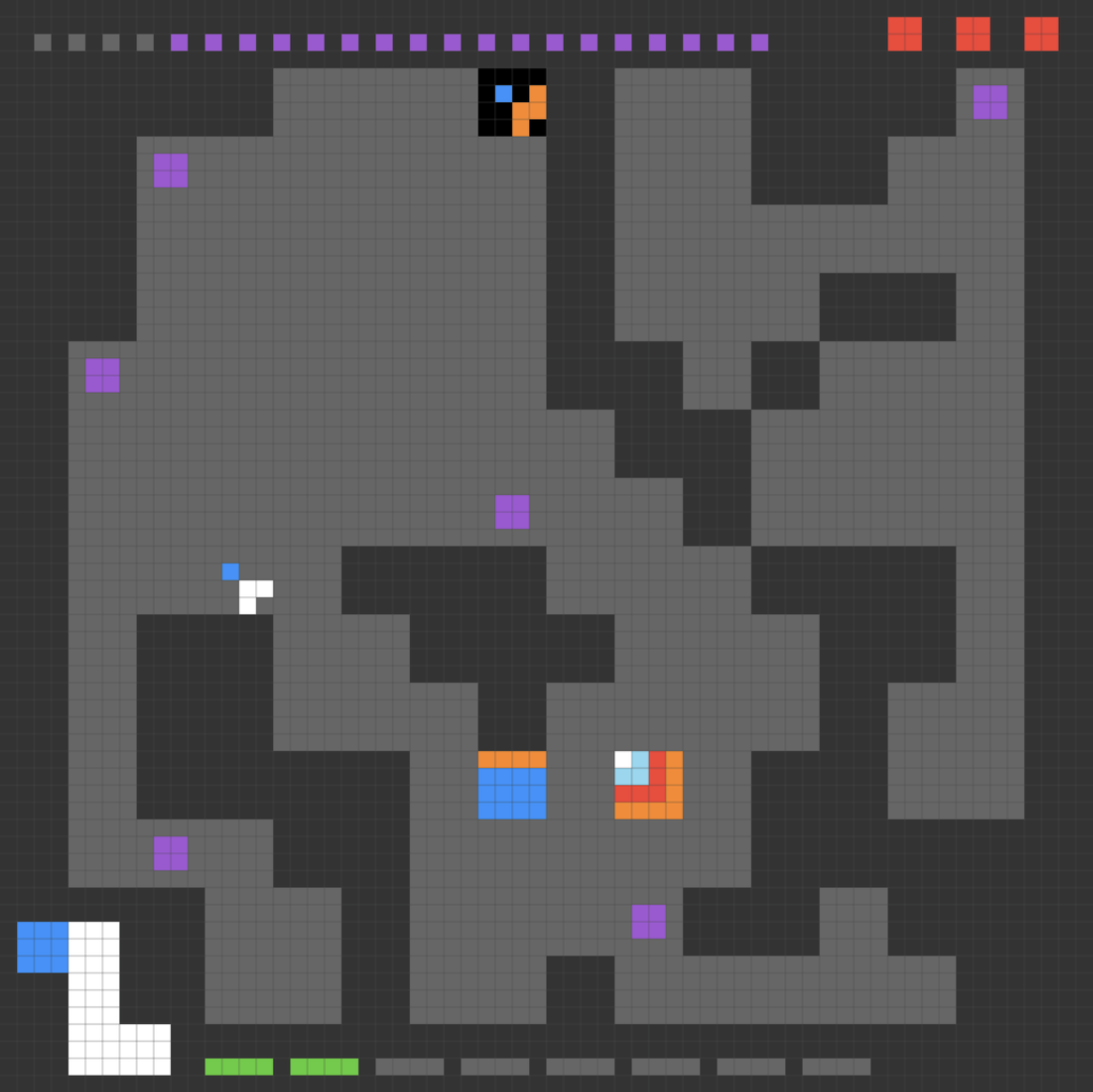
The image depicts a top-down, grid-based puzzle level, characteristic of logic-based video games (e.g., *Baba Is You* or similar block-pushing puzzle games). The environment consists of a dark grey background with lighter grey walkable paths defined by walls. Various colored blocks and shapes are distributed throughout the map, and there are status bars at the top and bottom of the frame.
### Components/Axes
* **Grid System:** The entire map is constructed on a uniform square grid.
* **Walls:** Represented by the dark grey areas. These appear to be impassable boundaries.
* **Walkable Space:** Represented by the lighter grey areas.
* **Status Bars:**
* **Top Bar:** A horizontal sequence of squares spanning the width of the map.
* **Bottom Bar:** A horizontal sequence of squares spanning the width of the map.
* **Interactive Objects:**
* **Purple Squares:** Scattered throughout the map.
* **White L-Shaped Blocks:** Located on the left side.
* **Blue and Orange Squares:** Located in the center and top-center.
* **Red Squares:** Located in the top-right corner.
### Detailed Analysis
#### 1. Status Bars
* **Top Bar (Header):** A horizontal row of squares positioned at the very top of the grid.
* **Composition:** 6 grey squares, followed by 25 purple squares, followed by 3 red squares.
* **Bottom Bar (Footer):** A horizontal row of squares positioned at the very bottom of the grid.
* **Composition:** 2 green squares, followed by 8 grey squares.
#### 2. Interactive Objects (Spatial Grounding)
* **Top-Center:** A 2x2 black block containing a blue square (top-left quadrant of the block) and an orange square (bottom-right quadrant of the block).
* **Top-Right:** A cluster of 3 red squares arranged horizontally.
* **Middle-Left:** A white L-shaped object consisting of 3 blocks (2 vertical, 1 horizontal).
* **Center:** A blue square and an orange square positioned adjacent to each other (blue on the left, orange on the right).
* **Bottom-Left:** A large white L-shaped object consisting of 5 blocks (3 vertical, 2 horizontal).
* **Scattered Purple Squares:** These are distributed as follows:
* One in the top-left quadrant.
* One in the mid-left quadrant.
* One in the center-left.
* One in the center (near the wall).
* One in the bottom-center.
* One in the top-right area.
#### 3. Map Layout (Walls vs. Paths)
* The map is a maze-like structure.
* The central area is dominated by a large, dark grey wall mass that forces movement around the perimeter or through specific corridors.
* The layout is asymmetrical, suggesting a specific pathing requirement to solve the puzzle.
### Key Observations
* **Color Coding:** The colors likely represent specific game mechanics (e.g., "pushable," "hazard," "goal," or "key").
* **Progress Tracking:** The top and bottom bars likely function as a progress tracker or an inventory display, where the colors correspond to the objects found or objectives completed within the level.
* **Object Pairing:** The presence of blue/orange pairs in both the top-center and the middle of the map suggests a relationship between these objects, possibly requiring them to be moved to specific locations.
* **L-Shaped Blocks:** The two white L-shaped blocks are the largest objects in the level, suggesting they may be obstacles or tools that require specific maneuvering.
### Interpretation
This image represents a static state of a logic puzzle level. The data suggests a "block-pushing" or "sokoban-style" game.
* **Mechanics:** The player likely controls an entity (not explicitly visible, or perhaps represented by one of the blocks) to manipulate the colored squares.
* **Objective:** The goal is likely to clear the level by moving the colored blocks into specific configurations or by collecting them. The top bar, which contains a large number of purple squares, suggests that collecting or interacting with purple squares is a primary objective.
* **Complexity:** The maze-like wall structure indicates that the difficulty lies in navigating the objects through narrow corridors without getting them stuck against walls. The distinct separation of the blue/orange pair in the center versus the top-center suggests a "matching" or "transport" mechanic is required to solve the level.