## Screenshot: Retro-Style Maze Game Interface
### Overview
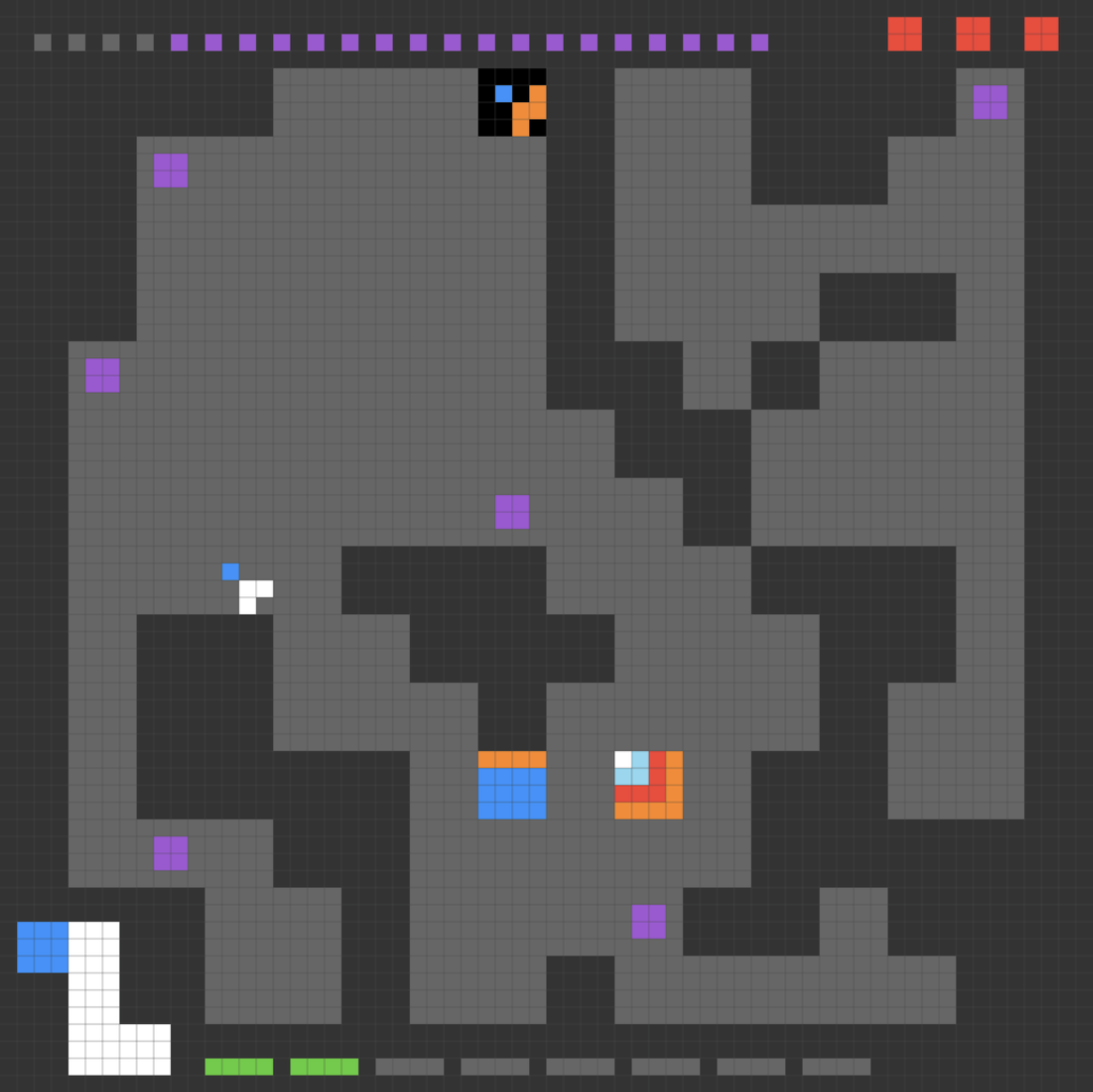
The image depicts a pixelated, grid-based maze environment characteristic of early arcade games (e.g., Pac-Man-inspired). The layout includes colored blocks, pathways, and game elements arranged in a structured grid. No textual labels, legends, or axis titles are visible.
### Components/Axes
- **Grid Structure**: A dark gray grid overlays the entire screen, dividing the maze into discrete cells.
- **Color-Coded Elements**:
- **Purple Squares**: Scattered throughout the maze (e.g., top-left, center, bottom-right).
- **Red Squares**: Clustered in the top-right corner.
- **Blue Square**: Located near the top-center, adjacent to a black block.
- **Orange Squares**: Positioned in the bottom-center, forming a small cluster.
- **White Squares**: Found in the bottom-left corner, adjacent to a blue square.
- **Green Rectangles**: Two horizontal bars at the bottom of the screen.
- **Player/Character**: A small white block with a blue square atop it, positioned near the bottom-left.
### Detailed Analysis
- **Grid Dimensions**: The maze spans approximately 15x15 grid cells (estimated based on visible rows/columns).
- **Pathways**: Black blocks form walls, creating a labyrinthine structure. Open paths are represented by gray grid cells.
- **Color Distribution**:
- Purple squares: 5 total (top-left, center, bottom-right, and two others).
- Red squares: 3 in the top-right cluster.
- Blue square: 1 near the top-center.
- Orange squares: 3 in the bottom-center.
- White squares: 2 in the bottom-left.
- Green rectangles: 2 at the bottom edge.
### Key Observations
- **Objective Indicators**: Purple squares may represent collectibles or objectives, common in maze games.
- **Hazards/Enemies**: Red squares could denote enemies or obstacles, given their clustering.
- **Player Position**: The white/blue block in the bottom-left suggests the player’s starting point or current location.
- **Green Rectangles**: Likely represent a status bar, score counter, or timer (common UI elements in retro games).
### Interpretation
The image represents a simplified maze game environment where the player (white/blue block) must navigate through pathways (gray cells) to collect purple squares while avoiding red squares (potential enemies). The green rectangles at the bottom likely track game metrics (e.g., score, lives). The absence of text suggests this is either a prototype, a minimalist design, or a screenshot from a game where UI elements are implied rather than explicitly labeled. The grid-based design emphasizes spatial reasoning and pathfinding, core mechanics in such games.
## No textual data (labels, legends, axis titles) is present in the image. All analysis is based on visual elements and positional relationships.