## Diagram: 5x5 Grid with Numerical Entries
### Overview
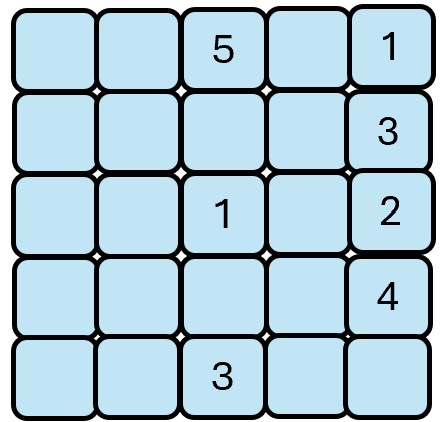
The image displays a 5x5 grid of light blue squares with rounded corners and black outlines. Some of the squares contain single-digit numbers, while others are empty. The grid is presented on a plain white background.
### Components/Axes
* **Structure:** A 5x5 matrix of squares.
* **Visual Style:** Each square is filled with a uniform light blue color and has a distinct black border.
* **Content:** Numerical digits are centered within specific squares. The numbers are in a standard, black, sans-serif font.
* **Legend/Axes:** Not applicable. This is a diagram, not a chart with axes or a legend.
### Detailed Analysis
The grid can be described by its rows (1-5, top to bottom) and columns (1-5, left to right). The following table lists the content of each cell:
| Row | Column 1 | Column 2 | Column 3 | Column 4 | Column 5 |
| :-- | :------- | :------- | :------- | :------- | :------- |
| **1** | (empty) | (empty) | **5** | (empty) | **1** |
| **2** | (empty) | (empty) | (empty) | (empty) | **3** |
| **3** | (empty) | (empty) | **1** | (empty) | **2** |
| **4** | (empty) | (empty) | (empty) | (empty) | **4** |
| **5** | (empty) | (empty) | **3** | (empty) | (empty) |
**Spatial Grounding:**
* The number **5** is located in the top row, center column (Row 1, Column 3).
* The number **1** appears twice: in the top-right corner (Row 1, Column 5) and in the center of the grid (Row 3, Column 3).
* The number **3** appears twice: in the second row, rightmost column (Row 2, Column 5) and in the bottom row, center column (Row 5, Column 3).
* The number **2** is in the third row, rightmost column (Row 3, Column 5).
* The number **4** is in the fourth row, rightmost column (Row 4, Column 5).
* All other squares (17 out of 25) are empty.
### Key Observations
1. **Distribution:** The numbers are not randomly scattered. They are concentrated in the **center column (Column 3)** and the **rightmost column (Column 5)**.
2. **Column 3 Pattern:** Contains the numbers 5, 1, and 3 in rows 1, 3, and 5 respectively, creating a vertical sequence with gaps.
3. **Column 5 Pattern:** Contains the numbers 1, 3, 2, and 4 in rows 1, 2, 3, and 4 respectively, forming a nearly complete vertical sequence from top to bottom.
4. **Empty Columns:** Columns 1, 2, and 4 are entirely empty.
5. **Repetition:** The numbers 1 and 3 each appear twice within the grid.
### Interpretation
This diagram presents a sparse data matrix. The arrangement suggests it could be:
* A **partial representation of a larger dataset**, where only specific cells are populated.
* A **visual puzzle or game state** (e.g., a logic puzzle, a Sudoku-like grid in progress, or a memory game).
* A **schematic for a physical layout**, where the numbers label specific positions or items in a 5x5 array.
The clustering of data in Columns 3 and 5 is the most significant pattern. It implies that whatever system or data this grid represents has activity or defined values primarily along these two vertical axes. The empty columns (1, 2, 4) represent inactive or undefined zones. The repetition of numbers (1 and 3) indicates these values have multiple instances or occurrences within the defined structure. Without additional context, the specific meaning of the numbers (e.g., counts, identifiers, priorities) cannot be determined, but their spatial relationship is clearly defined.