## Line Chart: EGA vs Episode
### Overview
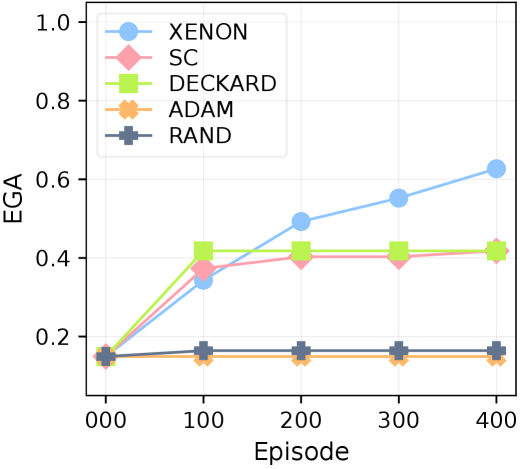
The image is a line chart comparing the performance of five different algorithms (XENON, SC, DECKARD, ADAM, and RAND) over a series of episodes. The y-axis represents EGA (likely a performance metric), and the x-axis represents the episode number. The chart shows how the EGA value changes for each algorithm as the number of episodes increases.
### Components/Axes
* **Title:** There is no explicit title on the chart.
* **X-axis:**
* Label: "Episode"
* Scale: 000, 100, 200, 300, 400
* **Y-axis:**
* Label: "EGA"
* Scale: 0.2, 0.4, 0.6, 0.8, 1.0
* **Legend:** Located in the top-left corner.
* XENON (light blue line with circle markers)
* SC (light pink line with diamond markers)
* DECKARD (light green line with square markers)
* ADAM (light orange line with asterisk-like markers)
* RAND (dark gray line with plus-like markers)
### Detailed Analysis
* **XENON (light blue line with circle markers):** The line starts at approximately 0.15 EGA at episode 0, increases to approximately 0.35 at episode 100, then to approximately 0.5 at episode 200, then to approximately 0.55 at episode 300, and finally reaches approximately 0.63 at episode 400. The trend is generally upward.
* **SC (light pink line with diamond markers):** The line starts at approximately 0.15 EGA at episode 0, increases to approximately 0.38 at episode 100, then remains relatively constant at approximately 0.4 at episodes 200, 300, and 400.
* **DECKARD (light green line with square markers):** The line starts at approximately 0.15 EGA at episode 0, increases to approximately 0.42 at episode 100, then remains relatively constant at approximately 0.42 at episodes 200, 300, and 400.
* **ADAM (light orange line with asterisk-like markers):** The line starts at approximately 0.15 EGA at episode 0 and remains relatively constant at approximately 0.15 across all episodes (100, 200, 300, 400).
* **RAND (dark gray line with plus-like markers):** The line starts at approximately 0.15 EGA at episode 0 and remains relatively constant at approximately 0.16 across all episodes (100, 200, 300, 400).
### Key Observations
* XENON shows the most significant improvement in EGA as the number of episodes increases.
* SC and DECKARD show a significant initial increase in EGA but then plateau.
* ADAM and RAND show very little change in EGA across all episodes.
* All algorithms start at approximately the same EGA value at episode 0.
### Interpretation
The chart demonstrates the learning performance of different algorithms over a series of episodes. XENON appears to be the most effective algorithm, as it shows the greatest improvement in EGA as the number of episodes increases. SC and DECKARD show some initial learning but then plateau, suggesting they may have reached their performance limit or require further tuning. ADAM and RAND show very little learning, indicating they may not be suitable for this particular task or require significant modifications. The fact that all algorithms start at approximately the same EGA value suggests a fair comparison at the beginning of the training process.