## Diagram: Model Predictions vs Ground Truth Sequence
### Overview
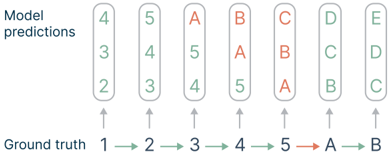
The diagram compares a sequence of model predictions against a ground truth sequence, visualized through vertical bars and directional arrows. The model predictions deviate from the ground truth in both numerical and categorical values, with color-coded discrepancies highlighted.
### Components/Axes
- **Left Section**: "Model predictions" labeled at the top.
- **Right Section**: "Ground truth" labeled at the bottom.
- **Vertical Bars**:
- Model predictions use green numbers (2-5) and red letters (A-E).
- Ground truth uses sequential numbers (1-5) and letters (A-B).
- **Arrows**:
- Green arrows indicate correct transitions in the ground truth.
- Red arrows in the model predictions highlight incorrect transitions.
### Detailed Analysis
1. **Model Predictions**:
- **Steps 1-3**: Predicts 4 → 3 → 2 (incorrect, ground truth is 1 → 2 → 3).
- **Steps 4-5**: Predicts 5 → 4 → 3 (incorrect, ground truth is 4 → 5).
- **Steps 6-7**: Predicts A → B → C → D → E (incorrect, ground truth is A → B).
- **Color Coding**: Red letters (A-E) in model predictions suggest errors or out-of-sequence predictions.
2. **Ground Truth**:
- Linear progression: 1 → 2 → 3 → 4 → 5 → A → B.
- Arrows are uniformly green, indicating correct transitions.
3. **Discrepancies**:
- **Numerical Errors**: Model overpredicts initial values (4,3,2 instead of 1,2,3).
- **Categorical Errors**: Model predicts additional letters (C, D, E) after B, which are absent in ground truth.
- **Arrow Mismatch**: Model’s red arrows (e.g., 5 → A) conflict with ground truth’s green arrows (4 → 5 → A → B).
### Key Observations
- The model struggles with early numerical predictions, consistently overestimating values.
- After step 5, the model introduces extraneous categories (C, D, E) not present in ground truth.
- Red arrows in the model’s path visually emphasize prediction errors.
### Interpretation
The diagram reveals systematic errors in the model’s ability to:
1. Accurately predict sequential numerical values (steps 1-5).
2. Maintain categorical consistency (steps 6-7).
The red arrows and letters act as visual flags for misaligned predictions, suggesting the model may require retraining or adjustment to better align with the ground truth sequence. The divergence after step 5 indicates a potential failure to generalize beyond the initial numerical phase.