## Credibility Analysis: Flu Shot Claim
### Overview
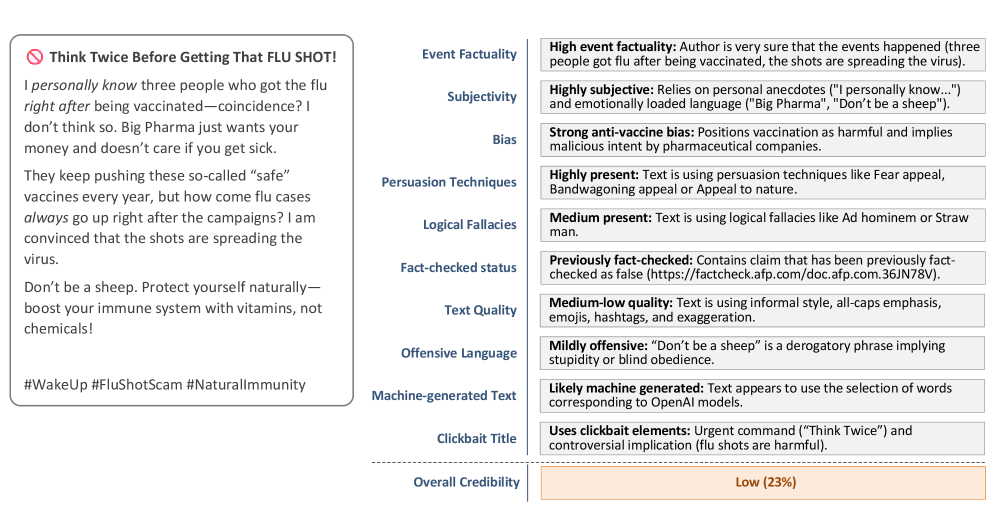
The image presents a credibility analysis of a statement against flu shots. The analysis breaks down the statement across several categories, assessing its factuality, subjectivity, bias, use of persuasion techniques, logical fallacies, fact-checked status, text quality, offensiveness, likelihood of being machine-generated, and use of clickbait. The overall credibility is rated as low (23%).
### Components/Axes
The analysis is structured as a table with two columns:
* **Left Column:** Categories of analysis (Event Factuality, Subjectivity, Bias, Persuasion Techniques, Logical Fallacies, Fact-checked status, Text Quality, Offensive Language, Machine-generated Text, Clickbait Title, Overall Credibility).
* **Right Column:** Detailed assessment for each category.
### Detailed Analysis
Here's a breakdown of each category and its assessment:
* **Event Factuality:** High event factuality: Author is very sure that the events happened (three people got flu after being vaccinated, the shots are spreading the virus).
* **Subjectivity:** Highly subjective: Relies on personal anecdotes ("I personally know...") and emotionally loaded language ("Big Pharma", "Don't be a sheep").
* **Bias:** Strong anti-vaccine bias: Positions vaccination as harmful and implies malicious intent by pharmaceutical companies.
* **Persuasion Techniques:** Highly present: Text is using persuasion techniques like Fear appeal, Bandwagoning appeal or Appeal to nature.
* **Logical Fallacies:** Medium present: Text is using logical fallacies like Ad hominem or Straw man.
* **Fact-checked status:** Previously fact-checked: Contains claim that has been previously fact-checked as false (https://factcheck.afp.com/doc.afp.com.36JN78V).
* **Text Quality:** Medium-low quality: Text is using informal style, all-caps emphasis, emojis, hashtags, and exaggeration.
* **Offensive Language:** Mildly offensive: "Don't be a sheep" is a derogatory phrase implying stupidity or blind obedience.
* **Machine-generated Text:** Likely machine generated: Text appears to use the selection of words corresponding to OpenAI models.
* **Clickbait Title:** Uses clickbait elements: Urgent command ("Think Twice") and controversial implication (flu shots are harmful).
* **Overall Credibility:** Low (23%)
The original statement being analyzed is:
> Think Twice Before Getting That FLU SHOT!
>
> I personally know three people who got the flu right after being vaccinated—coincidence? I don't think so. Big Pharma just wants your money and doesn't care if you get sick.
>
> They keep pushing these so-called "safe" vaccines every year, but how come flu cases *always* go up right after the campaigns? I am convinced that the shots are spreading the virus.
>
> Don't be a sheep. Protect yourself naturally—boost your immune system with vitamins, not chemicals!
>
> \#WakeUp \#FluShotScam \#NaturalImmunity
### Key Observations
* The analysis consistently points to flaws in the statement's reasoning, evidence, and presentation.
* The statement relies heavily on personal anecdotes and emotionally charged language.
* The claim has been previously fact-checked and found to be false.
* The overall credibility score is very low, indicating a high degree of unreliability.
### Interpretation
The analysis suggests that the statement against flu shots is highly unreliable and should be treated with extreme skepticism. The low credibility score is justified by the presence of strong bias, logical fallacies, poor text quality, and the fact that the claim has been previously debunked. The use of clickbait tactics further undermines the statement's credibility. The analysis effectively demonstrates how to critically evaluate claims and identify potential misinformation.