## Analysis of a Social Media Post Credibility Assessment
### Overview
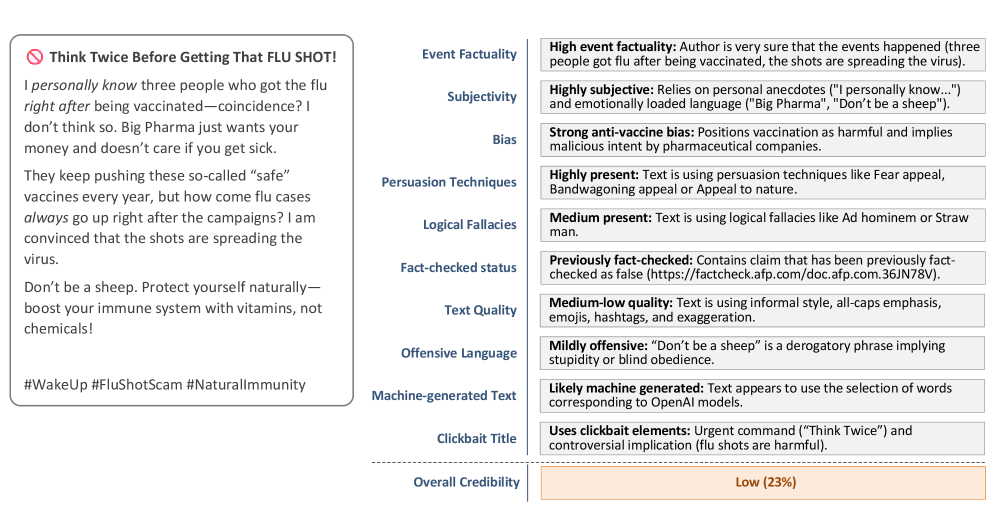
The image presents a structured credibility analysis of a social media post advocating against flu vaccination. It displays the original post text on the left and a detailed breakdown of its rhetorical and factual characteristics across multiple evaluation categories on the right, culminating in an overall credibility score.
### Components
The image is divided into three main vertical sections:
1. **Left Column (Sample Text):** Contains the full text of the social media post being analyzed.
2. **Middle Column (Evaluation Categories):** Lists the criteria used for analysis.
3. **Right Column (Assessment Details):** Provides the specific evaluation for each corresponding category.
### Detailed Analysis / Content Details
**1. Sample Post Text (Left Column):**
* **Title/Headline:** "Think Twice Before Getting That FLU SHOT!" (Preceded by a red "no" or prohibition symbol).
* **Body Text:**
* "I *personally know* three people who got the flu *right after* being vaccinated—coincidence? I don't think so. Big Pharma just wants your money and doesn't care if you get sick."
* "They keep pushing these so-called "safe" vaccines every year, but how come flu cases *always* go up right after the campaigns? I am convinced that the shots are spreading the virus."
* "Don't be a sheep. Protect yourself naturally—boost your immune system with vitamins, not chemicals!"
* **Hashtags:** "#WakeUp #FluShotScam #NaturalImmunity"
**2. Evaluation Categories & Assessments (Middle & Right Columns):**
* **Event Factuality:** "High event factuality: Author is very sure that the events happened (three people got flu after being vaccinated, the shots are spreading the virus)."
* **Subjectivity:** "Highly subjective: Relies on personal anecdotes ("I personally know...") and emotionally loaded language ("Big Pharma", "Don't be a sheep")."
* **Bias:** "Strong anti-vaccine bias: Positions vaccination as harmful and implies malicious intent by pharmaceutical companies."
* **Persuasion Techniques:** "Highly present: Text is using persuasion techniques like Fear appeal, Bandwagoning appeal or Appeal to nature."
* **Logical Fallacies:** "Medium present: Text is using logical fallacies like Ad hominem or Straw man."
* **Fact-checked status:** "Previously fact-checked: Contains claim that has been previously fact-checked as false (https://factcheck.afp.com/doc.afp.com.36JN78V)."
* **Text Quality:** "Medium-low quality: Text is using informal style, all-caps emphasis, emojis, hashtags, and exaggeration."
* **Offensive Language:** "Mildly offensive: "Don't be a sheep" is a derogatory phrase implying stupidity or blind obedience."
* **Machine-generated Text:** "Likely machine generated: Text appears to use the selection of words corresponding to OpenAI models."
* **Clickbait Title:** "Uses clickbait elements: Urgent command ("Think Twice") and controversial implication (flu shots are harmful)."
* **Overall Credibility:** "Low (23%)" (Displayed in an orange-colored bar at the bottom).
### Key Observations
* The analysis identifies a high degree of subjectivity and bias, relying on personal anecdotes and emotionally charged language.
* The post employs multiple persuasion techniques and logical fallacies.
* A specific claim within the post has been previously fact-checked and debunked by an external source (AFP Fact Check).
* The text is flagged as likely machine-generated, suggesting it may not be an organic personal opinion.
* The overall credibility score is quantified as very low (23%).
### Interpretation
This image serves as a technical breakdown of misinformation tactics. It demonstrates how a single piece of content can be deconstructed across multiple analytical dimensions to assess its reliability. The high "Event Factuality" score is notable and potentially misleading; it indicates the author's *certainty* about their claims, not the objective truth of those claims. This highlights a key distinction in misinformation analysis: the difference between the speaker's confidence and factual accuracy.
The analysis suggests the post is a crafted piece of persuasive content designed to evoke fear and distrust ("Fear appeal," "anti-vaccine bias") using common rhetorical shortcuts (logical fallacies, clickbait). The "Machine-generated Text" flag is particularly significant, as it implies the content may be part of a coordinated campaign rather than an individual's genuine concern. The low overall credibility score (23%) synthesizes these findings, indicating the post is highly unreliable and should not be trusted as a source of health information. The structure of the analysis itself provides a model for systematically evaluating online content, moving from surface-level text to underlying persuasive strategies and external verification.