## ASCII Diagram: Frame 5 (Ground Impact)
### Overview
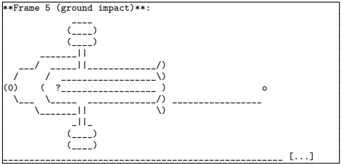
The image displays a technical ASCII art diagram titled "**Frame 5 (ground impact)**". It appears to be a schematic representation from a simulation or analysis, likely depicting the state of an object or system at the moment of impact with a ground surface. The diagram uses standard text characters (parentheses, brackets, slashes, underscores, etc.) to create a simplified, side-view schematic.
### Components/Axes
* **Title/Header:** Located at the top center: `**Frame 5 (ground impact)**`.
* **Main Diagram:** A central structure composed of ASCII characters, representing the primary object or system.
* **Ground Line:** A horizontal line of underscores (`_`) at the bottom, representing the ground surface.
* **Annotation:** A question mark (`?`) is embedded within the central structure.
* **Ellipsis:** The symbol `[...]` is present at the bottom-right corner, suggesting continuation or omitted data.
### Detailed Analysis
The diagram can be segmented into the following spatial regions:
**1. Header Region:**
* Contains only the title text.
**2. Main Diagram Region (Center):**
* **Left Side:** A symbol `(o)` is positioned on the far left. This likely represents a wheel, a point of contact, or an initial state marker.
* **Central Structure:** A complex arrangement of characters forms the core object. Key elements include:
* Parentheses `( )` and brackets `[ ]` creating a box-like or chassis structure.
* Forward slashes `/` and backslashes `\` forming angled or deformed sections, possibly indicating crumple zones or impact deformation.
* Vertical bars `|` and equals signs `=` suggesting structural supports or connections.
* A prominent question mark `?` is located within the central mass, slightly left of the diagram's horizontal center. This is a critical annotation, highlighting an area of uncertainty, a point of measurement, or a component under investigation.
* **Right Side:** Dashed lines (`---`) extend from the central structure to the right, terminating in a small circle `o`. This could represent a trajectory, a detached component, or a sensor reading point post-impact.
**3. Ground/Footnote Region:**
* A continuous line of underscores (`_`) runs along the bottom, representing the ground plane upon which impact occurs.
* The ellipsis `[...]` is placed at the far right end of this ground line.
### Key Observations
* **Asymmetry:** The diagram is not symmetrical. The left side features the `(o)` symbol, while the right side has the dashed line and circle, suggesting a directional event (e.g., forward motion leading to impact).
* **Deformation Indicators:** The use of angled slashes (`/`, `\`) within the central structure, as opposed to clean vertical/horizontal lines, strongly implies visual shorthand for deformation, bending, or damage resulting from the ground impact.
* **Focus on Uncertainty:** The embedded `?` is the only alphabetic character within the diagram's body, making it a focal point. It explicitly marks a region of unknown status, data, or critical importance in the analysis of the impact frame.
* **Contextual Frame:** The title "Frame 5" indicates this is one snapshot in a temporal sequence, specifically capturing the "ground impact" event.
### Interpretation
This ASCII diagram is a low-fidelity but information-dense technical sketch, likely used in engineering, physics simulation, or accident reconstruction reports where quick, text-based visualization is needed.
* **What it Demonstrates:** The diagram captures the configuration of a system at the precise moment of ground contact. The deformation cues and the highlighted `?` suggest the analysis is focused on structural response, force distribution, or identifying failure points during impact.
* **Relationship of Elements:** The `(o)` on the left likely denotes the initial point or leading edge. The central mass is the main body experiencing the impact forces, with the `?` pinpointing the area of greatest interest or unknown behavior. The dashed line to the right may show the path of a ejected part or a measurement vector. The ground line provides the essential reference plane for the event.
* **Notable Anomalies:** The primary "anomaly" is the intentionally marked `?`. In a technical context, this is not a flaw in the diagram but a deliberate annotation. It signals to the reader that the state, composition, or data for that specific sub-component is either unknown, variable, or the subject of further investigation in the study from which this frame is taken. The diagram's purpose is likely to frame a question or highlight a problem area rather than to present definitive quantitative data.