## Line Chart: Critic Score Mean Over Training Steps
### Overview
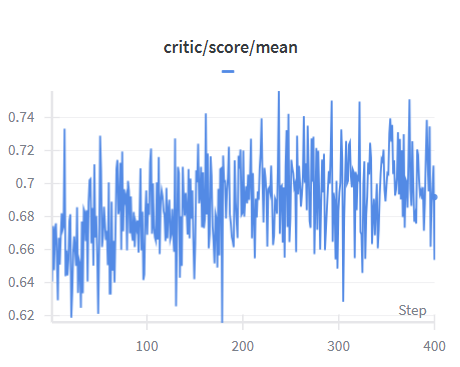
The image displays a line chart tracking the mean critic score over a series of training steps. The chart shows a single, highly volatile data series with a general upward trend. The visual style is minimal, with a light gray grid and a single blue line representing the data.
### Components/Axes
* **Chart Title:** `critic/score/mean` (centered at the top).
* **X-Axis:**
* **Label:** `Step` (positioned at the bottom-right).
* **Scale:** Linear scale from 0 to 400.
* **Major Tick Marks:** Labeled at `100`, `200`, `300`, and `400`.
* **Y-Axis:**
* **Scale:** Linear scale from approximately 0.62 to 0.74.
* **Major Tick Marks:** Labeled at `0.62`, `0.64`, `0.66`, `0.68`, `0.7`, `0.72`, and `0.74`.
* **Legend:** A single entry consisting of a short blue line segment. It is positioned directly below the chart title. There is no accompanying text label for the series.
* **Data Series:** A single, continuous blue line plotted across the entire x-axis range.
### Detailed Analysis
* **Trend Verification:** The blue line exhibits a clear, albeit noisy, upward trend from left (Step 0) to right (Step 400). The volatility is high throughout, with frequent sharp peaks and troughs.
* **Data Point Approximation (Key Points):**
* **Start (Step ~0):** The line begins at approximately `0.66`.
* **Early Trough (Step ~50):** A significant dip occurs, reaching near the `0.62` mark.
* **Mid-Chart Dip (Step ~180):** The most pronounced trough in the series, dropping slightly below the `0.62` grid line.
* **Peak Region 1 (Step ~250):** The line reaches its highest point, approximately `0.745` (slightly above the `0.74` label).
* **Peak Region 2 (Step ~350):** Another major peak, reaching approximately `0.74`.
* **End (Step 400):** The series concludes at a value of approximately `0.69`.
* **Range and Volatility:** The data fluctuates within a range of about `0.125` (from ~0.62 to ~0.745). The line rarely stays at a given level for more than a few steps, indicating high variance in the metric being measured.
### Key Observations
1. **Positive Trend with High Noise:** Despite extreme step-to-step volatility, the overall trajectory of the mean critic score is upward over the 400 steps.
2. **Significant Dips:** Two major downward spikes are visible, one early in the process (~Step 50) and a more severe one near the middle (~Step 180).
3. **Peak Performance in Later Stages:** The highest values are achieved in the second half of the chart, specifically around steps 250 and 350.
4. **Lack of Stabilization:** The metric does not show signs of converging or stabilizing by step 400; volatility remains high.
### Interpretation
This chart likely visualizes a key performance metric from a machine learning training process, specifically the average score provided by a "critic" network (common in reinforcement learning or GANs) over successive training iterations (steps).
* **What the data suggests:** The upward trend indicates that, on average, the critic's evaluation is improving as training progresses. This could mean the primary model is getting better at the task the critic is judging.
* **Relationship between elements:** The high volatility is a critical feature. It suggests the training process is unstable or that the critic's scores are highly sensitive to minor changes in the model or data batches. The severe dip at step 180 could indicate a temporary collapse in performance, a problematic batch of data, or an adjustment in training parameters.
* **Notable anomalies:** The dip below 0.62 at step 180 is the most significant anomaly, representing the worst performance point in the entire series. The fact that the model recovers and later achieves its peak scores suggests resilience in the training process.
* **Underlying meaning:** The chart tells a story of gradual learning amidst chaos. While the end result (a higher mean score) is positive, the path is noisy and unpredictable. This pattern is common in complex model training, where progress is non-linear and subject to setbacks. The lack of stabilization by step 400 implies that further training might yield additional improvements, but also carries the risk of continued instability.