\n
## Diagram: Symbolic Associations of "Hook"
### Overview
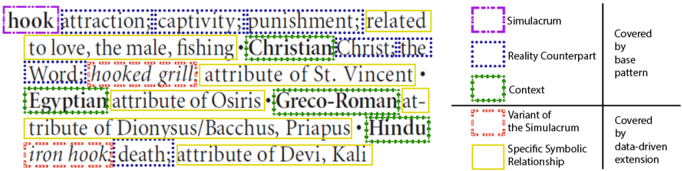
The image presents a diagram illustrating symbolic associations related to the concept of "hook." It consists of a word cloud-like arrangement of terms on the left, color-coded to represent different categories, and a 2x2 matrix on the right defining the relationships between these categories.
### Components/Axes
The diagram is divided into two main sections:
1. **Left Side:** A collection of terms associated with "hook," each enclosed in a colored rectangle.
2. **Right Side:** A 2x2 matrix with the following labels:
* Top-Left: "Simulacrum"
* Top-Right: "Covered by base pattern"
* Bottom-Left: "Context"
* Bottom-Right: "Covered by data-driven extension"
* Middle: "Reality Counterpart"
* Middle: "Variant of the Simulacrum"
* Middle: "Specific Symbolic Relationship"
The color coding on the left side is as follows:
* Purple: "hook"
* Green: Terms related to religious or mythological figures/concepts.
* Red: Terms related to physical objects or actions.
* Yellow: Terms related to death or negative concepts.
### Detailed Analysis or Content Details
**Left Side - Term Associations:**
* **Purple:** "hook" - attraction, captivity, punishment, related to love, the male, fishing.
* **Green:** "Christian" - Christ, the Word, hooked grill, attribute of St. Vincent. "Egyptian" - attribute of Osiris. "Greco-Roman" - attribute of Dionysus/Bacchus, Priapus. "Hindu" - attribute of Devi, Kali.
* **Red:** iron hook.
* **Yellow:** death.
**Right Side - Matrix Relationships:**
The matrix defines relationships between the categories represented by the colors. The terms "Reality Counterpart," "Variant of the Simulacrum," and "Specific Symbolic Relationship" are positioned in the center of the matrix, connecting the categories. The matrix suggests that the "Simulacrum" is covered by a "base pattern," and the "Context" is covered by a "data-driven extension."
### Key Observations
The diagram highlights the multifaceted symbolism of the "hook," ranging from its literal function (fishing, physical object) to its metaphorical associations with attraction, captivity, punishment, and religious/mythological contexts. The matrix suggests a hierarchical relationship between these associations, with the "Simulacrum" and "Context" being foundational elements.
### Interpretation
The diagram appears to be a visual representation of a semiotic analysis of the symbol "hook." It explores how the concept of a hook extends beyond its physical form to encompass a range of cultural, religious, and psychological associations. The matrix on the right suggests a framework for understanding how these associations are related to each other, potentially drawing on concepts from post-structuralist theory (e.g., Jean Baudrillard's work on simulacra and simulation). The use of color-coding and spatial arrangement emphasizes the interconnectedness of these associations, suggesting that the meaning of "hook" is not fixed but rather fluid and context-dependent. The diagram implies that the "hook" is a powerful symbol that can evoke a wide range of emotions and ideas, and that its meaning is shaped by both cultural and individual experiences.