## Diagram: Semantic Network of "Hook" Across Cultural and Symbolic Contexts
### Overview
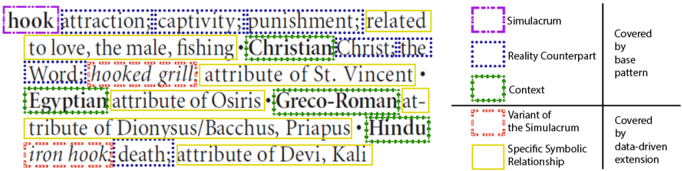
The image is a technical diagram illustrating the semantic and symbolic associations of the concept "hook" across various cultural, religious, and linguistic contexts. It uses a color-coded system of dashed boxes to categorize different types of relationships and concepts. The diagram is divided into two primary sections: a left panel containing the annotated text network and a right panel containing the legend.
### Components/Axes
**Legend (Right Panel):**
The legend is positioned on the right side of the image and defines five categories, each associated with a specific color and dashed box style:
1. **Simulacrum** (Purple dashed box): Covered by base pattern.
2. **Reality Counterpart** (Blue dashed box): Covered by base pattern.
3. **Context** (Green dashed box): Covered by base pattern.
4. **Variant of the Simulacrum** (Red dashed box): Covered by data-driven extension.
5. **Specific Symbolic Relationship** (Yellow solid box): Covered by data-driven extension.
A vertical black line separates the legend into two columns: "Covered by base pattern" (top three categories) and "Covered by data-driven extension" (bottom two categories).
**Main Content (Left Panel):**
The left panel contains a multi-line block of text. Key terms and phrases within this text are enclosed in colored dashed or solid boxes corresponding to the legend. The text is arranged in a flowing, non-linear manner, suggesting interconnected concepts rather than a simple list.
### Detailed Analysis
**Text Transcription and Color-Coding:**
The following text is present in the left panel. Words/phrases in **bold** are enclosed in colored boxes as specified:
- **hook** (Purple) attraction (Blue) captivity (Blue) punishment (Blue) related (Yellow)
- to love, the male, fishing **Christian** (Green) **dirt** (Green) **bx** (Green)
- **Word** (Green) **hooked grill** (Red) attribute of St. Vincent
- **Egyptian** (Green) attribute of Osiris
- **Greco-Roman** (Green) attribute of Dionysus/Bacchus, Priapus
- **Hindu** (Green) **iron hooks** (Red) death, attribute of Devi, Kali
**Spatial Grounding:**
- The legend is anchored to the right side of the image.
- The main text block occupies the left and central portion.
- The colored boxes are placed directly around their respective terms within the text flow. For example, the purple box for "hook" is at the very beginning of the first line. The green boxes for cultural contexts ("Christian", "Egyptian", etc.) are distributed throughout the text.
**Trend/Pattern Verification:**
The diagram does not present numerical data or trends. Instead, it maps conceptual relationships. The visual "trend" is the clustering of concepts:
- **Blue (Reality Counterpart)** terms ("attraction", "captivity", "punishment") are grouped together in the first line, suggesting core, literal associations.
- **Green (Context)** terms ("Christian", "Word", "Egyptian", "Greco-Roman", "Hindu") are scattered, indicating the concept's cross-cultural presence.
- **Red (Variant of the Simulacrum)** terms ("hooked grill", "iron hooks") appear as specific, derived objects.
- **Yellow (Specific Symbolic Relationship)** appears only once, linking "hook" to the broader concept "related."
### Key Observations
1. **Central Node:** The word "hook" (Purple/Simulacrum) is the primary node from which all other associations radiate.
2. **Cultural Breadth:** The concept is explicitly linked to five major cultural/religious frameworks: Christian, Egyptian, Greco-Roman, and Hindu.
3. **Semantic Range:** Associations span from concrete ("fishing", "iron hooks") to abstract ("attraction", "punishment", "death").
4. **Specific Deities:** The diagram names specific deities associated with hooks: Osiris (Egyptian), Dionysus/Bacchus & Priapus (Greco-Roman), and Devi/Kali (Hindu).
5. **Structural Division:** The legend's split between "base pattern" and "data-driven extension" suggests a two-tiered analytical model, where core symbolic meanings (Simulacrum, Reality Counterpart, Context) are extended by more specific or variant interpretations.
### Interpretation
This diagram functions as a **semantic map or knowledge graph** for the symbol of the "hook." It demonstrates how a single object or concept accrues layered meanings across different domains of human thought.
- **What it suggests:** The "hook" is a potent polysemous symbol. Its primary, "base pattern" meanings involve capture, connection, and punishment (Reality Counterparts). These core ideas are then contextualized within specific cultural and religious frameworks (Context), where they become attributes of specific deities or concepts. Finally, the symbol extends into more specific material variants (e.g., "iron hooks" for Kali) or specialized symbolic relationships.
- **How elements relate:** The color-coding creates a taxonomy of meaning. The purple "Simulacrum" is the abstract archetype. Blue "Reality Counterparts" are its real-world manifestations. Green "Contexts" are the cultural lenses that shape its interpretation. Red "Variants" are concrete instantiations. Yellow denotes a direct, specific symbolic link.
- **Notable patterns:** The association with both love ("attraction") and death ("punishment", "death") highlights the symbol's dualistic nature—capable of representing both connection and destruction. The presence in diverse mythologies (Osiris, Kali, Priapus) underscores its archetypal significance in human storytelling and religious thought, often tied to themes of binding, sacrifice, and power.