## Diagram: Semantic Relationships and Cultural Attributions
### Overview
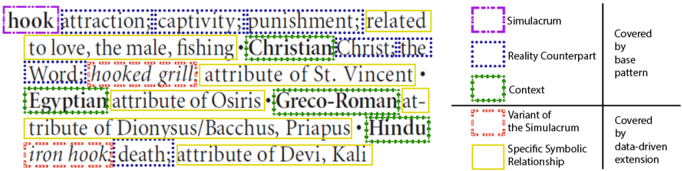
The image is a conceptual diagram illustrating semantic relationships between words and their cultural, symbolic, or contextual associations. It uses color-coded boxes and dotted lines to map connections between terms, attributes, and categories. The diagram is divided into two main sections: a legend on the right and a word-attribute matrix on the left.
---
### Components/Axes
#### Legend (Right Side)
- **Simulacrum** (Purple): Represented by a purple dotted box.
- **Reality Counterpart** (Yellow): Represented by a yellow dotted box.
- **Context** (Green): Represented by a green dotted box.
- **Variant of Simulacrum** (Red): Represented by a red dotted box.
- **Specific Symbolic Relationship** (Yellow): Represented by a yellow solid box.
#### Left Side (Word-Attribute Matrix)
- **Words/Phrases**:
- "hook" (Purple)
- "to love, the male, fishing" (Yellow)
- "Christian" (Yellow)
- "Word: hooked grill" (Red)
- "Egyptian" (Green)
- "Greco-Roman" (Green)
- "tribute of Dionysus/Bacchus, Priapus" (Green)
- "Hindu" (Green)
- "iron hook" (Red)
- **Attributes/Connections**:
- "attraction; captivity; punishment; related to love, the male, fishing" (linked to "hook")
- "attribute of St. Vincent" (linked to "hooked grill")
- "attribute of Osiris" (linked to "Egyptian")
- "attribute of Devi, Kali" (linked to "iron hook")
- "Greco-Roman attribute of Dionysus/Bacchus, Priapus" (linked to "Greco-Roman")
- "Hindu" (linked to "Kali")
---
### Detailed Analysis
#### Word-Attribute Relationships
1. **Simulacrum (Purple)**:
- "hook" is associated with abstract concepts like "attraction," "captivity," and "punishment."
- Dotted lines connect "hook" to its attributes, suggesting a foundational or archetypal relationship.
2. **Reality Counterpart (Yellow)**:
- "Christian" and "Hindu" are linked to cultural/religious figures ("Christ," "Kali").
- "to love, the male, fishing" is tied to human experiences or narratives.
3. **Context (Green)**:
- "Egyptian," "Greco-Roman," and "Hindu" are tied to cultural attributes (e.g., "Osiris," "Dionysus/Bacchus/Priapus").
- These terms emphasize historical or mythological contexts.
4. **Variant of Simulacrum (Red)**:
- "hooked grill" and "iron hook" are specific extensions of the "hook" concept.
- "hooked grill" is an attribute of St. Vincent, while "iron hook" relates to "death" and deities like Devi and Kali.
5. **Specific Symbolic Relationship (Yellow)**:
- No direct connections are shown, but the category implies unique, data-driven extensions (e.g., "iron hook" as a symbolic variant).
---
### Key Observations
- **Color Consistency**: The legend’s colors (purple, yellow, red, green) are strictly applied to words and their attributes.
- **Hierarchical Structure**:
- "Simulacrum" and "Reality Counterpart" represent abstract or foundational relationships.
- "Context" and "Variant of Simulacrum" add specificity (cultural or symbolic).
- **Cultural Symbolism**: Terms like "Osiris," "Dionysus," and "Kali" anchor the diagram in mythological or religious frameworks.
- **Ambiguity in "Specific Symbolic Relationship"**: The yellow solid box lacks explicit connections, suggesting it may require further data-driven interpretation.
---
### Interpretation
The diagram categorizes words into semantic and cultural frameworks, using color to distinguish between abstract relationships (Simulacrum, Reality Counterpart) and contextual or symbolic extensions (Context, Variant of Simulacrum). For example:
- **"Hook"** serves as a base concept (Simulacrum), with attributes like "attraction" and "punishment."
- **"Christian"** and **"Hindu"** act as Reality Counterparts, linking to religious figures.
- **"Iron hook"** and **"hooked grill"** are Variants of Simulacrum, tied to specific symbolic meanings (death, St. Vincent).
- **"Egyptian"** and **"Greco-Roman"** emphasize cultural Context, connecting to deities like Osiris and Dionysus.
The absence of explicit data points (e.g., numerical values) suggests the diagram is a conceptual model rather than a quantitative analysis. The use of dotted lines implies flexible or overlapping relationships, while solid boxes (e.g., "Specific Symbolic Relationship") may require additional data to define.
This structure could be used to analyze how language, culture, and symbolism intersect in semantic networks, with potential applications in linguistics, cultural studies, or AI-driven semantic modeling.