## Diagram: Resource Allocation with Dual Arms
### Overview
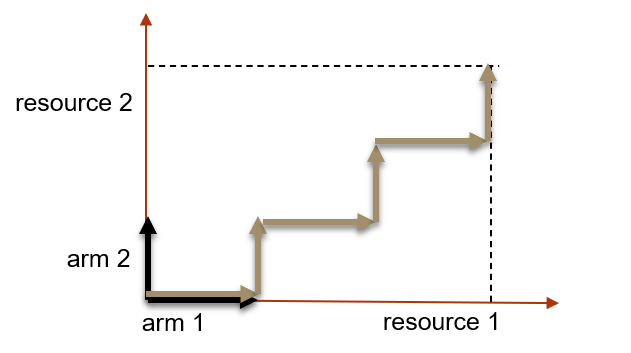
The image depicts a two-dimensional diagram with labeled axes ("arm 1" and "arm 2") and a stepwise progression of arrows. The diagram includes references to "resource 1" and "resource 2," with arrows indicating directional flow. The arrows form a staircase-like pattern, suggesting a sequential or phased process.
### Components/Axes
- **Horizontal Axis (Arm 1)**: Labeled "arm 1," extending left to right.
- **Vertical Axis (Arm 2)**: Labeled "arm 2," extending bottom to top.
- **Resources**:
- "resource 1" is positioned along the horizontal axis (right side).
- "resource 2" is positioned along the vertical axis (top side).
- **Arrows**:
- **Black arrows**: Point upward (vertical) and leftward (horizontal).
- **Brown arrows**: Point upward (vertical) and rightward (horizontal).
- **Legend**: No explicit legend is present, but arrow colors (black/brown) may differentiate stages or types of actions.
### Detailed Analysis
1. **Arrow Path**:
- The sequence begins at the origin (0,0).
- **Step 1**: Black arrow moves left (decreasing arm 1) and upward (increasing arm 2) to (0,1).
- **Step 2**: Brown arrow moves right (increasing arm 1) and upward (increasing arm 2) to (1,1).
- **Step 3**: Brown arrow moves right (increasing arm 1) and upward (increasing arm 2) to (2,1).
- **Step 4**: Brown arrow moves upward (increasing arm 2) to (2,2).
- **Step 5**: Brown arrow moves right (increasing arm 1) and upward (increasing arm 2) to (3,2).
- **Step 6**: Brown arrow moves upward (increasing arm 2) to (3,3).
2. **Resource Allocation**:
- The diagram implies a trade-off between "arm 1" and "arm 2" as resources are allocated.
- The final position (3,3) suggests equal allocation to both arms.
3. **Directional Flow**:
- The black arrow at the origin may represent an initial adjustment or correction phase.
- Subsequent brown arrows indicate progressive resource allocation toward both arms.
### Key Observations
- The stepwise progression suggests a phased or iterative process.
- The final equal allocation (3,3) implies a balanced resource distribution.
- The black arrow’s leftward movement (decreasing arm 1) contrasts with the brown arrows’ rightward progression, indicating a potential correction or reallocation step.
### Interpretation
This diagram likely models a resource allocation strategy where resources are incrementally assigned to two competing or complementary arms. The use of distinct arrow colors (black/brown) may represent different phases (e.g., initial adjustment vs. ongoing allocation). The equal final allocation (3,3) suggests a goal of equilibrium, but the initial black arrow hints at a need for corrective action early in the process. The absence of numerical values or explicit units leaves the scale ambiguous, but the relative positions emphasize proportional relationships between arms and resources.
**Note**: No numerical data or explicit units are provided in the image. The analysis is based on spatial relationships and directional flow.