## Diagram: Semantic Data Processing Pipeline
### Overview
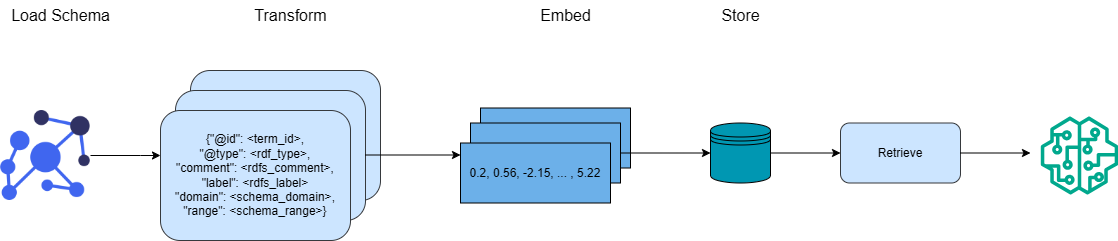
The image depicts a linear, five-stage technical pipeline for processing structured data, transforming it into embeddings, storing it, and enabling retrieval. The flow moves from left to right, indicated by directional arrows connecting each stage. The diagram uses a combination of icons, text labels, and data representations to illustrate each step.
### Components/Axes
The pipeline consists of five distinct stages, each labeled at the top:
1. **Load Schema** (Far Left)
* **Icon:** A network graph visualization with interconnected nodes of varying sizes and shades of blue.
* **Function:** Represents the ingestion of structured data or a knowledge graph schema.
2. **Transform** (Center-Left)
* **Icon:** Three stacked, light blue document icons, suggesting multiple records or entities.
* **Embedded Text:** A JSON-like structure is visible on the front document:
```
{"@id": <term_id>,
"@type": <rdf_type>,
"comment": <rdfs_comment>,
"label": <rdfs_label>,
"domain": <schema_domain>,
"range": <schema_range>}
```
* **Function:** Represents the transformation of raw schema data into a standardized, semantic format (likely RDF/Schema based on the keys).
3. **Embed** (Center)
* **Icon:** Three stacked, solid blue rectangles, representing vector data.
* **Embedded Text:** A sequence of numerical values is displayed on the front rectangle: `0.2, 0.56, -2.15, ..., 5.22`.
* **Function:** Represents the conversion of the transformed semantic data into numerical vector embeddings.
4. **Store** (Center-Right)
* **Icon:** A teal-colored cylinder, the standard symbol for a database.
* **Function:** Represents the persistence of the generated embeddings into a storage system (e.g., a vector database).
5. **Retrieve** (Far Right)
* **Icon:** A light blue rounded rectangle labeled "Retrieve".
* **Output Icon:** A green brain/circuit icon, symbolizing an AI model or intelligent system.
* **Function:** Represents the querying of the stored embeddings to provide data to an downstream AI application or model.
**Flow Direction:** Black arrows connect each stage sequentially: Load Schema → Transform → Embed → Store → Retrieve → AI Brain Icon.
### Detailed Analysis
* **Data Transformation:** The "Transform" stage explicitly shows the conversion of entities into a semantic web format. The keys `@id`, `@type`, `comment`, `label`, `domain`, and `range` are standard in RDF Schema (RDFS) and Schema.org vocabularies, indicating this pipeline is designed for knowledge graph processing.
* **Embedding Output:** The "Embed" stage shows a vector starting with `0.2, 0.56, -2.15` and ending with `5.22`, with an ellipsis (`...`) indicating a longer, truncated sequence. This confirms the output is a high-dimensional numerical vector.
* **Spatial Layout:** The stages are evenly spaced horizontally. The legend/labels are positioned directly above their corresponding components. The "Retrieve" box is the only stage with a text label inside its icon.
### Key Observations
1. **Linear, Unidirectional Flow:** The process is strictly sequential with no feedback loops or branching paths shown.
2. **Abstraction of Complexity:** Each stage simplifies a complex technical process (schema loading, RDF transformation, vector embedding, database storage, and retrieval) into a single conceptual step.
3. **Data State Change:** The diagram visually tracks the data's form: from a graph (Load Schema), to structured text (Transform), to numerical vectors (Embed), to persisted storage (Store), and finally to a queryable resource (Retrieve).
4. **Purpose-Driven End Point:** The pipeline culminates in feeding data to an AI/ML model (the brain icon), defining its ultimate purpose as enabling intelligent systems.
### Interpretation
This diagram illustrates a **knowledge graph embedding pipeline**, a fundamental architecture in modern AI systems that combine symbolic knowledge (structured data) with sub-symbolic AI (neural networks).
* **What it demonstrates:** The pipeline shows how human-readable, structured knowledge (like a product catalog or medical ontology) is machine-processed into a form that AI models can efficiently use. The "Transform" step is critical for adding semantic meaning, while the "Embed" step translates that meaning into the mathematical language of AI.
* **Relationships:** Each stage is a prerequisite for the next. You cannot embed without transforming the data into a consistent format, and you cannot retrieve from storage without first storing the embeddings. The final arrow to the brain icon signifies that the entire pipeline's value is realized when it powers inference, search, or recommendation in an AI application.
* **Notable Implication:** The ellipsis in the embedding vector (`...`) is a key detail. It implies high dimensionality (hundreds or thousands of values), which is necessary to capture the nuanced meaning of the original semantic data. This is not a simple 2D or 3D plot but a representation of complex, multi-faceted information.