## Mathematical Expression Analysis
### Overview
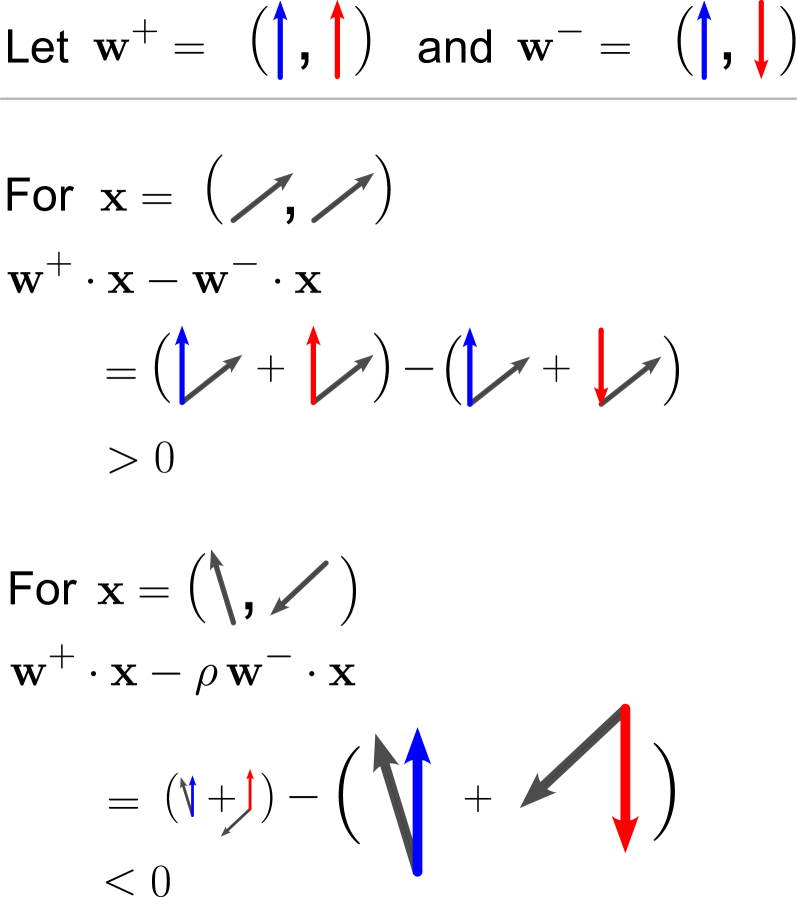
The image presents a mathematical analysis involving vectors and dot products. It defines two vectors, w+ and w-, and then explores the results of dot product operations with another vector x under different conditions. The analysis aims to demonstrate how the dot products and their differences result in positive or negative values based on the vector x.
### Components/Axes
* **Definitions:**
* w+ = (↑, ↑) where the left arrow is blue and the right arrow is red.
* w- = (↑, ↓) where the left arrow is blue and the right arrow is red.
* **Expressions:**
* For x = (↗, ↗): w+ · x - w- · x = (↑↗ + ↑↗) - (↑↗ + ↓↗) > 0 where the left arrow is blue and the right arrow is red.
* For x = (↖, ↗): w+ · x - ρ w- · x = (↑↖ + ↑↗) - (↑↗ + ↓↗) < 0 where the left arrow is blue and the right arrow is red.
### Detailed Analysis
**First Case:**
* **Vector x:** x = (↗, ↗)
* **Expression:** w+ · x - w- · x
* **Expansion:** (↑↗ + ↑↗) - (↑↗ + ↓↗)
* The first term (w+ · x) consists of the dot product of a blue upward arrow with a gray upward-right arrow, plus the dot product of a red upward arrow with a gray upward-right arrow.
* The second term (w- · x) consists of the dot product of a blue upward arrow with a gray upward-right arrow, plus the dot product of a red downward arrow with a gray upward-right arrow.
* **Result:** > 0
**Second Case:**
* **Vector x:** x = (↖, ↗)
* **Expression:** w+ · x - ρ w- · x
* **Expansion:** (↑↖ + ↑↗) - (↑↗ + ↓↗)
* The first term (w+ · x) consists of the dot product of a blue upward arrow with a gray upward-left arrow, plus the dot product of a red upward arrow with a gray upward-right arrow.
* The second term (ρ w- · x) consists of the dot product of a gray upward-left arrow with a blue upward arrow, plus the dot product of a gray upward-right arrow with a red downward arrow.
* **Result:** < 0
### Key Observations
* The vectors w+ and w- are defined with upward arrows, but w- has a downward-pointing red arrow.
* The vector x changes between the two cases, affecting the outcome of the dot product.
* The constant ρ is introduced in the second case, scaling the second dot product.
### Interpretation
The image demonstrates how the choice of vector x and the introduction of a scaling factor (ρ) can influence the sign of the expression w+ · x - w- · x. The first case shows a positive result, while the second case shows a negative result. This suggests that the relationship between the vectors and the scaling factor determines the overall outcome, potentially representing a decision boundary or a classification rule in a higher-dimensional space. The use of arrows pointing in different directions likely represents vector components or basis vectors.