## Mathematical Explanation: Vector Dot Product Analysis
### Overview
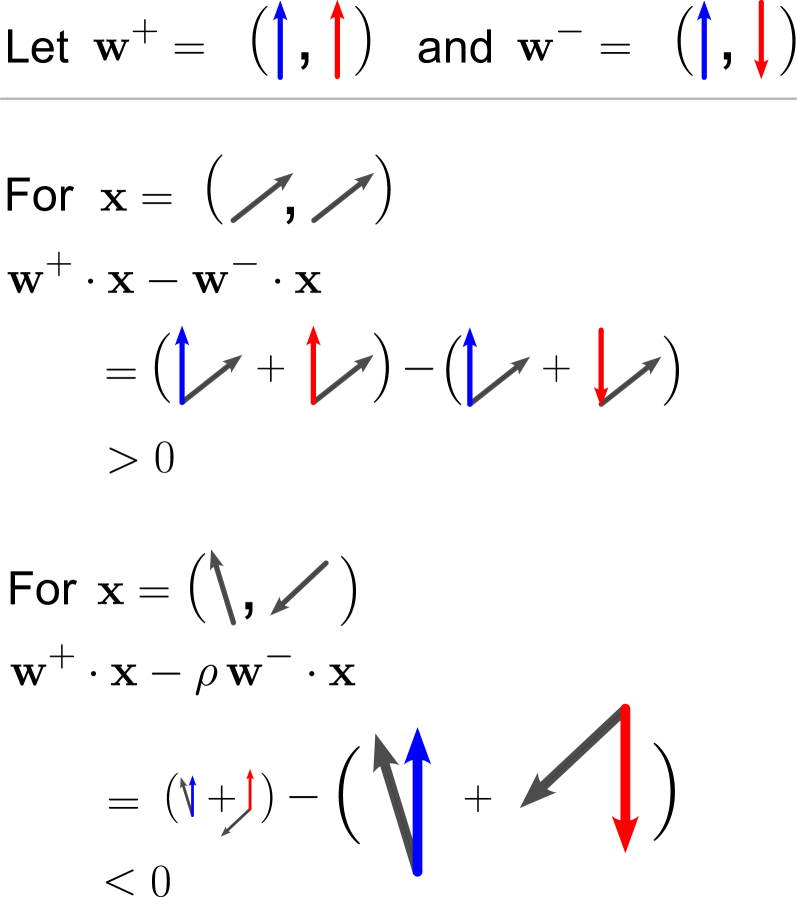
The image presents a mathematical explanation involving vector operations, specifically dot products between vectors **w⁺**, **w⁻**, and **x**. It demonstrates how the sign of the difference between these dot products determines a binary outcome (>0 or <0).
### Components/Axes
- **Vectors**:
- **w⁺** = (↑, ↑) [blue and red upward arrows]
- **w⁻** = (↑, ↓) [blue upward, red downward arrows]
- **Equations**:
1. For **x** = (↗, ↗):
- **w⁺ · x - w⁻ · x** = (↗ + ↗) - (↗ + ↙) > 0
2. For **x** = (↖, ↘):
- **w⁺ · x - ρ w⁻ · x** = (↖ + ↗) - (↖ + ↘) < 0
- **Symbols**:
- **ρ** (rho) appears as a scalar multiplier in the second equation.
### Detailed Analysis
1. **First Case (x = (↗, ↗))**:
- **w⁺ · x** = (↗ + ↗) [sum of blue and red components of **w⁺** dotted with **x**]
- **w⁻ · x** = (↗ + ↙) [sum of blue and red components of **w⁻** dotted with **x**]
- Result: **w⁺ · x - w⁻ · x > 0**
2. **Second Case (x = (↖, ↘))**:
- **w⁺ · x** = (↖ + ↗)
- **ρ w⁻ · x** = (↖ + ↘) [scaled by ρ]
- Result: **w⁺ · x - ρ w⁻ · x < 0**
### Key Observations
- The sign of the difference between dot products determines the outcome.
- The first case uses **w⁺** and **w⁻** directly, while the second introduces a scaling factor **ρ** for **w⁻**.
- Arrows are color-coded (blue for upward, red for downward) but lack a formal legend.
### Interpretation
This explanation likely models a decision boundary in a binary classification problem (e.g., perceptron or SVM). The vectors **w⁺** and **w⁻** represent weights for positive and negative classes, respectively. The dot product differences quantify how **x** aligns with these weights, with the sign indicating class assignment. The introduction of **ρ** in the second case suggests a weighted or regularized influence of **w⁻**, possibly to adjust sensitivity to negative examples.
No numerical values or explicit trends are provided, as the focus is on symbolic vector relationships. The spatial arrangement of arrows visually reinforces the directional components of the vectors.