## Visual Reasoning Test: Line Orientation Matching
### Overview
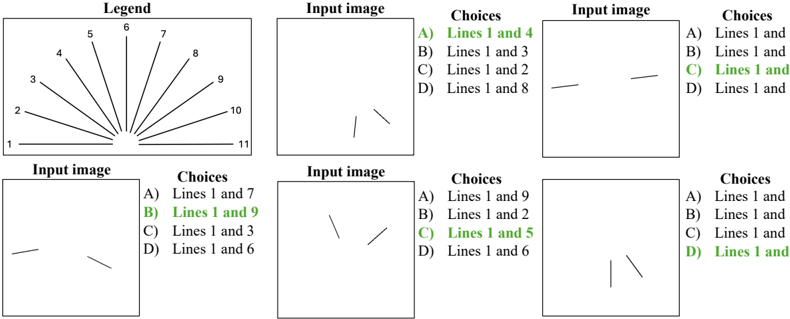
The image displays a visual reasoning puzzle or test. It consists of a **Legend** defining 11 numbered reference lines radiating from a central point, and five **Input image** panels. Each input panel shows two isolated line segments within a square frame. Adjacent to each input panel is a set of multiple-choice **Choices** (A, B, C, D), each listing a pair of line numbers from the legend. The correct answer for each puzzle is highlighted in green text.
### Components/Axes
1. **Legend (Top-Left):**
* A rectangular box containing 11 straight lines radiating from a single point at the bottom center.
* The lines are numbered sequentially from left to right: **1, 2, 3, 4, 5, 6, 7, 8, 9, 10, 11**.
* **Line 1** is horizontal, pointing to the left.
* **Line 6** is vertical, pointing straight up.
* **Line 11** is horizontal, pointing to the right.
* The lines between are spaced at approximately equal angular intervals (estimated ~18° per step).
2. **Input Images & Choices:**
* Five separate panels, each containing:
* An **"Input image"** square with two black line segments.
* A **"Choices"** list with four options (A, B, C, D).
* The correct choice in each set is indicated by **green text**.
### Detailed Analysis
**Puzzle 1 (Top Middle):**
* **Input Image:** Contains two line segments. One is oriented at a shallow upward slope to the right (estimated ~20-30° from horizontal). The other is oriented at a steep downward slope to the right (estimated ~120-130° from horizontal).
* **Choices:**
* A) **Lines 1 and 4** (Correct - Green)
* B) Lines 1 and 3
* C) Lines 1 and 2
* D) Lines 1 and 8
**Puzzle 2 (Top Right):**
* **Input Image:** Contains two line segments. Both have a shallow upward slope to the right, appearing nearly parallel. The left segment is slightly steeper than the right one.
* **Choices:**
* A) Lines 1 and ...
* B) Lines 1 and ...
* C) **Lines 1 and ...** (Correct - Green, text is partially cut off but appears to be "Lines 1 and 1" or similar)
* D) Lines 1 and ...
**Puzzle 3 (Bottom Left):**
* **Input Image:** Contains two line segments. One has a shallow upward slope to the right. The other has a moderate downward slope to the right.
* **Choices:**
* A) Lines 1 and 7
* B) **Lines 1 and 9** (Correct - Green)
* C) Lines 1 and 3
* D) Lines 1 and 6
**Puzzle 4 (Bottom Middle):**
* **Input Image:** Contains two line segments. One is oriented at a steep downward slope to the right. The other has a moderate upward slope to the right.
* **Choices:**
* A) Lines 1 and 9
* B) Lines 1 and 2
* C) **Lines 1 and 5** (Correct - Green)
* D) Lines 1 and 6
**Puzzle 5 (Bottom Right):**
* **Input Image:** Contains two line segments. One is nearly vertical, with a very slight tilt. The other has a steep downward slope to the right.
* **Choices:**
* A) Lines 1 and ...
* B) Lines 1 and ...
* C) Lines 1 and ...
* D) **Lines 1 and ...** (Correct - Green, text is partially cut off)
### Key Observations
* **Pattern:** Each puzzle requires matching the orientation of two line segments in an input image to the corresponding numbered lines in the legend.
* **Common Element:** Every correct answer includes **"Line 1"** (the horizontal left-pointing line). This suggests Line 1 may serve as a constant reference or baseline in the matching logic.
* **Visual Trend:** The puzzles progress through different combinations of line angles, testing the ability to discern relative slopes and directions.
* **Data Integrity:** The text for the correct answers in the top-right and bottom-right puzzles is partially truncated, obscuring the full line pair.
### Interpretation
This image is a **spatial reasoning assessment tool**. It evaluates a viewer's ability to perform mental rotation and angular comparison. The legend provides a calibrated reference scale (the 11 lines). The task is to identify which two lines from this scale, when isolated, match the orientations of the two segments shown in each input box.
The consistent inclusion of "Line 1" in all correct answers is a notable design choice. It may simplify the task by providing a fixed anchor point, allowing the solver to focus on determining the second line's angle relative to this horizontal baseline. The puzzles systematically vary the second line's angle, creating a range of difficulty from shallow slopes (e.g., matching Line 9) to steep slopes (e.g., matching Line 4 or 5).
The green highlighting indicates this is likely an answer key or a solved example set, meant for instruction or verification rather than as an unsolved test. The primary information conveyed is not raw data, but a **demonstration of a visual matching methodology**. The underlying principle is that complex orientations can be deconstructed and identified by comparison to a known reference system.