## Horizontal Bar Chart: Number of Benchmarks in Category
### Overview
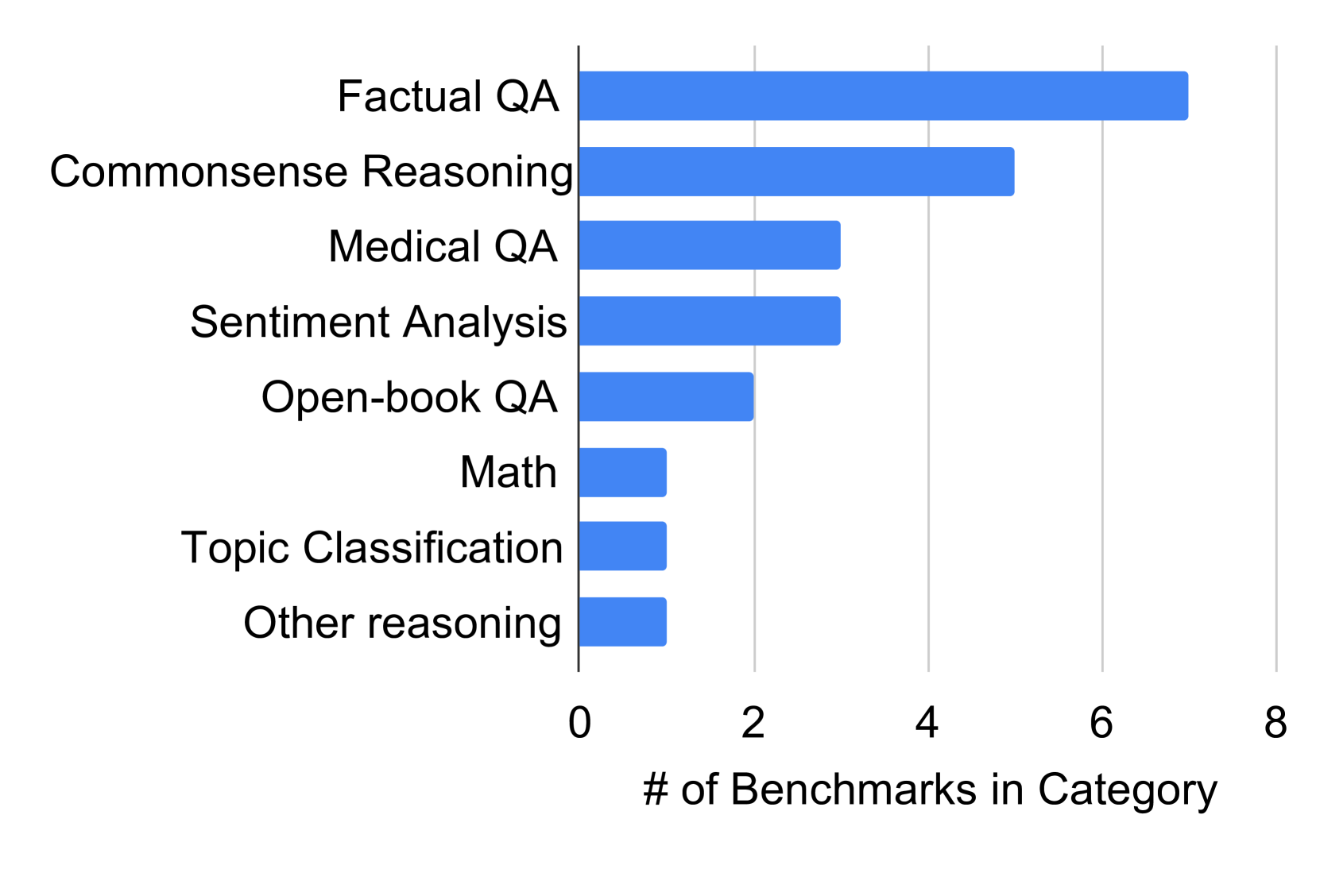
The image is a horizontal bar chart comparing the number of benchmarks in different categories. The categories are listed on the vertical axis, and the number of benchmarks is represented on the horizontal axis. The bars are blue.
### Components/Axes
* **Vertical Axis (Categories):** Factual QA, Commonsense Reasoning, Medical QA, Sentiment Analysis, Open-book QA, Math, Topic Classification, Other reasoning
* **Horizontal Axis:** "# of Benchmarks in Category". The scale ranges from 0 to 8, with tick marks at every integer value.
### Detailed Analysis
Here's a breakdown of the number of benchmarks for each category, based on the length of the blue bars:
* **Factual QA:** Approximately 7.5 benchmarks.
* **Commonsense Reasoning:** Approximately 5 benchmarks.
* **Medical QA:** Approximately 3 benchmarks.
* **Sentiment Analysis:** Approximately 2.75 benchmarks.
* **Open-book QA:** Approximately 2 benchmarks.
* **Math:** Approximately 1 benchmark.
* **Topic Classification:** Approximately 1 benchmark.
* **Other reasoning:** Approximately 1 benchmark.
### Key Observations
* Factual QA has the highest number of benchmarks, significantly more than any other category.
* Commonsense Reasoning is the second highest, but still considerably lower than Factual QA.
* Math, Topic Classification, and Other reasoning have the fewest benchmarks, with approximately the same number.
### Interpretation
The chart indicates the relative prevalence of benchmarks in different AI and NLP task categories. Factual QA is the most benchmarked area, suggesting a strong focus on evaluating systems' ability to answer factual questions. Commonsense Reasoning also has a substantial number of benchmarks, reflecting the importance of this area. The lower numbers for Math, Topic Classification, and Other reasoning may indicate less emphasis or fewer available benchmarks in these areas. The data suggests that the AI/NLP community prioritizes factual question answering and commonsense reasoning over other types of reasoning and classification tasks.