## Combined Chart: KG-Trie Size, Hit Rate, Precision, Recall, and F1 Score vs. KG-Trie Path Length
### Overview
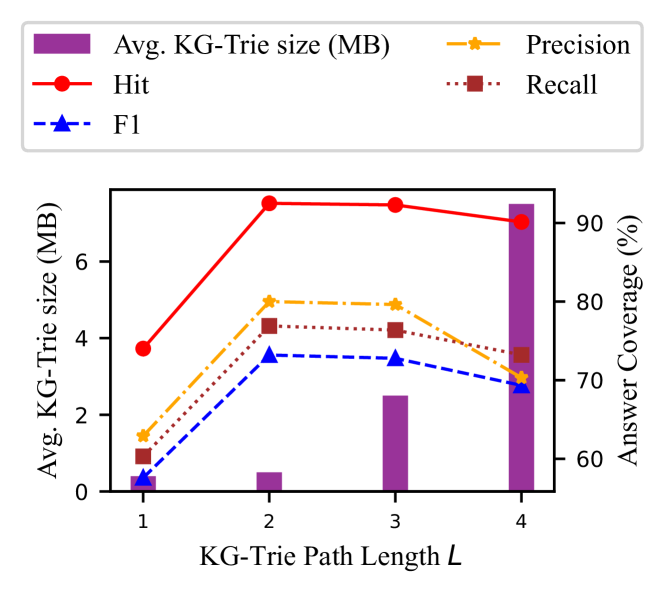
The image is a combined chart displaying the relationship between KG-Trie Path Length (L) and several metrics: Average KG-Trie size (MB), Hit rate, Precision, Recall, and F1 score. The x-axis represents the KG-Trie Path Length, while the left y-axis represents the Average KG-Trie size in MB, and the right y-axis represents Answer Coverage in percentage for Hit, Precision, Recall, and F1.
### Components/Axes
* **X-axis:** KG-Trie Path Length *L*, with values 1, 2, 3, and 4.
* **Left Y-axis:** Avg. KG-Trie size (MB), ranging from 0 to 8 MB, with tick marks at every 2 MB.
* **Right Y-axis:** Answer Coverage (%), ranging from 60% to 90%, with tick marks at every 10%.
* **Legend (Top):**
* Purple bar: Avg. KG-Trie size (MB)
* Red line with circle markers: Hit
* Blue dashed line with triangle markers: F1
* Orange dashed-dotted line with star markers: Precision
* Brown dotted line with square markers: Recall
### Detailed Analysis
* **Avg. KG-Trie size (MB) (Purple Bars):**
* At L=1: Approximately 0.1 MB
* At L=2: Approximately 0.5 MB
* At L=3: Approximately 2.5 MB
* At L=4: Approximately 7 MB
* Trend: The size increases with path length.
* **Hit (Red Line):**
* At L=1: Approximately 3.8 MB
* At L=2: Approximately 7.3 MB
* At L=3: Approximately 7.3 MB
* At L=4: Approximately 7.1 MB
* Trend: Increases sharply from L=1 to L=2, then plateaus and slightly decreases.
* **F1 (Blue Dashed Line):**
* At L=1: Approximately 0.3 %
* At L=2: Approximately 75 %
* At L=3: Approximately 74 %
* At L=4: Approximately 72 %
* Trend: Increases from L=1 to L=2, then decreases slightly.
* **Precision (Orange Dashed-Dotted Line):**
* At L=1: Approximately 72 %
* At L=2: Approximately 80 %
* At L=3: Approximately 79 %
* At L=4: Approximately 71 %
* Trend: Increases from L=1 to L=2, then decreases.
* **Recall (Brown Dotted Line):**
* At L=1: Approximately 62 %
* At L=2: Approximately 79 %
* At L=3: Approximately 78 %
* At L=4: Approximately 74 %
* Trend: Increases from L=1 to L=2, then decreases.
### Key Observations
* The Avg. KG-Trie size (MB) increases significantly as the KG-Trie Path Length increases.
* The Hit rate plateaus after L=2.
* F1, Precision, and Recall peak at L=2 and then decrease as L increases.
* The increase in KG-Trie size does not necessarily translate to better performance in terms of F1, Precision, and Recall beyond a path length of 2.
### Interpretation
The data suggests that increasing the KG-Trie Path Length beyond a certain point (L=2 in this case) does not improve the performance metrics (F1, Precision, Recall) and only increases the size of the KG-Trie. This indicates a trade-off between storage space and performance. The optimal KG-Trie Path Length appears to be around 2, where the performance metrics are relatively high without a significant increase in the KG-Trie size. The plateauing of the Hit rate after L=2 further supports this conclusion.