## Diagram: Chain of Thought (CoT) Variants
### Overview
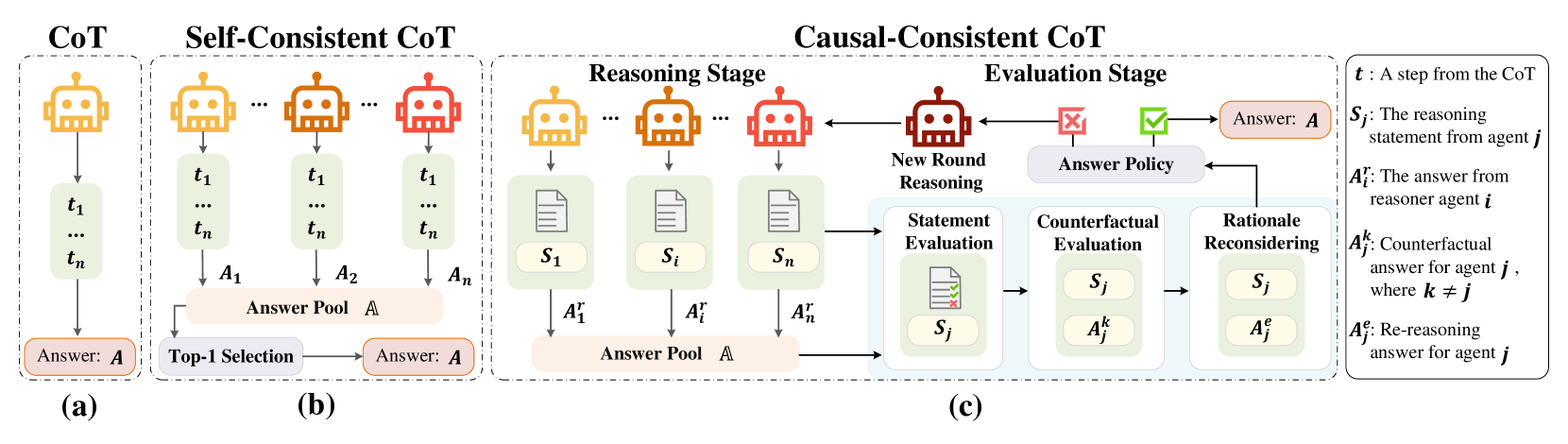
The image presents a diagram comparing three different Chain of Thought (CoT) approaches: CoT, Self-Consistent CoT, and Causal-Consistent CoT. It illustrates the flow of reasoning and evaluation in each approach, highlighting the key differences in how answers are generated and refined.
### Components/Axes
* **Titles:**
* CoT (left)
* Self-Consistent CoT (center)
* Causal-Consistent CoT (right)
* **Elements:**
* Robot icons: Represent agents or reasoners. The color of the robot changes from yellow to orange to red, indicating a progression or change in state.
* `t1 ... tn`: Represent steps in the CoT process.
* `S1 ... Sn`: Represent reasoning statements.
* `A1 ... An`: Represent answers.
* `Answer Pool A`: Represents a collection of answers.
* `Answer: A`: Represents the final answer.
* Arrows: Indicate the flow of information or reasoning.
* Boxes: Group related elements and processes.
* Evaluation Stage: A stage in the Causal-Consistent CoT process.
* Reasoning Stage: A stage in the Causal-Consistent CoT process.
* **Legend (Top-Right):**
* `t`: A step from the CoT
* `Sj`: The reasoning statement from agent j
* `A^i_i`: The answer from reasoner agent i
* `A^k_j`: Counterfactual answer for agent j, where k ≠ j
* `A^e_j`: Re-reasoning answer for agent j
### Detailed Analysis
**1. CoT (Left)**
* A single yellow robot generates a series of reasoning steps (`t1` to `tn`).
* These steps lead to a final `Answer: A`.
**2. Self-Consistent CoT (Center)**
* Multiple robots (yellow, orange, and red) each generate a series of reasoning steps (`t1` to `tn`).
* Each set of steps leads to an answer (`A1`, `A2`, ..., `An`).
* These answers are collected in an `Answer Pool A`.
* A `Top-1 Selection` process selects the final `Answer: A`.
**3. Causal-Consistent CoT (Right)**
* **Reasoning Stage:** Multiple robots (yellow, orange, and red) each generate a reasoning statement (`S1`, `Si`, ..., `Sn`).
* Each statement leads to an answer (`A^r_1`, `A^r_i`, ..., `A^r_n`) which are collected in an `Answer Pool A`.
* **Evaluation Stage:**
* A `New Round Reasoning` process, represented by a red robot, evaluates the statements.
* `Statement Evaluation` checks the validity of the reasoning statements (`Sj`).
* `Counterfactual Evaluation` considers alternative answers (`A^k_j`).
* `Rationale Reconsidering` re-evaluates the reasoning (`A^e_j`).
* An `Answer Policy` determines whether to accept or reject the current answer. If rejected, the process loops back to `New Round Reasoning`. If accepted, the final `Answer: A` is produced.
### Key Observations
* CoT is the simplest approach, with a single chain of reasoning.
* Self-Consistent CoT introduces multiple reasoning chains and selects the best answer from a pool.
* Causal-Consistent CoT adds an evaluation stage to refine the reasoning process and ensure consistency.
* The color change of the robot icons in Self-Consistent CoT and Causal-Consistent CoT might represent different agents or iterations of the reasoning process.
### Interpretation
The diagram illustrates the evolution of Chain of Thought (CoT) reasoning techniques. It shows how the basic CoT approach can be enhanced by introducing multiple reasoning paths (Self-Consistent CoT) and a feedback loop for evaluating and refining the reasoning process (Causal-Consistent CoT). The Causal-Consistent CoT approach is the most complex, incorporating elements of statement evaluation, counterfactual reasoning, and rationale reconsideration to arrive at a more robust and reliable answer. The diagram suggests that Causal-Consistent CoT aims to improve the quality of answers by actively identifying and correcting potential flaws in the reasoning process.