## Diagram: Comparison of Chain-of-Thought (CoT) Reasoning Methods
### Overview
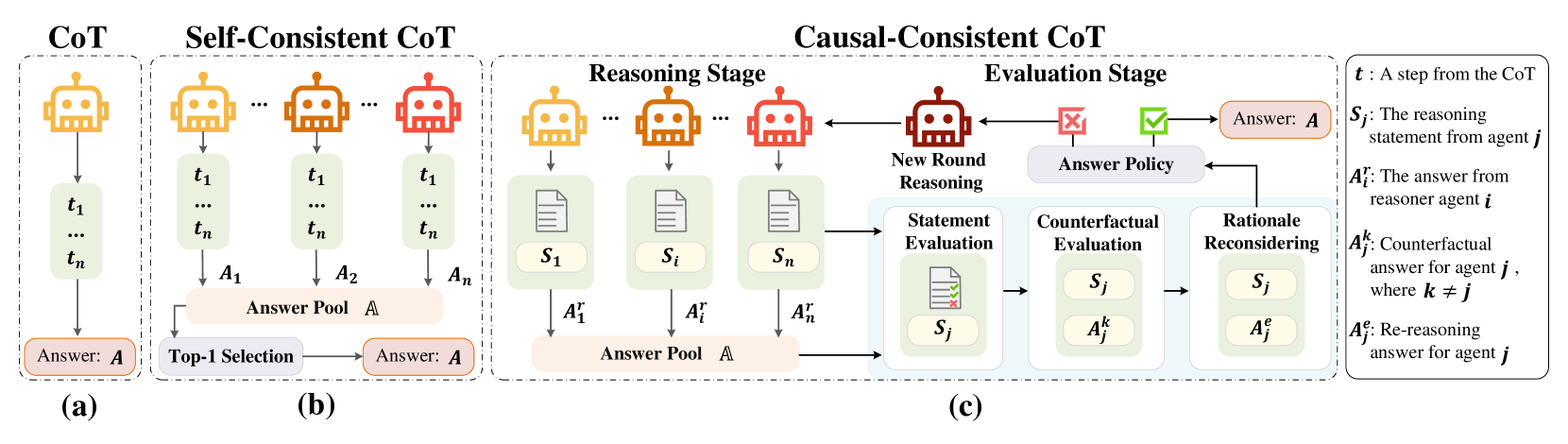
The diagram illustrates three variants of Chain-of-Thought (CoT) reasoning frameworks:
1. **Basic CoT** (a)
2. **Self-Consistent CoT** (b)
3. **Causal-Consistent CoT** (c)
Each method is visualized with distinct components, workflows, and evaluation mechanisms.
---
### Components/Axes
#### Key Labels and Symbols
- **t₁...tₙ**: Steps in the CoT process (e.g., reasoning steps).
- **A**: Final answer.
- **S₁...Sₙ**: Reasoning statements from agents.
- **Aᵣ**: Answer from reasoner agent *i*.
- **Aᵏ**: Counterfactual answer for agent *j* (where *k ≠ j*).
- **Aᵉ**: Re-reasoning answer for agent *j*.
- **Answer Policy**: Mechanism to select the final answer.
#### Spatial Layout
- **Legend**: Located on the far right, mapping symbols to their meanings.
- **Color Coding**:
- Orange: Basic CoT (a).
- Brown: Self-Consistent CoT (b).
- Red: Causal-Consistent CoT (c).
---
### Detailed Analysis
#### (a) Basic CoT
- **Workflow**:
1. A single agent generates sequential reasoning steps (*t₁* to *tₙ*).
2. The final answer (*A*) is derived directly from these steps.
- **Limitations**: No evaluation or consistency checks.
#### (b) Self-Consistent CoT
- **Workflow**:
1. Multiple agents (*A₁* to *Aₙ*) generate reasoning steps (*t₁* to *tₙ*).
2. Answers are pooled into an **Answer Pool**.
3. The **Top-1 Selection** mechanism picks the most consistent answer (*A*).
- **Improvement**: Aggregates diverse reasoning paths to reduce errors.
#### (c) Causal-Consistent CoT
- **Workflow**:
1. **Reasoning Stage**:
- Agents (*S₁* to *Sₙ*) produce reasoning statements (*Sᵢ*) and answers (*Aᵣ*).
- Answers are pooled into an **Answer Pool**.
2. **Evaluation Stage**:
- **Statement Evaluation**: Validates reasoning statements (*Sⱼ*).
- **Counterfactual Evaluation**: Tests answers under hypothetical scenarios (*Aᵏ*).
- **Rationale Reconsidering**: Re-evaluates answers (*Aᵉ*) based on prior steps.
3. **Final Answer**: Selected via an **Answer Policy** after rigorous evaluation.
- **Advantages**: Incorporates causal consistency and robustness through multi-stage validation.
---
### Key Observations
1. **Complexity Progression**:
- Basic CoT (a) is linear and simplistic.
- Self-Consistent CoT (b) introduces diversity via multiple agents.
- Causal-Consistent CoT (c) adds layered evaluation for reliability.
2. **Evaluation Mechanisms**:
- Causal-Consistent CoT uniquely includes **counterfactual** and **reconsidering** stages, suggesting a focus on robustness.
3. **Agent Roles**:
- In (c), agents (*Sᵢ*) specialize in reasoning, while the **Answer Policy** acts as a meta-decision maker.
---
### Interpretation
- **Purpose**: The diagram highlights how CoT methods evolve from simple reasoning to structured, self-consistent, and causally consistent frameworks.
- **Trade-offs**:
- **Basic CoT** is efficient but error-prone.
- **Self-Consistent CoT** improves accuracy via aggregation but lacks causal rigor.
- **Causal-Consistent CoT** maximizes reliability but requires computational overhead for evaluation.
- **Implications**: The inclusion of counterfactual and re-evaluation stages in (c) suggests a shift toward fault-tolerant AI systems, prioritizing correctness over speed.
This progression reflects a trend in AI research toward building systems that not only reason but also validate their reasoning against hypothetical and real-world scenarios.