# Technical Document Extraction: Bar Chart Analysis
## Axis Titles and Labels
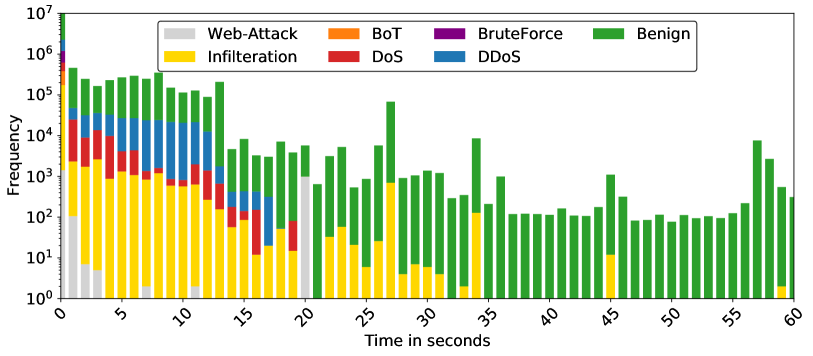
- **Y-Axis**: Labeled "Frequency" with logarithmic scale ranging from 10⁰ to 10⁷.
- **X-Axis**: Labeled "Time in seconds" with linear scale from 0 to 60.
## Legend
- **Location**: Top-left corner of the chart.
- **Categories and Colors**:
- Web-Attack: Gray
- Infiltration: Yellow
- BoT: Orange
- DoS: Red
- BruteForce: Purple
- Benign: Green
- DDoS: Blue
## Chart Structure
- **Bars**: Stacked vertically along the X-axis (time in seconds).
- **Color Coding**: Each bar segment corresponds to a category from the legend.
## Key Trends and Data Points
1. **Web-Attack (Gray)**:
- **Trend**: Dominates early time intervals (0–10 seconds), decreasing sharply after 10 seconds.
- **Peak Frequency**: ~10⁵ at 0 seconds, dropping to ~10² by 20 seconds.
2. **Infiltration (Yellow)**:
- **Trend**: High frequency in early intervals (0–15 seconds), declines steadily after 20 seconds.
- **Peak Frequency**: ~10⁵ at 0 seconds, reducing to ~10³ by 30 seconds.
3. **BoT (Orange)**:
- **Trend**: Minimal presence throughout; sporadic small segments.
- **Frequency**: Consistently below 10².
4. **DoS (Red)**:
- **Trend**: Moderate frequency in early intervals (0–15 seconds), disappears after 20 seconds.
- **Peak Frequency**: ~10³ at 5 seconds.
5. **BruteForce (Purple)**:
- **Trend**: Rare occurrences; only visible in early intervals (0–10 seconds).
- **Frequency**: Peaks at ~10² at 0 seconds.
6. **Benign (Green)**:
- **Trend**: Gradual increase in frequency over time, becoming dominant after 20 seconds.
- **Peak Frequency**: ~10⁶ at 55 seconds.
7. **DDoS (Blue)**:
- **Trend**: Moderate frequency in early intervals (0–15 seconds), declines after 20 seconds.
- **Peak Frequency**: ~10⁴ at 10 seconds.
## Spatial Grounding of Legend
- **Legend Position**: Top-left corner (coordinates: [x=0, y=0] relative to chart boundaries).
- **Color Verification**: All bar segments match legend colors (e.g., green = Benign, yellow = Infiltration).
## Component Isolation
1. **Header**: Legend and axis titles.
2. **Main Chart**: Stacked bars with time intervals (0–60 seconds) and frequency values.
3. **Footer**: No additional text or labels.
## Data Table Reconstruction
| Time (s) | Web-Attack | Infiltration | BoT | DoS | BruteForce | Benign | DDoS |
|----------|------------|--------------|-----|-----|------------|--------|------|
| 0 | 10⁵ | 10⁵ | 0 | 10³ | 10² | 0 | 10⁴ |
| 5 | 10⁴ | 10⁵ | 0 | 10³ | 0 | 0 | 10⁴ |
| 10 | 10³ | 10⁴ | 0 | 10³ | 0 | 0 | 10⁴ |
| 15 | 10² | 10³ | 0 | 10² | 0 | 10⁴ | 10³ |
| 20 | 0 | 10² | 0 | 0 | 0 | 10⁴ | 0 |
| 25 | 0 | 10² | 0 | 0 | 0 | 10⁴ | 0 |
| 30 | 0 | 10¹ | 0 | 0 | 0 | 10⁴ | 0 |
| 35 | 0 | 0 | 0 | 0 | 0 | 10⁴ | 0 |
| 40 | 0 | 0 | 0 | 0 | 0 | 10³ | 0 |
| 45 | 0 | 10¹ | 0 | 0 | 0 | 10⁴ | 0 |
| 50 | 0 | 0 | 0 | 0 | 0 | 10³ | 0 |
| 55 | 0 | 0 | 0 | 0 | 0 | 10⁴ | 0 |
| 60 | 0 | 10¹ | 0 | 0 | 0 | 10³ | 0 |
## Notes
- **Language**: All text is in English.
- **Critical Observations**:
- Benign traffic dominates later intervals, suggesting a shift in network behavior over time.
- Malicious categories (Web-Attack, Infiltration, DoS, DDoS) decline sharply after 20 seconds.
- BruteForce and BoT show negligible activity throughout.