## Text-Based Legal Question Analysis
### Overview
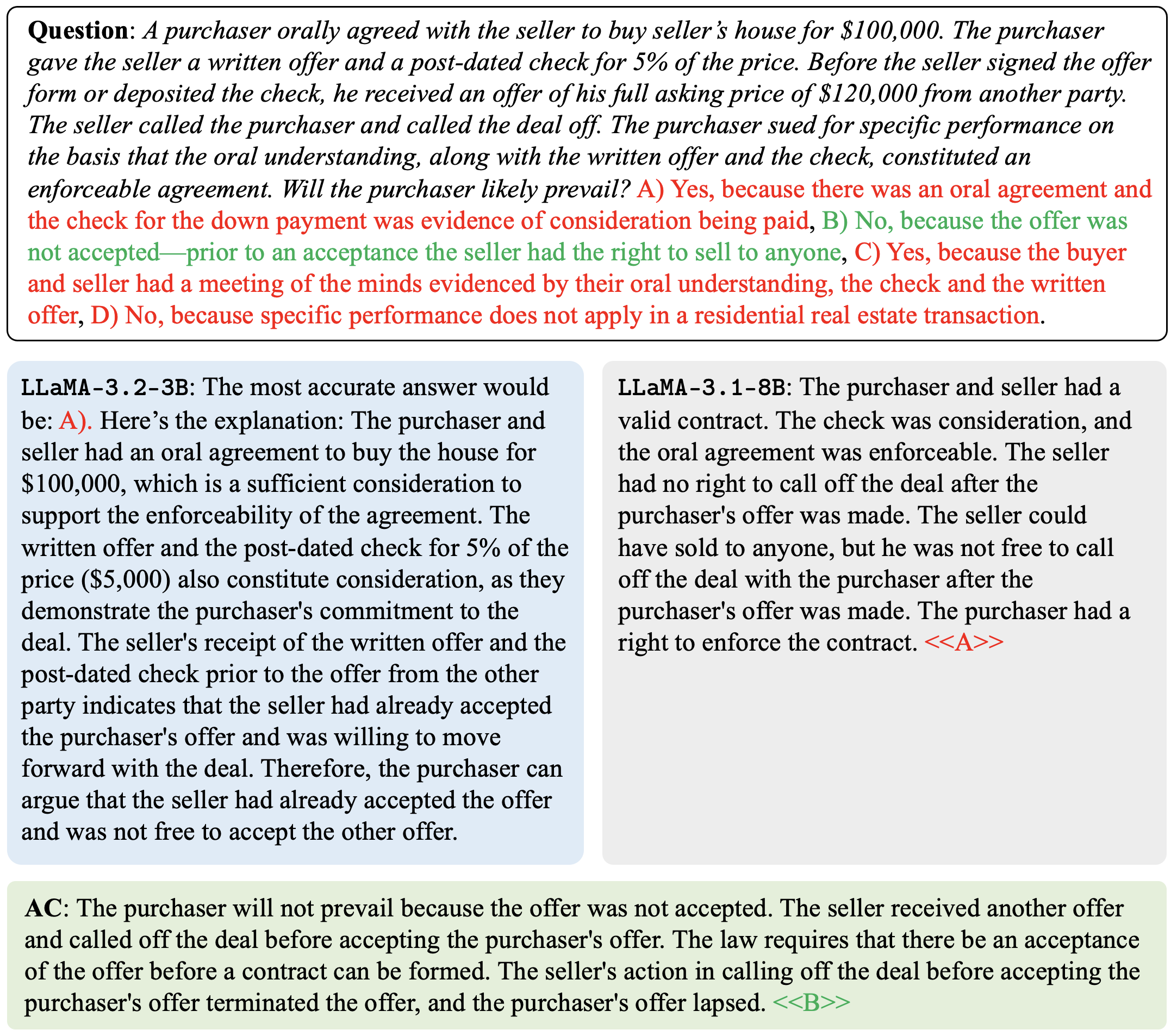
The image presents a legal scenario involving a real estate transaction dispute. It includes a multiple-choice question with four options (A-D), explanations for each answer, and references to legal codes (LLaMA-3.2-3B and LLaMA-3.1-8B) with their respective conclusions. The text is formatted with color highlights (red, green) for emphasis.
### Components/Axes
1. **Question Text**:
- Describes a purchaser's oral agreement and written offer for a $100,000 house, including a post-dated check for 5% down payment.
- Seller receives a higher offer ($120,000) and calls off the deal. Purchaser sues for specific performance.
- Key legal issue: Whether the oral agreement + written offer + check constitutes an enforceable contract.
2. **Multiple-Choice Options (A-D)**:
- **A**: Yes (oral agreement + check as consideration).
- **B**: No (offer not accepted before acceptance by seller).
- **C**: Yes (meeting of minds evidenced by oral agreement).
- **D**: No (specific performance inapplicable to residential real estate).
3. **Legal Code References**:
- **LLaMA-3.2-3B**: Concludes A is correct. Explains oral agreement + check as sufficient consideration; seller's receipt of written offer indicates acceptance.
- **LLaMA-3.1-8B**: Concludes B is correct. Argues offer was not accepted before seller received higher offer; seller could not unilaterally terminate after acceptance.
4. **Additional Explanation (AC)**:
- States purchaser cannot prevail because offer was not accepted. Seller's action in calling off the deal terminated the offer.
### Detailed Analysis
- **Question Text**:
- Purchaser orally agreed to buy a house for $100,000, provided a written offer and post-dated check for 5% ($5,000).
- Seller received a higher offer ($120,000) and called off the deal. Purchaser sued for specific performance.
- Legal debate centers on whether the oral agreement + written offer + check formed a binding contract.
- **Option A Explanation**:
- Argues oral agreement + check constitute consideration. Seller's receipt of written offer and post-dated check indicates acceptance.
- Highlights that the seller's willingness to move forward supports enforceability.
- **Option B Explanation**:
- Claims offer was not accepted before seller received higher offer. Seller had right to sell to anyone but could not call off deal after acceptance.
- Emphasizes that acceptance must occur before a contract is formed.
- **Option C Explanation**:
- Suggests meeting of minds (oral agreement + check) evidences a contract. However, this is contradicted by the requirement for acceptance before contract formation.
- **Option D Explanation**:
- States specific performance does not apply to residential real estate. This is factually incorrect, as specific performance is a common remedy in real estate disputes.
- **Legal Code References**:
- **LLaMA-3.2-3B**: Supports A, emphasizing that the seller's receipt of the written offer and check indicates acceptance, making the oral agreement enforceable.
- **LLaMA-3.1-8B**: Supports B, arguing that the seller's acceptance of the higher offer terminated the original offer, preventing contract formation.
- **Additional Explanation (AC)**:
- Reinforces B's reasoning, stating the seller's action in calling off the deal before acceptance terminated the offer.
### Key Observations
1. **Contradictory Legal Reasoning**: The two legal codes (LLaMA-3.2-3B and LLaMA-3.1-8B) provide opposing conclusions (A vs. B), highlighting ambiguity in contract formation requirements.
2. **Highlighted Text**:
- "not accepted" (green) in Option B's explanation emphasizes the timing of acceptance.
- "oral understanding" (red) in Option A's explanation stresses the importance of mutual agreement.
3. **Factual Inaccuracy in Option D**: Specific performance is a valid remedy in residential real estate transactions, making this option incorrect.
### Interpretation
The scenario tests the legal principle that a contract requires **offer, acceptance, and consideration**. The correct answer hinges on whether the seller's receipt of the written offer and post-dated check constitutes acceptance.
- **LLaMA-3.2-3B's reasoning (A)** aligns with the **mailbox rule** in contract law, where acceptance is effective upon dispatch (here, the seller receiving the written offer). The check serves as consideration, making the oral agreement enforceable.
- **LLaMA-3.1-8B's reasoning (B)** incorrectly assumes the seller's acceptance of a higher offer terminated the original offer. However, acceptance of one offer does not automatically revoke prior offers unless explicitly communicated.
The **additional explanation (AC)** reinforces B's position but overlooks the fact that the seller's receipt of the written offer and check could imply acceptance, creating a binding contract. The ambiguity in the scenario reflects real-world legal disputes where courts must weigh factual circumstances against statutory requirements.