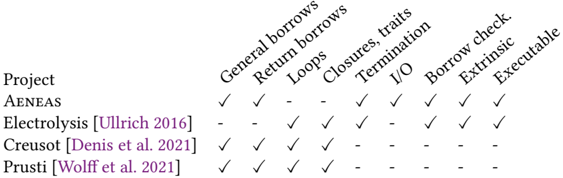
## Table: Project Feature Comparison
### Overview
The table compares four projects (Aeneas, Electrolysis, Creusot, Prusti) across 10 features related to borrow semantics, closures, termination, and executability. Each cell contains a checkmark (✓) or dash (-) to indicate feature presence/absence.
### Components/Axes
- **Rows**: Projects (Aeneas, Electrolysis [Ullrich 2016], Creusot [Denis et al. 2021], Prusti [Wolff et al. 2021])
- **Columns**: Features (General borrows, Return borrows, Loops, Closures, traits, Termination, I/O, Borrow check, Extrinsic, Executable)
- **Data Representation**: ✓ = Feature implemented, - = Feature not implemented
### Detailed Analysis
| Project | General borrows | Return borrows | Loops | Closures, traits | Termination | I/O | Borrow check | Extrinsic | Executable |
|------------------|-----------------|----------------|-------|------------------|-------------|-----|--------------|-----------|------------|
| **Aeneas** | ✓ | ✓ | - | - | ✓ | ✓ | ✓ | ✓ | ✓ |
| **Electrolysis** | - | - | ✓ | ✓ | ✓ | - | ✓ | ✓ | ✓ |
| **Creusot** | ✓ | ✓ | ✓ | ✓ | - | - | - | - | - |
| **Prusti** | ✓ | ✓ | ✓ | ✓ | - | - | - | - | - |
### Key Observations
1. **Aeneas** implements all features except Loops and Closures, traits.
2. **Electrolysis** implements Loops, Closures, traits, I/O, Borrow check, Extrinsic, and Executable but lacks General/Return borrows.
3. **Creusot** and **Prusti** implement the first four features (General/Return borrows, Loops, Closures, traits) but lack all subsequent features (Termination, I/O, Borrow check, Extrinsic, Executable).
### Interpretation
- **Aeneas** and **Electrolysis** demonstrate broader support for advanced features like borrow checking and executability, suggesting they may be better suited for applications requiring strict memory safety guarantees.
- **Creusot** and **Prusti** focus on foundational features (borrows, loops, closures) but omit later-stage features, potentially limiting their applicability in environments requiring full borrow semantics enforcement.
- The absence of I/O and Borrow check in Creusot/Prusti might indicate design trade-offs prioritizing simplicity over comprehensive borrow analysis.
- Electrolysis's implementation of Closures, traits, and Executable without General/Return borrows suggests a specialized approach to borrow management.