## Comparison Table: Rust Verification/Analysis Tool Features
### Overview
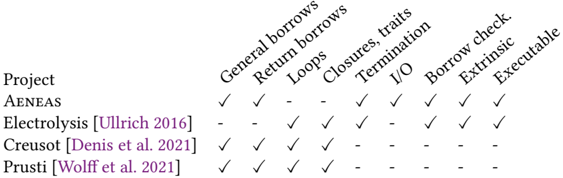
The image displays a comparison table evaluating four different software projects (likely static analysis or formal verification tools for the Rust programming language) across nine technical capability categories. The table uses checkmarks (✓) to indicate support for a feature and dashes (-) to indicate lack of support or non-applicability.
### Components/Axes
**Rows (Projects):**
1. **AENEAS**
2. **Electrolysis [Ullrich 2016]**
3. **Creusot [Denis et al. 2021]**
4. **Prusti [Wolff et al. 2021]**
**Columns (Capability Categories):**
The column headers are presented at a diagonal angle. From left to right, they are:
1. General borrows
2. Return borrows
3. Loops
4. Closures, traits
5. Termination
6. I/O
7. Borrow check.
8. Extrinsic
9. Executable
### Detailed Analysis
The table maps the support for each capability across the four projects. The data is extracted as follows:
| Project | General borrows | Return borrows | Loops | Closures, traits | Termination | I/O | Borrow check. | Extrinsic | Executable |
| :--- | :---: | :---: | :---: | :---: | :---: | :---: | :---: | :---: | :---: |
| **AENEAS** | ✓ | ✓ | - | - | ✓ | ✓ | ✓ | ✓ | ✓ |
| **Electrolysis [Ullrich 2016]** | - | - | ✓ | ✓ | ✓ | - | ✓ | ✓ | ✓ |
| **Creusot [Denis et al. 2021]** | ✓ | ✓ | ✓ | ✓ | ✓ | - | - | - | - |
| **Prusti [Wolff et al. 2021]** | ✓ | ✓ | ✓ | ✓ | - | - | - | - | - |
### Key Observations
1. **Feature Coverage Spectrum:** The projects show distinct specializations. **AENEAS** and **Electrolysis** both support generating an **Executable** and **Extrinsic** verification, but they have complementary strengths in other areas (e.g., AENEAS handles borrows and I/O, while Electrolysis handles loops and closures/traits).
2. **Core Verification Focus:** **Creusot** and **Prusti** share an identical feature profile in this table, both supporting core language features (borrows, loops, closures/traits, termination) but lacking support for I/O, extrinsic verification, borrow checking (as a listed feature), and executable generation.
3. **Termination Analysis:** Three of the four projects (AENEAS, Electrolysis, Creusot) claim support for **Termination** analysis. Prusti is the only one listed without it.
4. **I/O Support:** **AENEAS** is the only project indicated to handle **I/O** operations.
5. **Borrow Checking:** While "Borrow check." is a column, it's notable that **Prusti** and **Creusot** are marked with a dash (-). This likely means the table is not evaluating the presence of Rust's built-in borrow checker, but rather a specific, perhaps formal, borrow checking feature within the tool's own analysis framework.
### Interpretation
This table serves as a high-level feature matrix for researchers or developers choosing a verification or analysis tool for Rust code. The data suggests a trade-off between **deep, sound verification** and **practical, executable code generation**.
* **Creusot and Prusti** appear positioned as **dedicated verification frameworks**. Their support for core language constructs (borrows, loops, traits) and termination analysis, but lack of executable output, implies they are designed to prove properties about code, not to run it. They are likely used for formal proofs.
* **AENEAS and Electrolysis** seem to be **analysis and transformation tools**. Their ability to produce an **Executable** suggests they may perform some form of compilation, instrumentation, or abstract interpretation while preserving runtime behavior. Their support for **Extrinsic** verification (likely meaning verification conditions generated outside the tool) and differing feature sets (AENEAS for borrow/IO-heavy code, Electrolysis for code with complex control flow and traits) indicate they are built for different application domains within static analysis.
The absence of a single tool with all checkmarks highlights the inherent complexity and specialization required in program analysis for a language as rich as Rust. The table helps a user quickly identify which tool aligns with their specific needs—whether that's proving the absence of runtime errors (favoring Creusot/Prusti) or analyzing and transforming code for execution with certain guarantees (favoring AENEAS/Electrolysis).