## Diagram: Bot Descriptions
### Overview
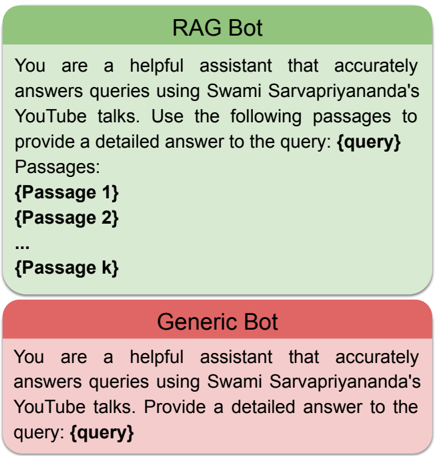
The image presents a comparison between two types of bots: a "RAG Bot" and a "Generic Bot." Each bot is described with a brief instruction set, highlighting their purpose and how they should respond to queries. The RAG Bot is distinguished by its use of specific passages to formulate its answers.
### Components/Axes
* **RAG Bot Box:** Located at the top, with a light green background.
* **Title:** "RAG Bot"
* **Description:** "You are a helpful assistant that accurately answers queries using Swami Sarvapriyananda's YouTube talks. Use the following passages to provide a detailed answer to the query: {query} Passages: {Passage 1} {Passage 2} ... {Passage k}"
* **Generic Bot Box:** Located at the bottom, with a light red background.
* **Title:** "Generic Bot"
* **Description:** "You are a helpful assistant that accurately answers queries using Swami Sarvapriyananda's YouTube talks. Provide a detailed answer to the query: {query}"
### Detailed Analysis or ### Content Details
The RAG Bot's description explicitly instructs it to use provided passages to answer queries, while the Generic Bot's description does not mention the use of passages. Both bots are designed to answer queries based on Swami Sarvapriyananda's YouTube talks. The RAG Bot is given specific passages labeled "{Passage 1}", "{Passage 2}", and so on, up to "{Passage k}".
### Key Observations
* The key difference between the two bots lies in the RAG Bot's utilization of specific passages to formulate its answers, suggesting a more targeted or context-aware approach.
* Both bots are designed to provide detailed answers to queries related to Swami Sarvapriyananda's YouTube talks.
### Interpretation
The diagram illustrates two different approaches to building a question-answering bot. The RAG Bot (Retrieval-Augmented Generation) uses a retrieval mechanism to identify relevant passages and then generates an answer based on those passages. This approach can lead to more accurate and contextually relevant answers. The Generic Bot, on the other hand, likely relies on a more general knowledge base or a different method for generating answers, without explicitly using provided passages. The diagram highlights the importance of context and information retrieval in building effective question-answering systems.