## Diagram: Theorem Representation as a Tree
### Overview
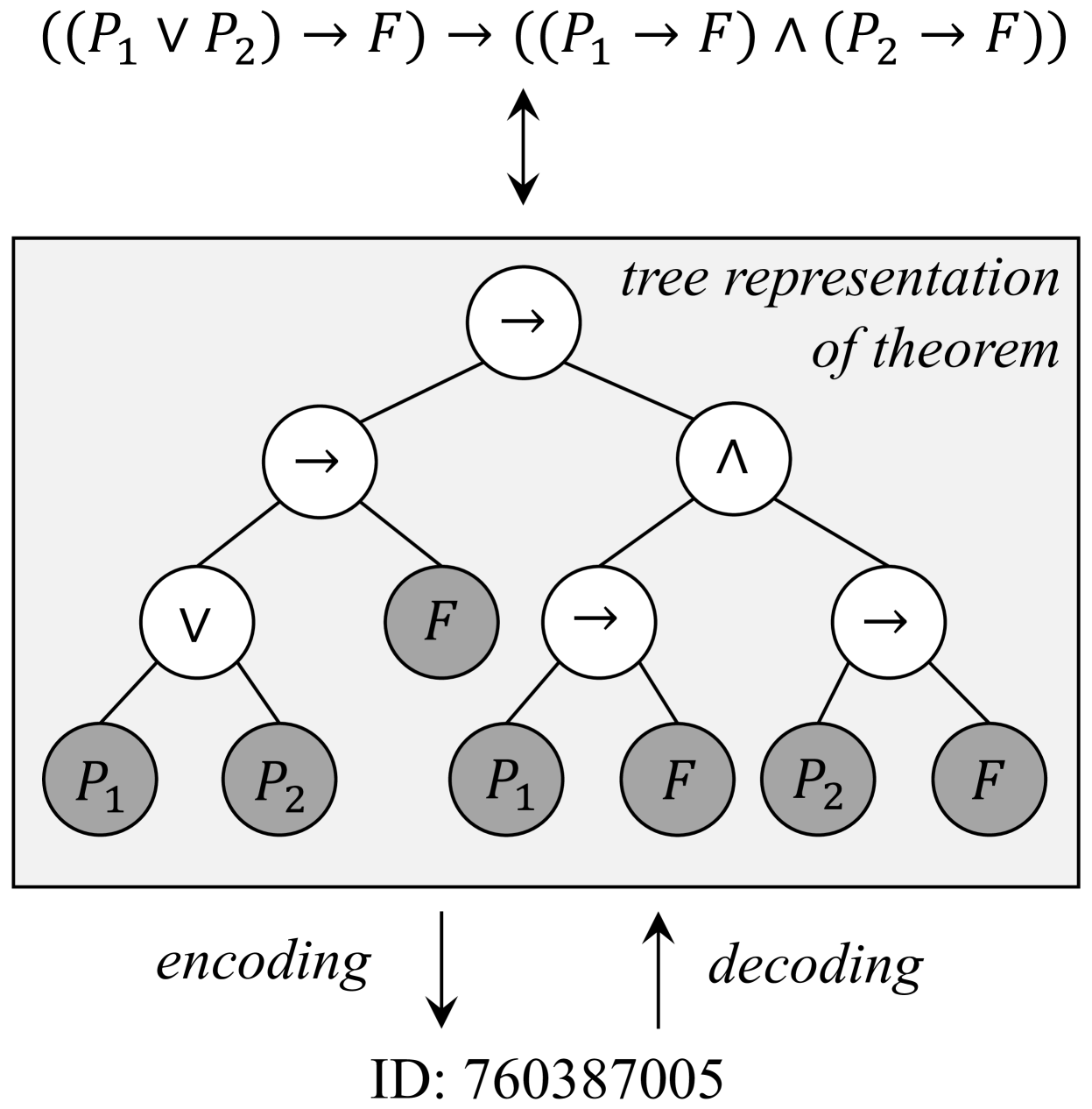
The image depicts a logical equivalence and its representation as a binary tree. The logical equivalence is: `((P₁ V P₂) → F) ↔ ((P₁ → F) ^ (P₂ → F))`. The tree structure visually breaks down the first part of the equivalence, `((P₁ V P₂) → F)`, into its constituent logical operations and variables. The diagram also indicates the processes of encoding and decoding related to the tree structure.
### Components/Axes
* **Logical Equivalence (Top):** `((P₁ V P₂) → F) → ((P₁ → F) ^ (P₂ → F))`
* **Equivalence Indicator:** A double-headed arrow pointing up and down, indicating equivalence.
* **Tree Representation:** A binary tree enclosed in a gray box, labeled "tree representation of theorem".
* **Nodes:** The nodes of the tree represent logical operations (→, V, ^) and variables (P₁, P₂, F).
* White nodes: Represent logical operations (→, V, ^).
* Gray nodes: Represent variables (P₁, P₂, F).
* **Encoding/Decoding:** Arrows indicating the direction of encoding (downward) and decoding (upward) processes.
* **ID:** "ID: 760387005" at the bottom.
### Detailed Analysis
**Logical Equivalence:**
* The logical equivalence states that "((P₁ OR P₂) IMPLIES F) is equivalent to ((P₁ IMPLIES F) AND (P₂ IMPLIES F))".
**Tree Structure:**
* The root node is an implication (→).
* The left child of the root is another implication (→).
* The right child of the root is a conjunction (^).
* The left child of the second-level implication is a disjunction (V).
* The right child of the second-level implication is F.
* The left child of the disjunction is P₁.
* The right child of the disjunction is P₂.
* The left child of the conjunction is an implication (→).
* The right child of the conjunction is an implication (→).
* The left child of the left-side implication is P₁.
* The right child of the left-side implication is F.
* The left child of the right-side implication is P₂.
* The right child of the right-side implication is F.
**Encoding/Decoding:**
* The "encoding" arrow points downward from the tree, suggesting a process of converting the tree structure into a specific format or code.
* The "decoding" arrow points upward towards the tree, suggesting a process of reconstructing the tree structure from a specific format or code.
### Key Observations
* The tree structure visually represents the breakdown of the left-hand side of the logical equivalence.
* The gray nodes represent the variables P₁, P₂, and F, while the white nodes represent the logical operations.
* The encoding/decoding arrows suggest a transformation process related to the tree representation.
### Interpretation
The diagram illustrates how a logical expression can be represented as a tree structure. This representation is useful for parsing, evaluating, and manipulating logical expressions in computer science and formal logic. The encoding/decoding processes likely refer to converting the tree into a linear format for storage or transmission and then reconstructing it. The ID at the bottom may be a unique identifier for this specific representation. The diagram demonstrates the relationship between a logical statement and its structural representation, highlighting the hierarchical nature of logical expressions.