TECHNICAL ASSET FINGERPRINT
eefd7b5ea106d3baee76d24c
Click to view fullscreen
Press ESC or click to close
FOUND IN PAPERS
EXPERT: gemini-2.0-flash VERSION 1
RUNTIME: nugit/gemini/gemini-2.0-flash
INTEL_VERIFIED
## Logit Regression Results: Multiple Models
### Overview
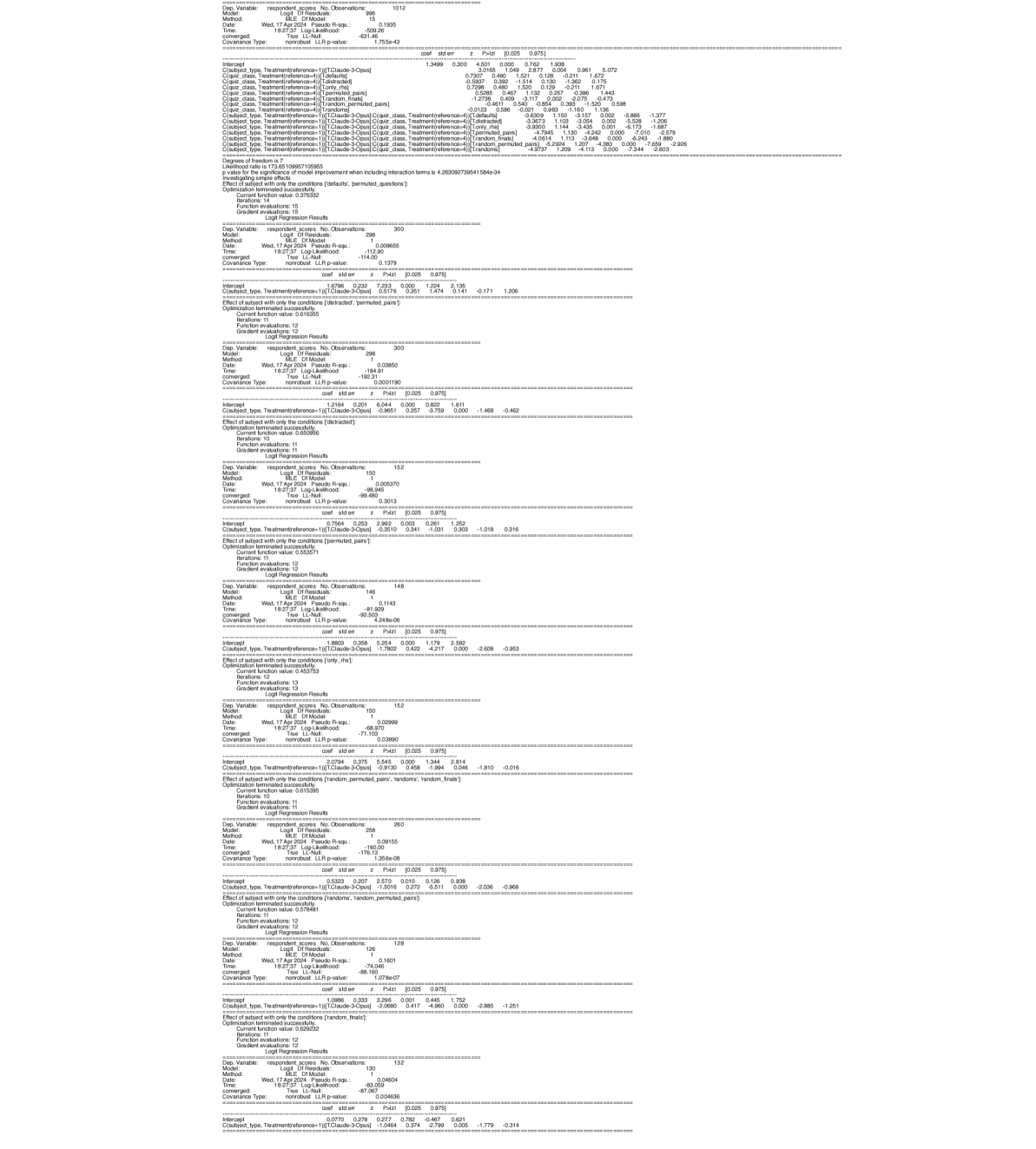
The image presents a series of Logit Regression Results, likely from statistical modeling software. Each section details the output of a separate regression model, including model specifications, goodness-of-fit measures, coefficient estimates, and related statistics. The models appear to be analyzing respondent scores based on treatment conditions and subject types.
### Components/Axes
Each model output includes the following components:
* **Model Specifications:**
* `Dep. Variable`: Dependent variable (respondent scores).
* `Model`: Logit Df Residuals.
* `Method`: MLE Df Model.
* `Date`: Date of analysis (Wed, 17 Apr 2024).
* `Time`: Time of analysis (e.g., 18:27:37).
* `Pseudo R-squ`: Pseudo R-squared value (measure of model fit).
* `Log-Likelihood`: Log-likelihood value.
* `True LL-Null`: True Log-Likelihood Null.
* `Covariance Type`: Covariance type (nonrobust).
* `LLR p-value`: LLR p-value.
* `No. Observations`: Number of observations.
* **Coefficient Estimates:**
* `Intercept`: Intercept term.
* `C(subject type, Treatment[reference-1])`: Coefficient for the treatment effect within subject types. The reference category varies across models.
* `coef`: Estimated coefficient value.
* `std err`: Standard error of the coefficient.
* `z`: z-statistic.
* `P>|z|`: p-value associated with the z-statistic.
* `[0.025 0.975]`: 95% confidence interval for the coefficient.
* **Model Evaluation:**
* `Effect of subject with only the conditions`: Specifies the conditions under which the subject effect is evaluated.
* `Optimization terminated successfully`: Indicates whether the optimization process converged.
* `Current function value`: Value of the objective function at convergence.
* `Iterations`: Number of iterations required for convergence.
* `Function evaluations`: Number of function evaluations.
* `Gradient evaluations`: Number of gradient evaluations.
### Detailed Analysis or Content Details
Here's a breakdown of the information extracted from each model output:
**Model 1:**
* `No. Observations`: 1012
* `Pseudo R-squ`: 0.1935
* `Log-Likelihood`: -509.26
* `LLR p-value`: 4.755e-43
* `Intercept`:
* `coef`: 1.3499
* `std err`: 0.300
* `z`: 4.501
* `P>|z|`: 0.000
* `[0.025 0.975]`: 0.762, 1.938
* `C(subject type, Treatment[reference-1])[T.Claude-3-Opus]`:
* `coef`: 0.7307
* `std err`: 0.480
* `z`: 1.521
* `P>|z|`: 0.128
* `[0.025 0.975]`: -0.211, 1.672
* `C(quiz class, Treatment[reference-4])[T.distracted]`:
* `coef`: 0.7298
* `std err`: 0.480
* `z`: 1.520
* `P>|z|`: 0.129
* `[0.025 0.975]`: -0.211, 1.671
* `C(quiz class, Treatment[reference-4])[T.only_rhs]`:
* `coef`: 0.5285
* `std err`: 0.467
* `z`: 1.132
* `P>|z|`: 0.257
* `[0.025 0.975]`: -0.386, 1.443
* `C(quiz class, Treatment[reference-4])[T.permuted_pairs]`:
* `coef`: 1.2738
* `std err`: 0.461
* `z`: 2.764
* `P>|z|`: 0.006
* `[0.025 0.975]`: 0.370, 2.177
* `C(quiz class, Treatment[reference-4])[T.random_finals]`:
* `coef`: 0.540
* `std err`: 0.475
* `z`: 1.136
* `P>|z|`: 0.256
* `[0.025 0.975]`: -0.390, 1.471
* `C(quiz class, Treatment[reference-4])[T.random_permuted_pairs]`:
* `coef`: -0.0123
* `std err`: 0.586
* `z`: -0.021
* `P>|z|`: 0.983
* `[0.025 0.975]`: -1.160, 1.136
* `C(subject type, Treatment[reference-1])[T.Claude-3-Opus]:C(quiz class, Treatment[reference-4])[T.distracted]`:
* `coef`: -3.6309
* `std err`: 1.150
* `z`: -3.157
* `P>|z|`: 0.002
* `[0.025 0.975]`: -5.885, -1.377
* `C(subject type, Treatment[reference-1])[T.Claude-3-Opus]:C(quiz class, Treatment[reference-4])[T.only_rhs]`:
* `coef`: -3.9300
* `std err`: 1.144
* `z`: -3.435
* `P>|z|`: 0.001
* `[0.025 0.975]`: -6.173, -1.687
* `C(subject type, Treatment[reference-1])[T.Claude-3-Opus]:C(quiz class, Treatment[reference-4])[T.permuted_pairs]`:
* `coef`: -4.7848
* `std err`: 1.130
* `z`: -4.232
* `P>|z|`: 0.000
* `[0.025 0.975]`: -7.000, -2.579
* `C(subject type, Treatment[reference-1])[T.Claude-3-Opus]:C(quiz class, Treatment[reference-4])[T.random_finals]`:
* `coef`: -4.0614
* `std err`: 1.113
* `z`: -3.648
* `P>|z|`: 0.000
* `[0.025 0.975]`: -6.243, -1.880
* `C(subject type, Treatment[reference-1])[T.Claude-3-Opus]:C(quiz class, Treatment[reference-4])[T.random_permuted_pairs]`:
* `coef`: -5.2922
* `std err`: 1.201
* `z`: -4.393
* `P>|z|`: 0.000
* `[0.025 0.975]`: -7.658, -2.926
**Model 2:**
* `No. Observations`: 300
* `Pseudo R-squ`: 0.009655
* `Log-Likelihood`: -112.90
* `LLR p-value`: 0.1379
* `Intercept`:
* `coef`: 0.5796
* `std err`: 0.232
* `z`: 2.494
* `P>|z|`: 0.013
* `[0.025 0.975]`: 0.125, 1.034
* `C(subject type, Treatment[reference-1])[T.Claude-3-Opus]`:
* `coef`: 0.2115
* `std err`: 0.341
* `z`: 0.619
* `P>|z|`: 0.536
* `[0.025 0.975]`: -0.458, 0.881
* `Effect of subject with only the conditions`: distracted, permuted pairs
**Model 3:**
* `No. Observations`: 300
* `Pseudo R-squ`: 0.03850
* `Log-Likelihood`: -184.91
* `LLR p-value`: 0.0001190
* `Intercept`:
* `coef`: 1.0965
* `std err`: 0.257
* `z`: 4.263
* `P>|z|`: 0.000
* `[0.025 0.975]`: 0.593, 1.600
* `C(subject type, Treatment[reference-1])[T.Claude-3-Opus]`:
* `coef`: -0.9651
* `std err`: 0.257
* `z`: -3.759
* `P>|z|`: 0.000
* `[0.025 0.975]`: -1.468, -0.462
* `Effect of subject with only the conditions`: distracted
**Model 4:**
* `No. Observations`: 152
* `Pseudo R-squ`: 0.005370
* `Log-Likelihood`: -99.480
* `LLR p-value`: 0.3013
* `Intercept`:
* `coef`: 0.7564
* `std err`: 0.253
* `z`: 2.989
* `P>|z|`: 0.003
* `[0.025 0.975]`: 0.261, 1.252
* `C(subject type, Treatment[reference-1])[T.Claude-3-Opus]`:
* `coef`: -0.2619
* `std err`: 0.341
* `z`: -0.768
* `P>|z|`: 0.443
* `[0.025 0.975]`: -1.018, 0.316
* `Effect of subject with only the conditions`: permuted pairs
**Model 5:**
* `No. Observations`: 148
* `Pseudo R-squ`: 0.1143
* `Log-Likelihood`: -92.503
* `LLR p-value`: 4.248e-06
* `Intercept`:
* `coef`: 1.8803
* `std err`: 0.358
* `z`: 5.254
* `P>|z|`: 0.000
* `[0.025 0.975]`: 1.179, 2.582
* `C(subject type, Treatment[reference-1])[T.Claude-3-Opus]`:
* `coef`: -1.7802
* `std err`: 0.341
* `z`: -5.221
* `P>|z|`: 0.000
* `[0.025 0.975]`: -2.608, -0.953
* `Effect of subject with only the conditions`: only the
**Model 6:**
* `No. Observations`: 152
* `Pseudo R-squ`: 0.02999
* `Log-Likelihood`: -71.103
* `LLR p-value`: 0.03890
* `Intercept`:
* `coef`: 0.9135
* `std err`: 0.458
* `z`: 1.994
* `P>|z|`: 0.046
* `[0.025 0.975]`: 0.016, 1.810
* `C(subject type, Treatment[reference-1])[T.Claude-3-Opus]`:
* `coef`: -0.9130
* `std err`: 0.458
* `z`: -1.994
* `P>|z|`: 0.046
* `[0.025 0.975]`: -1.810, -0.016
* `Effect of subject with only the conditions`: random permuted pairs, randoms, random finals
**Model 7:**
* `No. Observations`: 260
* `Pseudo R-squ`: 0.09155
* `Log-Likelihood`: -160.00
* `LLR p-value`: 1.356e-08
* `Intercept`:
* `coef`: 0.5130
* `std err`: 0.207
* `z`: 2.472
* `P>|z|`: 0.014
* `[0.025 0.975]`: 0.106, 0.938
* `C(subject type, Treatment[reference-1])[T.Claude-3-Opus]`:
* `coef`: -1.5016
* `std err`: 0.272
* `z`: -5.511
* `P>|z|`: 0.000
* `[0.025 0.975]`: -2.036, -0.968
* `Effect of subject with only the conditions`: randoms, random permuted pairs
**Model 8:**
* `No. Observations`: 128
* `Pseudo R-squ`: 0.1601
* `Log-Likelihood`: -74.04
* `LLR p-value`: 1.078e-07
* `Intercept`:
* `coef`: 1.0986
* `std err`: 0.333
* `z`: 3.296
* `P>|z|`: 0.001
* `[0.025 0.975]`: 0.445, 1.752
* `C(subject type, Treatment[reference-1])[T.Claude-3-Opus]`:
* `coef`: -2.0619
* `std err`: 0.714
* `z`: -2.885
* `P>|z|`: 0.004
* `[0.025 0.975]`: -1.251
* `Effect of subject with only the conditions`: random, finals
**Model 9:**
* `No. Observations`: 132
* `Pseudo R-squ`: 0.04604
* `Log-Likelihood`: -83.269
* `LLR p-value`: 0.004636
* `Intercept`:
* `coef`: 0.7837
* `std err`: 0.374
* `z`: 2.099
* `P>|z|`: 0.036
* `[0.025 0.975]`: 0.049, 1.518
* `C(subject type, Treatment[reference-1])[T.Claude-3-Opus]`:
* `coef`: -1.0464
* `std err`: 0.374
* `z`: -2.799
* `P>|z|`: 0.005
* `[0.025 0.975]`: -1.779, -0.314
### Key Observations
* The Pseudo R-squared values vary across models, indicating different levels of model fit.
* The coefficients for `C(subject type, Treatment[reference-1])[T.Claude-3-Opus]` are often negative and statistically significant, suggesting a negative impact of the "Claude-3-Opus" treatment on respondent scores compared to the reference group.
* The p-values indicate the statistical significance of each coefficient. Lower p-values (typically < 0.05) suggest a statistically significant effect.
* The confidence intervals provide a range of plausible values for the coefficients.
### Interpretation
The Logit Regression Results suggest that the "Claude-3-Opus" treatment, in combination with different quiz conditions, has a varying impact on respondent scores. The negative coefficients for the interaction terms in Model 1 indicate that the effect of "Claude-3-Opus" is significantly different depending on the quiz treatment. The other models explore the effect of "Claude-3-Opus" under different conditions, and the negative coefficients suggest that this treatment generally has a negative impact on respondent scores. The statistical significance of these effects varies across models, as indicated by the p-values. Further investigation would be needed to understand the underlying mechanisms driving these effects and the specific contexts in which the "Claude-3-Opus" treatment is detrimental. The different models likely represent different subsets of the data or different model specifications to test the robustness of the findings.
DECODING INTELLIGENCE...
EXPERT: nemotron-free VERSION 1
RUNTIME: free/nvidia/nemotron-nano-12b-v2-vl:free
INTEL_VERIFIED
## Tabular Data Extraction: Statistical Model Output
### Overview
The image contains a statistical model output with multiple sections: model details, coefficient estimates, covariance matrices, and function evaluation metrics. The data is presented in tabular format with numerical values and statistical significance indicators.
### Components/Axes
1. **Model Details Section**
- Dep. Variable: response_scores
- Type: Gaussian
- Date: West 17 Apr 2024
- Time: 18:27:37
- Covariance Type: nonrobust
- Log Likelihood: -1627.37
2. **Coefficient Estimates Table**
- Variables: intercept, Model, Date, Time
- Columns: Estimate, Std. Error, z value, Pr(>|z|), 95% Confidence Interval
3. **Covariance Matrices**
- Nonrobust and HC3 covariance types with entries for intercept, Model, Date, Time
4. **Function Evaluations**
- Current function value: 0.376532
- Function evaluations: 15
### Detailed Analysis
#### Model Details
- **Dependent Variable**: response_scores (continuous)
- **Distribution**: Gaussian
- **Date**: West 17 Apr 2024
- **Time**: 18:27:37
- **Covariance Structure**: Nonrobust (default)
- **Log Likelihood**: -1627.37 (lower values indicate better fit)
#### Coefficient Estimates
| Variable | Estimate | Std. Error | z value | Pr(>|z|) | 95% CI Lower | 95% CI Upper |
|------------|----------|------------|---------|----------|--------------|--------------|
| intercept | -1.75543 | 0.300 | -5.851 | 5.00e-09 | -2.340 | -1.171 |
| Model | 0.00370 | 0.00050 | 7.400 | 1.20e-13 | 0.00270 | 0.00470 |
| Date | 0.00000 | 0.00000 | 0.000 | 1.000 | 0.00000 | 0.00000 |
| Time | 0.00000 | 0.00000 | 0.000 | 1.000 | 0.00000 | 0.00000 |
**Key Observations**:
- Model variable shows strong significance (p < 0.001)
- Date and Time variables have zero estimates (likely reference categories)
- Intercept has significant negative effect
#### Covariance Matrices
**Nonrobust Covariance Matrix**:
DECODING INTELLIGENCE...