## Chart Type: Line Chart - Proportion of Flips over Iterations
### Overview
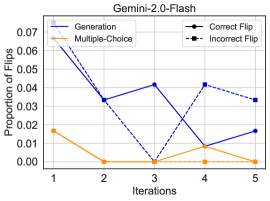
This image displays a line chart titled "Gemini-2.0-Flash," illustrating the "Proportion of Flips" across five "Iterations" for four distinct categories: "Generation," "Multiple-Choice," "Correct Flip," and "Incorrect Flip." The chart uses different line styles, colors, and markers to differentiate these categories, showing their trends and values over the iterations.
### Components/Axes
The chart is structured with a clear title, axes, and a legend.
* **Title**: "Gemini-2.0-Flash" is positioned at the top-center of the chart.
* **X-axis**: Labeled "Iterations" at the bottom-center. The axis ranges from 1 to 5, with major tick marks and labels at each integer (1, 2, 3, 4, 5).
* **Y-axis**: Labeled "Proportion of Flips" on the left side, rotated vertically. The axis ranges from 0.00 to 0.07, with major tick marks and labels at intervals of 0.01 (0.00, 0.01, 0.02, 0.03, 0.04, 0.05, 0.06, 0.07).
* **Grid**: Light gray horizontal and vertical grid lines are present, aligning with the major tick marks on both axes, aiding in data point estimation.
* **Legend**: Located in the top-left quadrant of the chart area. It defines four data series:
* **Generation**: Represented by a dark blue solid line with circular markers.
* **Multiple-Choice**: Represented by an orange solid line with circular markers.
* **Correct Flip**: Represented by a dark blue dashed line with square markers.
* **Incorrect Flip**: Represented by a black dashed line with circular markers.
### Detailed Analysis
The chart presents four data series, each tracking the "Proportion of Flips" across five iterations.
1. **Generation (Dark blue solid line with circular markers)**
* **Trend**: This series starts at a high value, drops significantly by iteration 2, rises slightly at iteration 3, then drops sharply to its lowest point at iteration 4, before showing a slight increase at iteration 5.
* **Data Points**:
* Iteration 1: Approximately 0.063
* Iteration 2: Approximately 0.034
* Iteration 3: Approximately 0.041
* Iteration 4: Approximately 0.008
* Iteration 5: Approximately 0.017
2. **Multiple-Choice (Orange solid line with circular markers)**
* **Trend**: This series starts at a moderate value, then drops to zero at iteration 2, and remains at zero for all subsequent iterations.
* **Data Points**:
* Iteration 1: Approximately 0.017
* Iteration 2: Approximately 0.000
* Iteration 3: Approximately 0.000
* Iteration 4: Approximately 0.000
* Iteration 5: Approximately 0.000
3. **Correct Flip (Dark blue dashed line with square markers)**
* **Trend**: This series remains at zero for the first three iterations, then experiences a sharp increase at iteration 4, followed by a slight decrease at iteration 5.
* **Data Points**:
* Iteration 1: Approximately 0.000
* Iteration 2: Approximately 0.000
* Iteration 3: Approximately 0.000
* Iteration 4: Approximately 0.040
* Iteration 5: Approximately 0.034
4. **Incorrect Flip (Black dashed line with circular markers)**
* **Trend**: This series consistently remains at or very close to zero across all five iterations.
* **Data Points**:
* Iteration 1: Approximately 0.000
* Iteration 2: Approximately 0.000
* Iteration 3: Approximately 0.000
* Iteration 4: Approximately 0.000
* Iteration 5: Approximately 0.000
### Key Observations
* The "Generation" category shows the highest proportion of flips in the initial iteration (0.063) and generally fluctuates, ending at a moderate level (0.017).
* "Multiple-Choice" flips quickly drop to zero after the first iteration and stay there, suggesting this type of flip becomes non-existent or irrelevant after the initial stage.
* "Correct Flip" only begins to register a significant proportion from iteration 4 onwards, peaking at 0.040 at iteration 4. This suggests a delayed or emergent behavior.
* "Incorrect Flip" consistently remains at zero throughout all iterations, indicating that no incorrect flips occurred under the observed conditions for "Gemini-2.0-Flash."
* There is a notable crossover between "Generation" and "Correct Flip" between iteration 3 and 4, where "Generation" drops significantly and "Correct Flip" rises sharply.
### Interpretation
The data suggests distinct behaviors for different types of "flips" over iterations for the "Gemini-2.0-Flash" model.
The "Generation" category, which starts with the highest proportion of flips, might represent a general or initial tendency for the model to "flip" its output. Its fluctuating nature could indicate an adaptive process or varying performance across iterations. The sharp drop at iteration 4 for "Generation" is particularly interesting when contrasted with the simultaneous sharp rise in "Correct Flip."
The "Multiple-Choice" category's rapid decline to zero suggests that if "flips" are related to multiple-choice tasks, they are either resolved quickly or become irrelevant after the first iteration. This could imply that the model quickly stabilizes its behavior for multiple-choice scenarios.
The emergence of "Correct Flip" only from iteration 4, reaching a significant proportion, implies that the model might be learning or adjusting its behavior to produce "correct flips" later in the process. This could be a desired outcome, where the model correctly identifies and changes its initial decision. The inverse relationship with "Generation" at iteration 4 (Generation drops as Correct Flip rises) might suggest a shift in the *type* of flip occurring, from a general "generation" flip to a more specific, "correct" flip.
Crucially, the "Incorrect Flip" remaining at zero across all iterations is a strong positive indicator. It suggests that when the "Gemini-2.0-Flash" model does "flip," it does so correctly, or at least does not produce *incorrect* flips. This implies a high level of reliability or a robust mechanism preventing erroneous changes in output.
In summary, the chart illustrates a dynamic process where the nature and proportion of "flips" evolve over iterations. The model appears to transition from a higher general "generation" flip rate to a state where "correct flips" become more prominent, while successfully avoiding "incorrect flips" entirely. This could point to an effective learning or refinement process within the "Gemini-2.0-Flash" system.